From Paper to Code: Understanding and Reproducing “Implicit Neural Representations with Periodic Activation Functions”#
 Code: GitHub Repository https://vsitzmann.github.io/siren/
Source Code in My Repo: ../../../../code/NeRF/siren-master/explore_siren.ipynb
Code: GitHub Repository https://vsitzmann.github.io/siren/
Source Code in My Repo: ../../../../code/NeRF/siren-master/explore_siren.ipynb
Paper Reading Notes#
1. Highlights#
This paper proposes SIREN, a novel method that uses continuous coordinates as input instead of discrete meshes to represent images, enabling arbitrary-resolution sampling and super-resolution image reconstruction.
For example, traditional meshes can only retrieve colors at integer coordinates, whereas SIREN allows querying at any real-valued coordinate such as (3.45, 4.98).
SIREN based on periodic activation functions, along with a principled initialization scheme to ensure stable training of deep networks. They demonstrate high-fidelity representations across images, videos, audio, and 3D shapes, and further show that SIRENs can solve partial differential equations (PDEs) directly from derivative supervision. In addition, they combine SIRENs with hypernetworks to learn priors over implicit function spaces, enabling tasks such as sparse image inpainting.
2. Background#
How to represent a signal is a fundamental question across science and engineering.
Traditional representations are typically discrete, such as pixel grids for images or voxel grids for 3D shapes.
However, these discrete formats suffer from issues like high memory usage, limited resolution, and difficulty in computing derivatives.
Recently, implicit neural representations (INRs) have emerged as a powerful alternative.
Instead of storing signals explicitly, they use neural networks to map coordinates \(x\) (e.g., spatial or spatiotemporal) directly to signal values \(\Phi(x)\).
For example, in many physical problems, we aim to learn a function \(\Phi\) that satisfies:
This includes problems in physics, imaging, graphics, and differential equations.
Most existing INR methods are built on ReLU-based MLPs. While these can fit low-frequency components, they struggle with high-frequency signals and fail to represent higher-order derivatives well — which are essential for many physical systems.
3. Method Overview#
This paper introduces SIREN (Sinusoidal Representation Networks), a neural network architecture that uses the sine function as its activation:
A full SIREN network is:
The key advantage is that any derivative of a sine is also a sine or cosine, which preserves expressiveness through derivatives.
This makes SIREN particularly powerful for modeling natural signals and their derivatives — such as gradients and Laplacians.
They define a general optimization objective to solve constraint problems of the form: $\( \begin{aligned} & \text{Find } \Phi(x) \text{ such that} \\ & C_m\left(a(x), \Phi(x), \nabla \Phi(x), \ldots\right) = 0, \\ & \forall x \in \Omega_m,\quad m=1,\ldots,M \end{aligned} \)$
The corresponding loss function is:
The authors further propose a principled initialization scheme for SIREN:
Weights \(W_i\) are sampled from \(U\left(-\sqrt{\frac{6}{n}}, \sqrt{\frac{6}{n}}\right)\)
The first layer uses a higher frequency \(\omega_0 = 30\) to match the spectrum of natural signals
This ensures stability in training and allows SIRENs to scale deeper without vanishing or exploding gradients.
4. References#
Vincent Sitzmann et al., Implicit Neural Representations with Periodic Activation Functions, arXiv:2006.09661, 2020
Ben Mildenhall et al., NeRF: Representing Scenes as Neural Radiance Fields for View Synthesis, arXiv:2003.08934
Jeong Joon Park et al., DeepSDF, CVPR 2019
Maziar Raissi et al., Physics-informed Neural Networks, JCP 2019
David Ha et al., Hypernetworks, ICLR 2017
Code Reproduction with Explanation: SIREN in Action – Image, Audio, and PDE Solving#
This implementation is based on the streamlined version of SIREN provided in the official Colab notebook: Implicit Neural Activations with Periodic Activation Functions.
Make sure that you have enabled the GPU under Edit -> Notebook Settings!
We will then reproduce the following results from the paper:
We will also explore Siren’s behavior outside of the training range.
Let’s go! First, some imports, and a function to quickly generate coordinate grids.
import torch
from torch import nn
import torch.nn.functional as F
from torch.utils.data import DataLoader, Dataset
import os

from PIL import Image
from torchvision.transforms import Resize, Compose, ToTensor, Normalize
import numpy as np
import skimage
import matplotlib.pyplot as plt

import time

def get_mgrid(sidelen, dim=2):
    '''Generates a flattened grid of (x,y,...) coordinates in a range of -1 to 1.
    sidelen: int
    dim: int'''
    tensors = tuple(dim * [torch.linspace(-1, 1, steps=sidelen)])
    mgrid = torch.stack(torch.meshgrid(*tensors), dim=-1)
    mgrid = mgrid.reshape(-1, dim)
    return mgrid
Now, we code up the sine layer, which will be the basic building block of SIREN. This is a much more concise implementation than the one in the main code, as here, we aren’t concerned with the baseline comparisons.
class SineLayer(nn.Module):
    # See paper sec. 3.2, final paragraph, and supplement Sec. 1.5 for discussion of omega_0.

    # If is_first=True, omega_0 is a frequency factor which simply multiplies the activations before the
    # nonlinearity. Different signals may require different omega_0 in the first layer - this is a
    # hyperparameter.

    # If is_first=False, then the weights will be divided by omega_0 so as to keep the magnitude of
    # activations constant, but boost gradients to the weight matrix (see supplement Sec. 1.5)

    def __init__(self, in_features, out_features, bias=True,
                 is_first=False, omega_0=30):
        super().__init__()
        self.omega_0 = omega_0
        self.is_first = is_first

        self.in_features = in_features
        self.linear = nn.Linear(in_features, out_features, bias=bias)

        self.init_weights()

    def init_weights(self):
        with torch.no_grad():
            if self.is_first:
                self.linear.weight.uniform_(-1 / self.in_features,
                                             1 / self.in_features)
            else:
                self.linear.weight.uniform_(-np.sqrt(6 / self.in_features) / self.omega_0,
                                             np.sqrt(6 / self.in_features) / self.omega_0)

    def forward(self, input):
        return torch.sin(self.omega_0 * self.linear(input))

    def forward_with_intermediate(self, input):
        # For visualization of activation distributions
        intermediate = self.omega_0 * self.linear(input)
        return torch.sin(intermediate), intermediate
And finally, differential operators that allow us to leverage autograd to compute gradients, the laplacian, etc.
def laplace(y, x):
    grad = gradient(y, x)
    return divergence(grad, x)


def divergence(y, x):
    div = 0.
    for i in range(y.shape[-1]):
        div += torch.autograd.grad(y[..., i], x, torch.ones_like(y[..., i]), create_graph=True)[0][..., i:i+1]
    return div


def gradient(y, x, grad_outputs=None):
    if grad_outputs is None:
        grad_outputs = torch.ones_like(y)
    grad = torch.autograd.grad(y, [x], grad_outputs=grad_outputs, create_graph=True)[0]
    return grad
Experiments#
For the image fitting and poisson experiments, we’ll use the classic cameraman image.
def get_cameraman_tensor(sidelength):
    img = Image.fromarray(skimage.data.camera())
    transform = Compose([
        Resize(sidelength),
        ToTensor(),
        Normalize(torch.Tensor([0.5]), torch.Tensor([0.5]))
    ])
    img = transform(img)
    return img
For a 256×256 image, each pixel corresponds to a 2D coordinate, so the input coords has shape \((1, 65536, 2)\). After passing through the network, the output shape becomes \((1, 65536, 1)\), representing the predicted signal (e.g., color or intensity) at each coordinate.
In each SineLayer, the input first goes through a linear transformation and is then scaled by \(\omega_0\) before applying the sine activation. The \(\omega_0\) controls the frequency of the sine function: a larger \(\omega_0\) enables the network to capture higher-frequency details in the data.
Notes on Input Coordinates, Omega, and Activation#
In each SineLayer, the activation is defined as torch.sin(self.omega_0 * self.linear(input)). The input coords are sampled from \([-1, 1]\). The frequency factor \(\omega_0\) scales the output of the linear layer before applying the sine function:
A larger \(\omega_0\) amplifies the pre-activation values, meaning a small change in the input coordinate leads to a large change in the sine input, resulting in rapid oscillations. This makes the network highly sensitive to fine, high-frequency features.
A smaller \(\omega_0\) causes smoother oscillations, favoring the modeling of low-frequency, slowly varying structures.
Here, torch.sin serves as the activation function, introducing periodic nonlinearity after each linear transformation.
class Siren(nn.Module):
    def __init__(self, in_features, hidden_features, hidden_layers, out_features, outermost_linear=False,
                 first_omega_0=30, hidden_omega_0=30.):
        super().__init__()

        self.net = []
        self.net.append(SineLayer(in_features, hidden_features,
                                  is_first=True, omega_0=first_omega_0))

        for i in range(hidden_layers):
            self.net.append(SineLayer(hidden_features, hidden_features,
                                      is_first=False, omega_0=hidden_omega_0))

        if outermost_linear:
            final_linear = nn.Linear(hidden_features, out_features)

            with torch.no_grad():
                final_linear.weight.uniform_(-np.sqrt(6 / hidden_features) / hidden_omega_0,
                                              np.sqrt(6 / hidden_features) / hidden_omega_0)

            self.net.append(final_linear)
        else:
            self.net.append(SineLayer(hidden_features, out_features,
                                      is_first=False, omega_0=hidden_omega_0))

        self.net = nn.Sequential(*self.net)

    def forward(self, coords):
        coords = coords.clone().detach().requires_grad_(True) # allows to take derivative w.r.t. input
        output = self.net(coords)
        return output, coords

    def forward_with_activations(self, coords, retain_grad=False):
        '''Returns not only model output, but also intermediate activations.
        Only used for visualizing activations later!'''
        activations = OrderedDict()

        activation_count = 0
        x = coords.clone().detach().requires_grad_(True)
        activations['input'] = x
        for i, layer in enumerate(self.net):
            if isinstance(layer, SineLayer):
                x, intermed = layer.forward_with_intermediate(x)

                if retain_grad:
                    x.retain_grad()
                    intermed.retain_grad()

                activations['_'.join((str(layer.__class__), "%d" % activation_count))] = intermed
                activation_count += 1
            else:
                x = layer(x)

                if retain_grad:
                    x.retain_grad()

            activations['_'.join((str(layer.__class__), "%d" % activation_count))] = x
            activation_count += 1

        return activations
Fitting an image#
First, let’s simply fit that image!
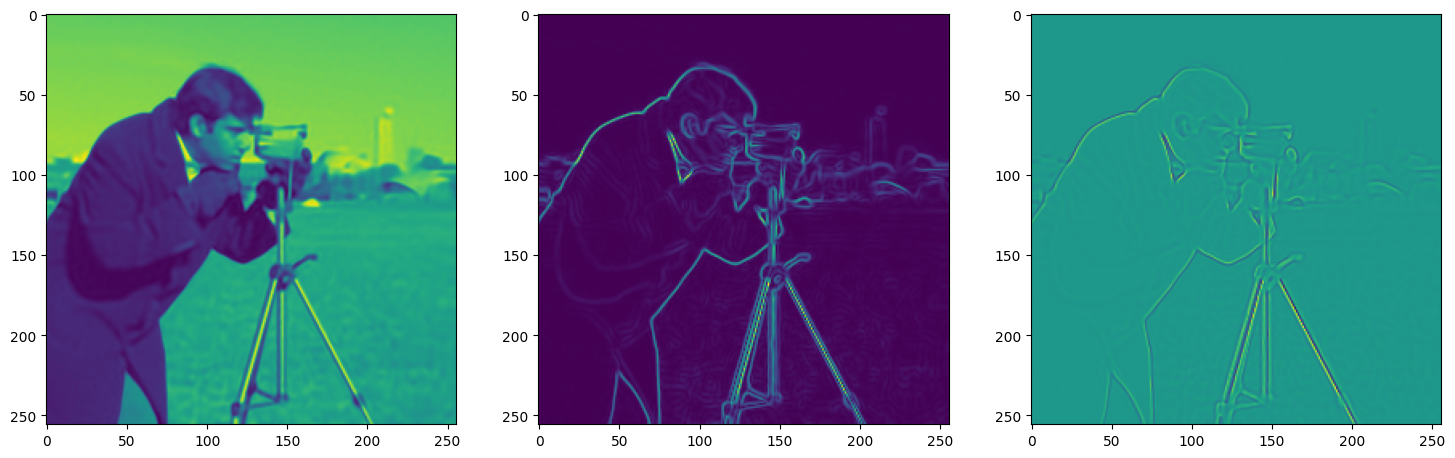
We seek to parameterize a greyscale image \(f(x)\) with pixel coordinates \(x\) with a SIREN \(\Phi(x)\).
That is we seek the function \(\Phi\) such that: \(\mathcal{L}=\int_{\Omega} \lVert \Phi(\mathbf{x}) - f(\mathbf{x}) \rVert\mathrm{d}\mathbf{x}\) is minimized, in which \(\Omega\) is the domain of the image.
We write a little datast that does nothing except calculating per-pixel coordinates:
class ImageFitting(Dataset):
    def __init__(self, sidelength):
        super().__init__()
        img = get_cameraman_tensor(sidelength)
        self.pixels = img.permute(1, 2, 0).view(-1, 1)
        self.coords = get_mgrid(sidelength, 2)

    def __len__(self):
        return 1

    def __getitem__(self, idx):
        if idx > 0: raise IndexError

        return self.coords, self.pixels
Let’s instantiate the dataset and our Siren. As pixel coordinates are 2D, the siren has 2 input features, and since the image is grayscale, it has one output channel.
cameraman = ImageFitting(256)
dataloader = DataLoader(cameraman, batch_size=1, pin_memory=True, num_workers=0)

img_siren = Siren(in_features=2, out_features=1, hidden_features=256,
                  hidden_layers=3, outermost_linear=True)
img_siren.cuda()
/home/xqgao/anaconda3/envs/inr/lib/python3.12/site-packages/torch/functional.py:534: UserWarning: torch.meshgrid: in an upcoming release, it will be required to pass the indexing argument. (Triggered internally at /opt/conda/conda-bld/pytorch_1729647329220/work/aten/src/ATen/native/TensorShape.cpp:3595.)
  return _VF.meshgrid(tensors, kwargs)  # type: ignore[attr-defined]


Siren(
  (net): Sequential(
    (0): SineLayer(
      (linear): Linear(in_features=2, out_features=256, bias=True)
    )
    (1): SineLayer(
      (linear): Linear(in_features=256, out_features=256, bias=True)
    )
    (2): SineLayer(
      (linear): Linear(in_features=256, out_features=256, bias=True)
    )
    (3): SineLayer(
      (linear): Linear(in_features=256, out_features=256, bias=True)
    )
    (4): Linear(in_features=256, out_features=1, bias=True)
  )
)
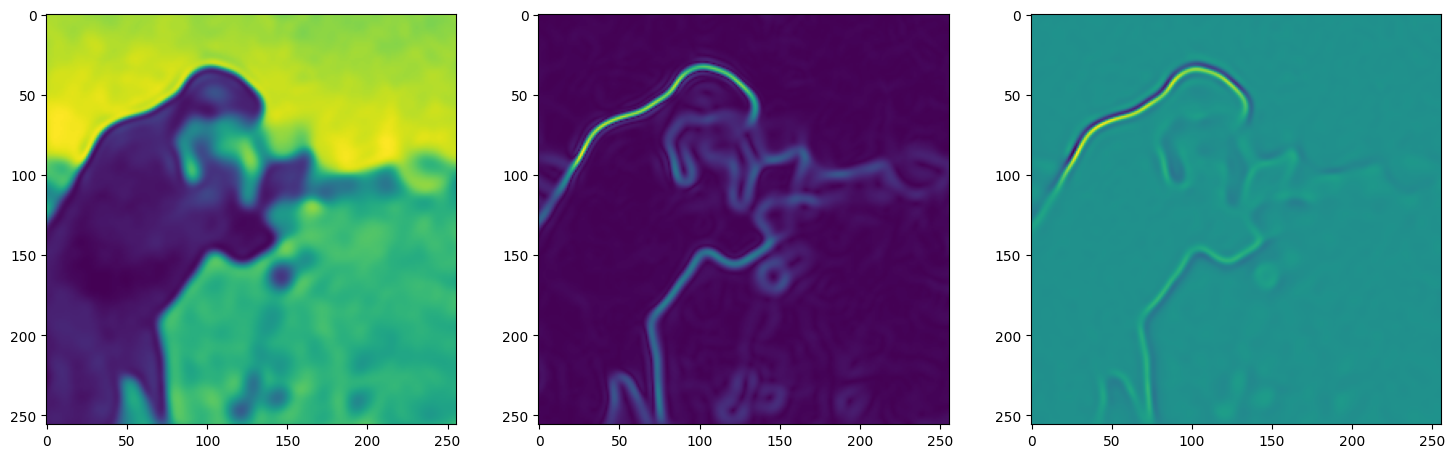
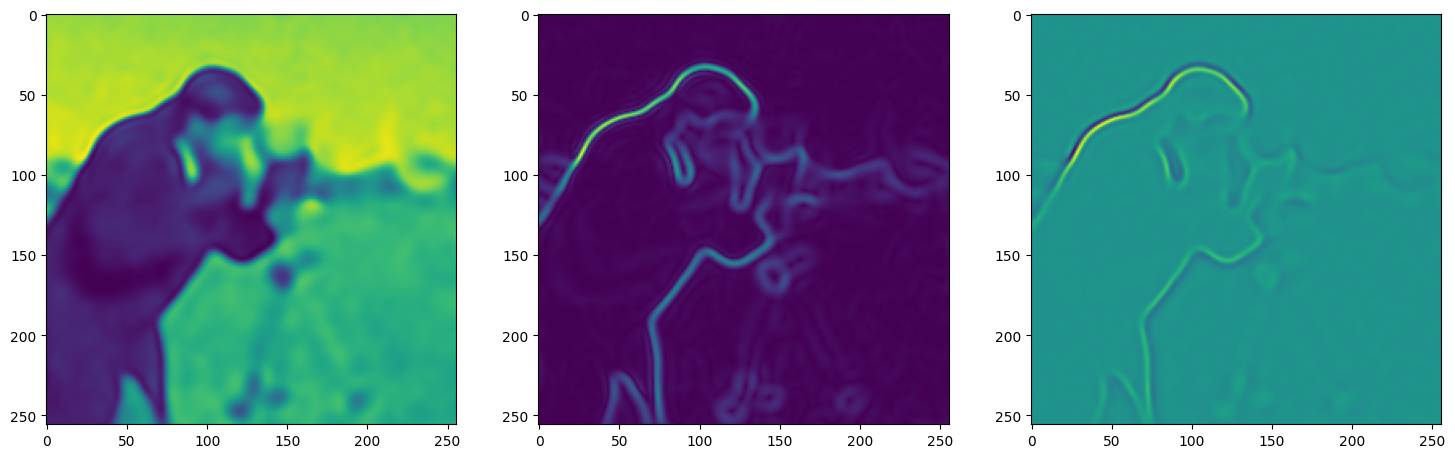
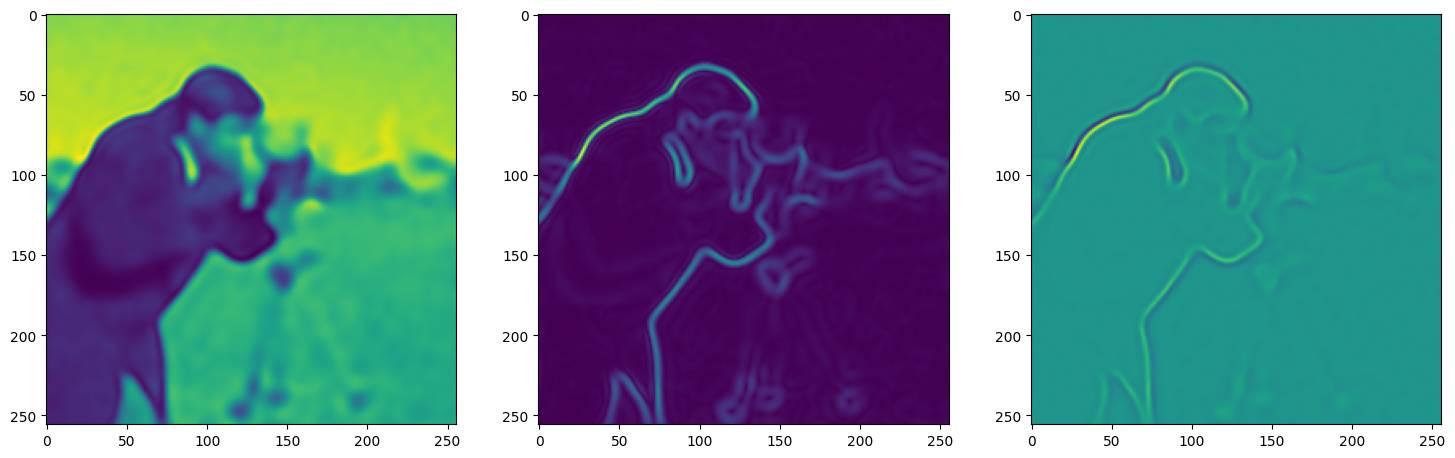
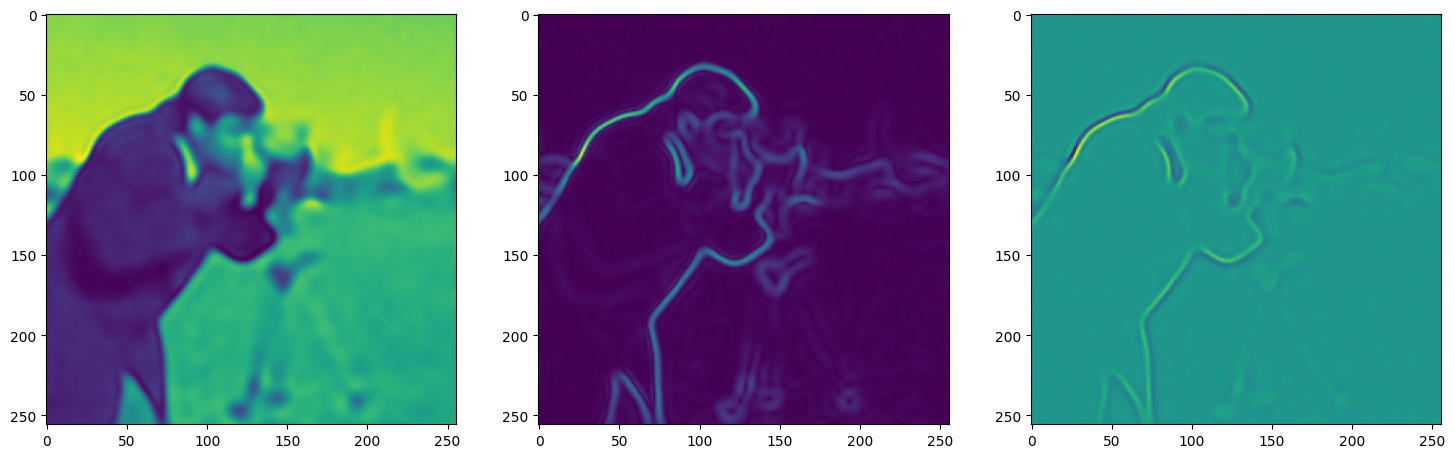
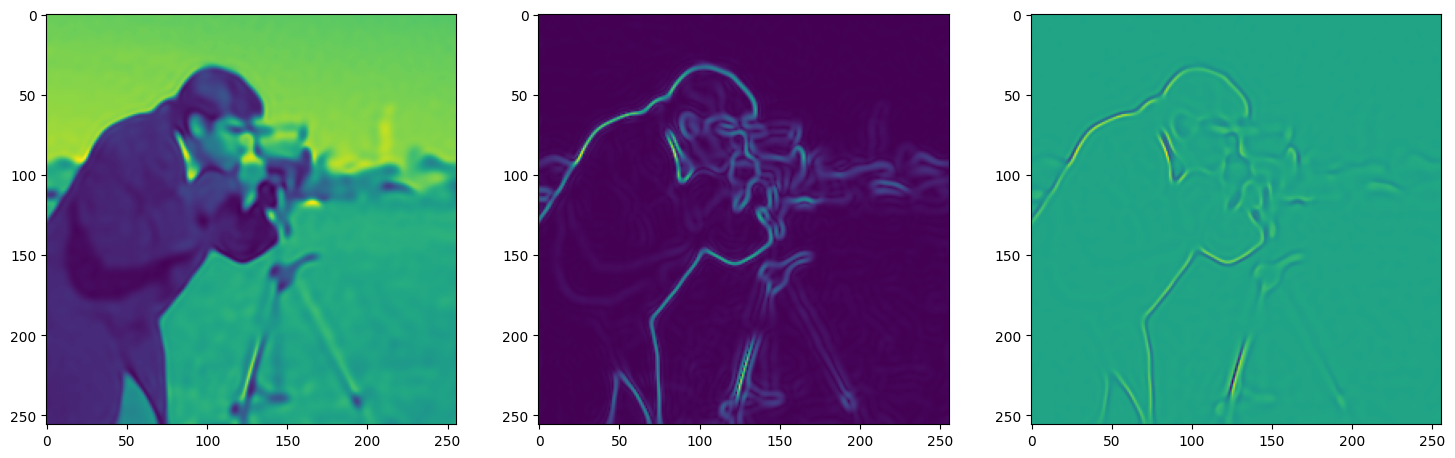
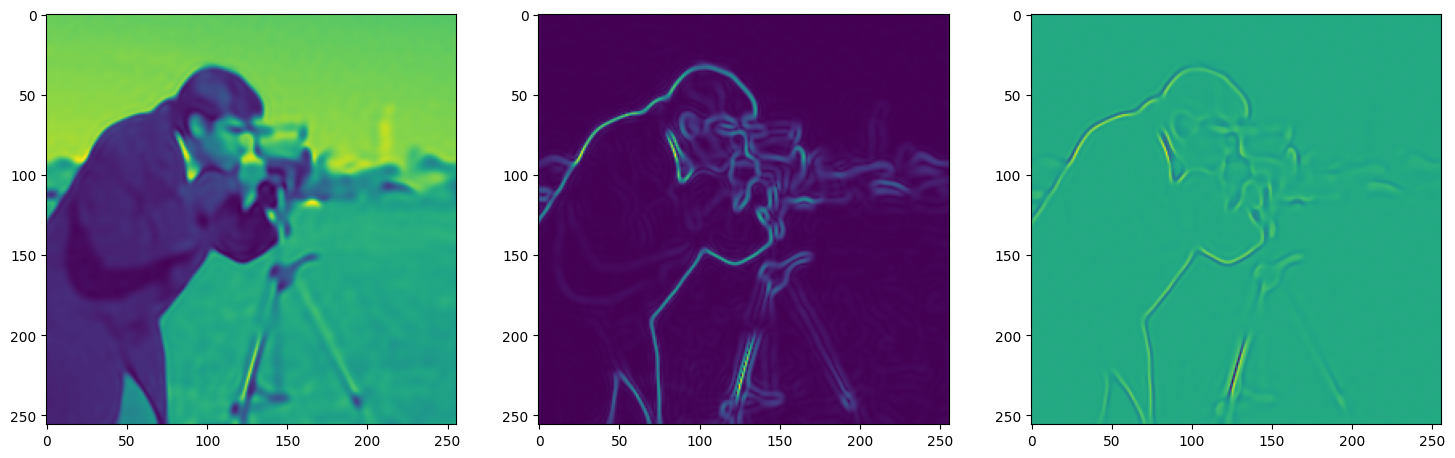
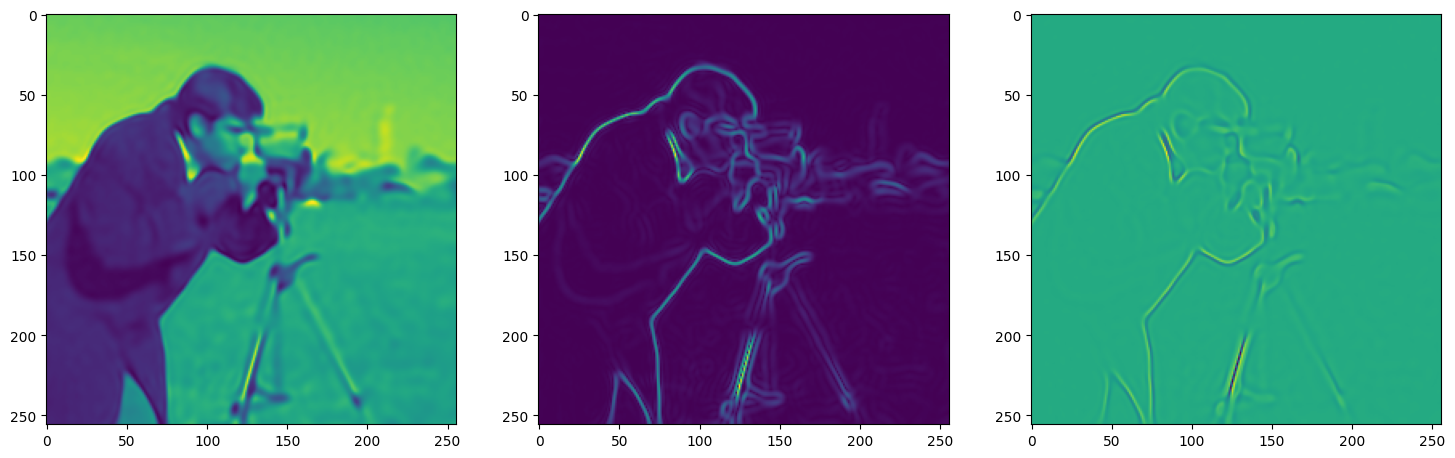
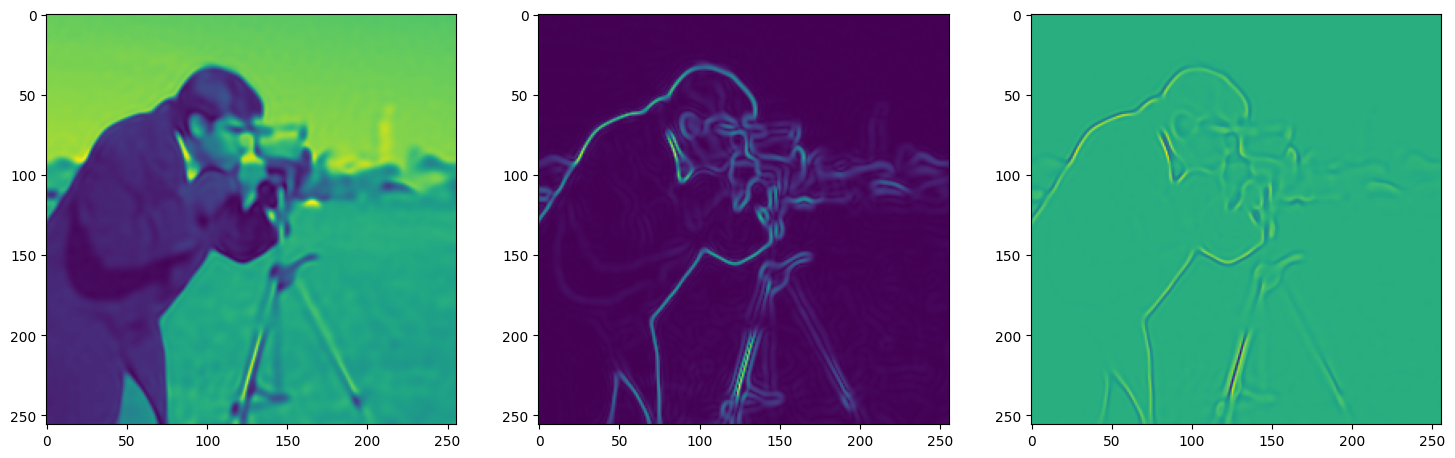
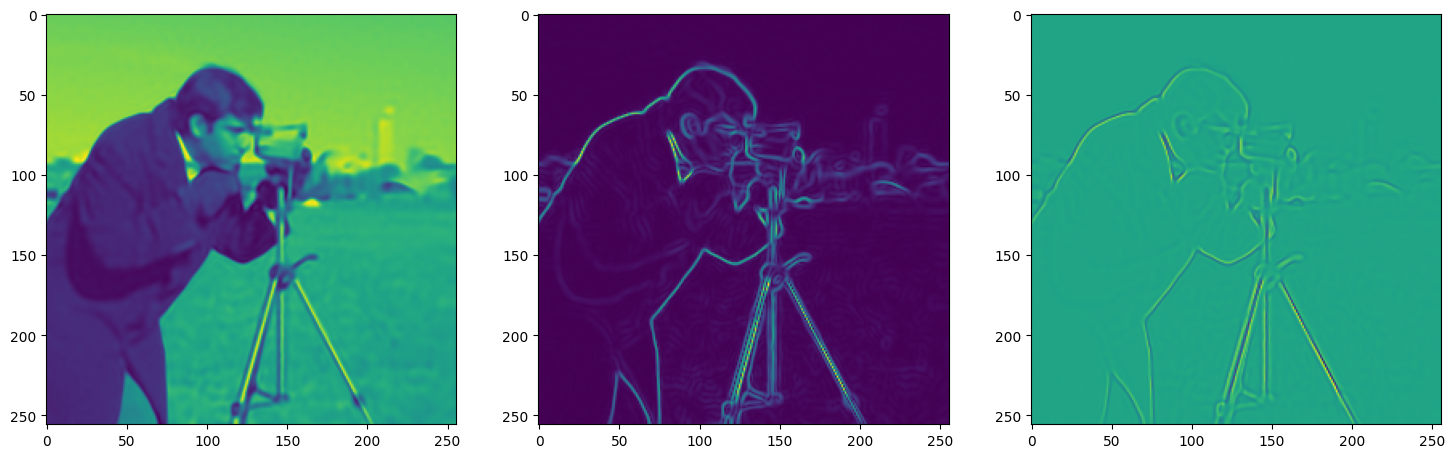
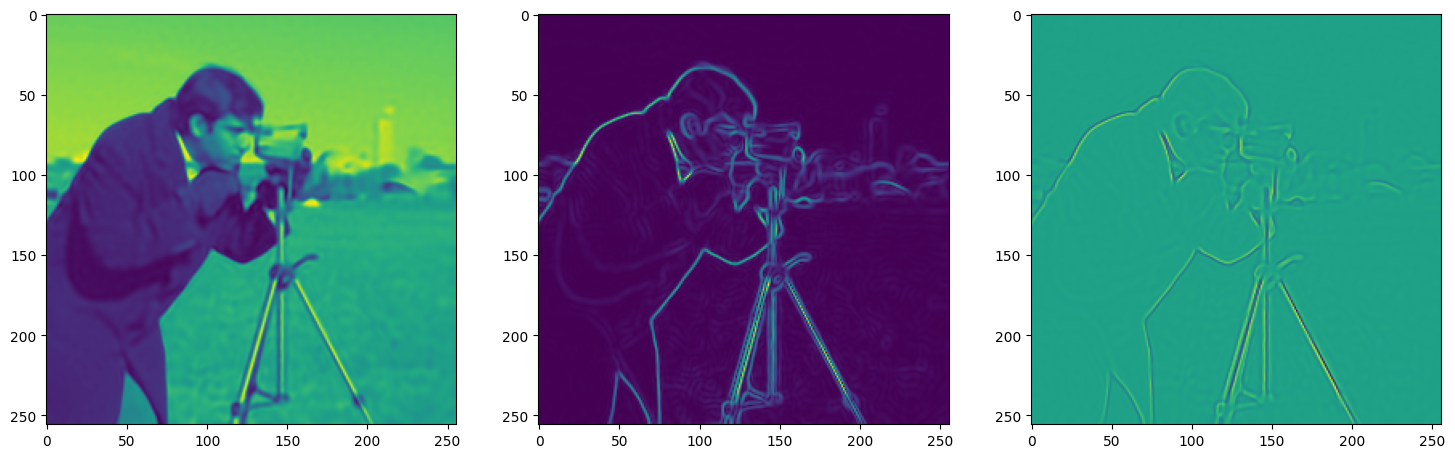
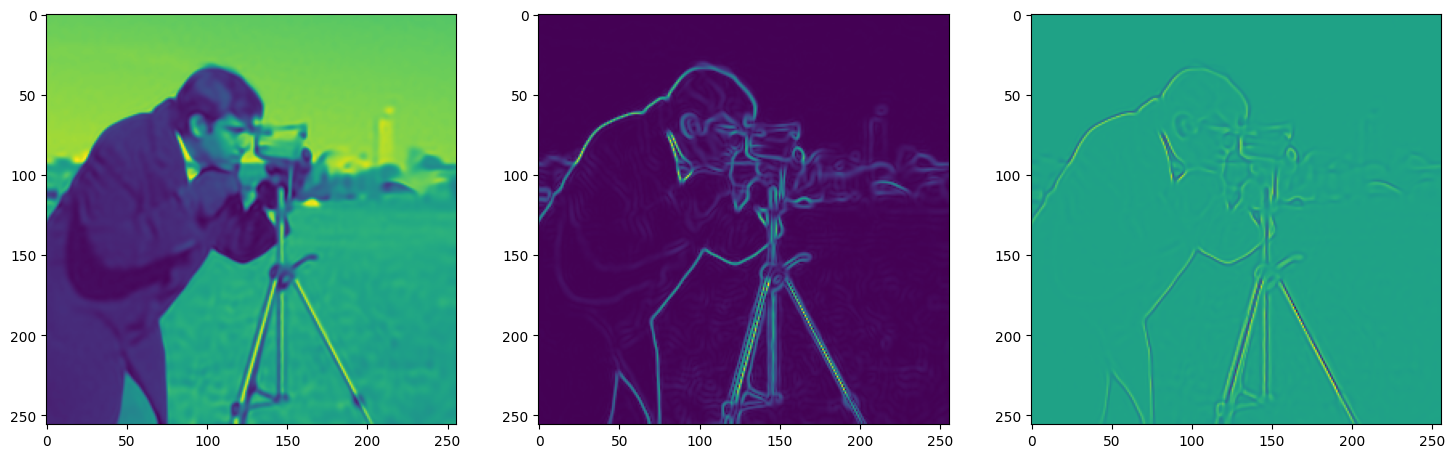
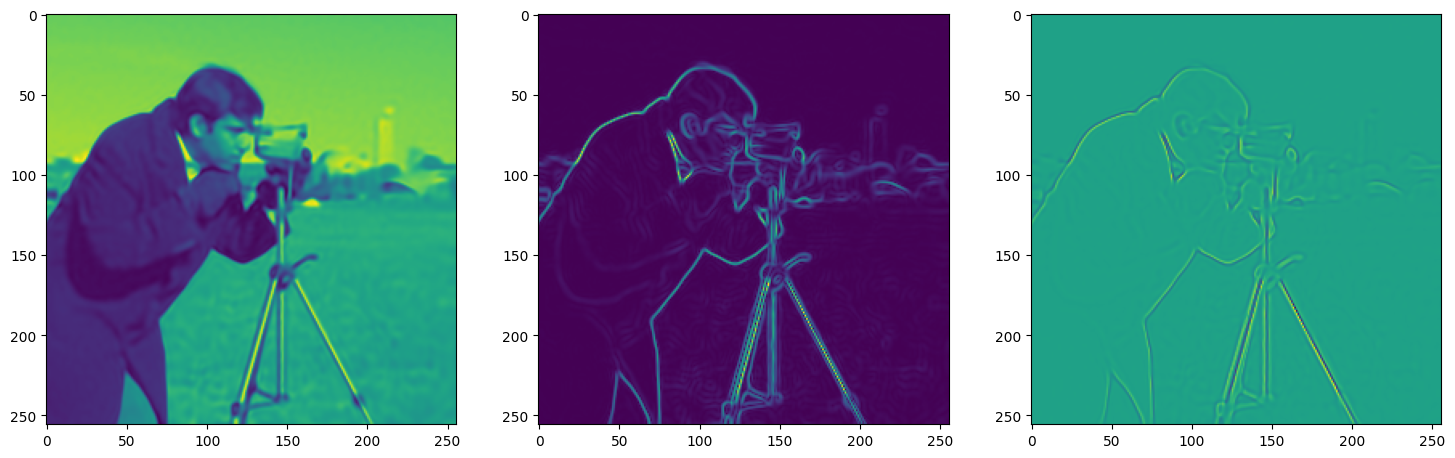
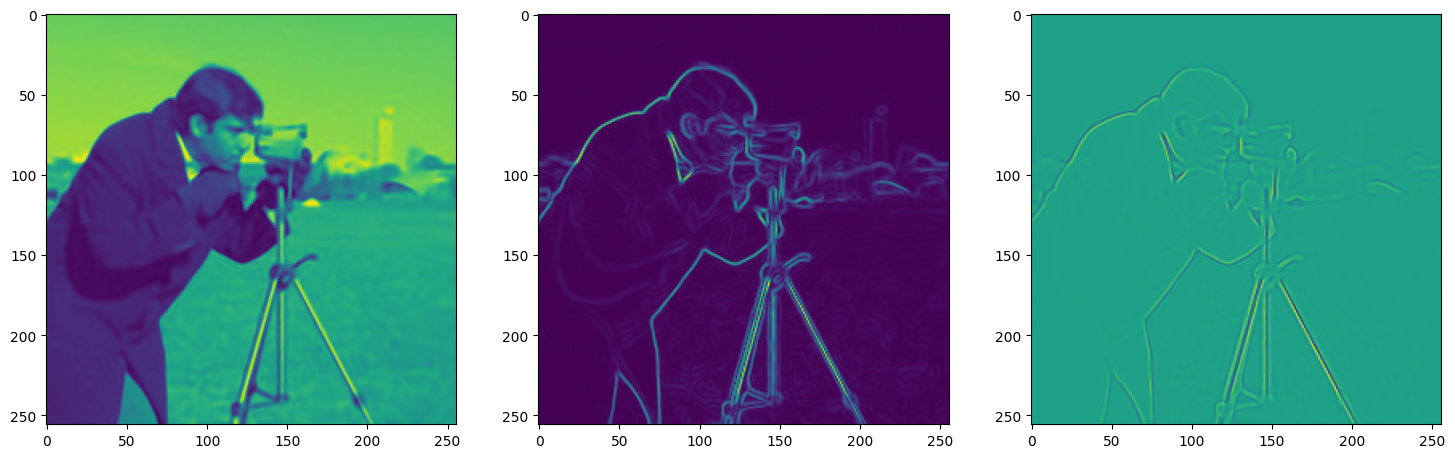
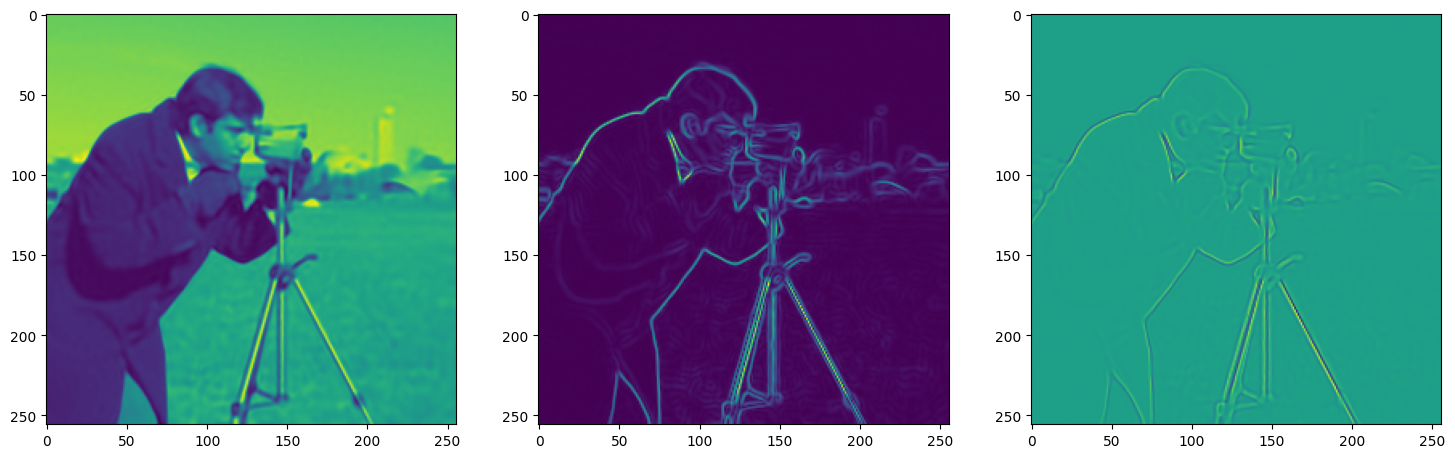
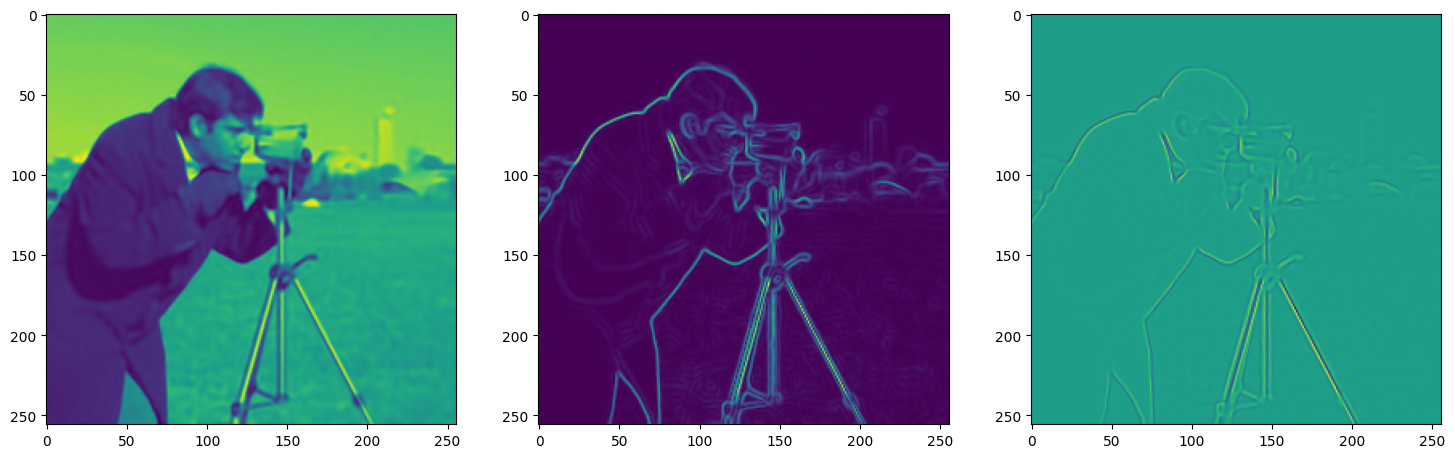
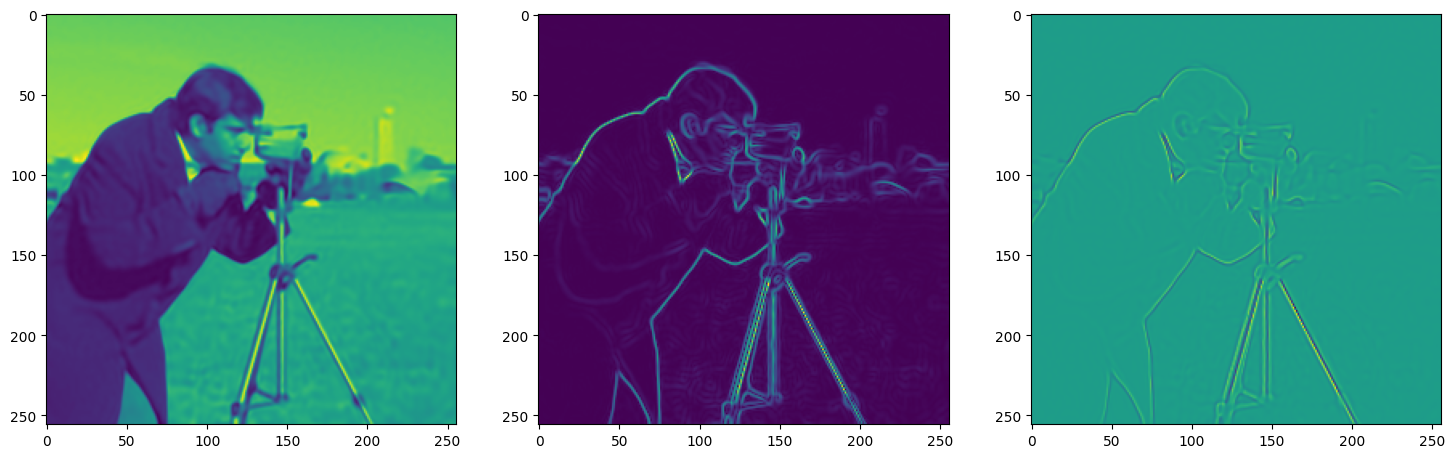
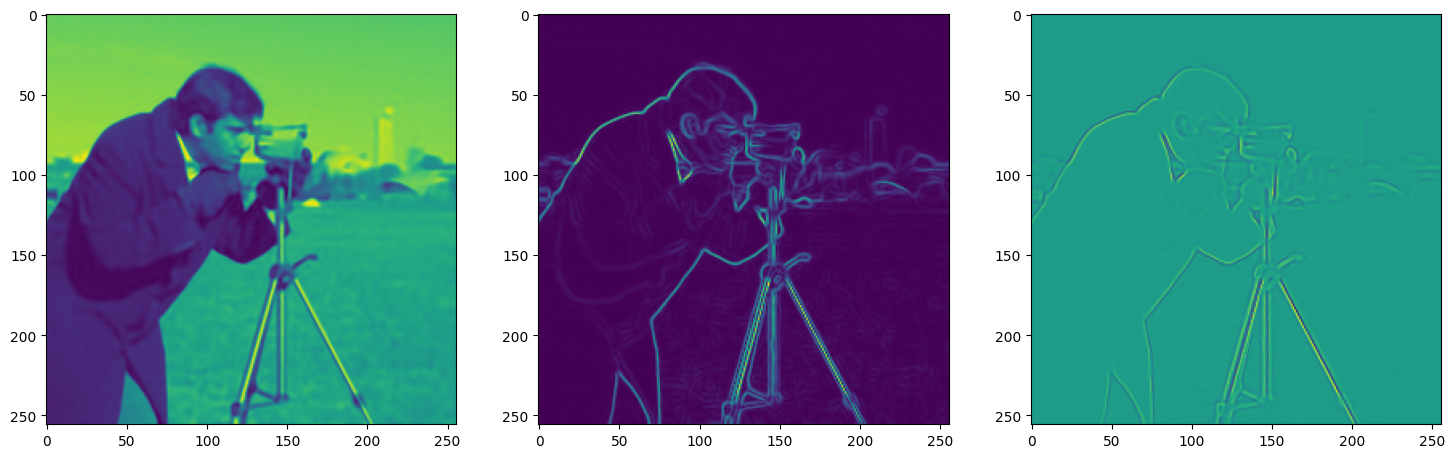
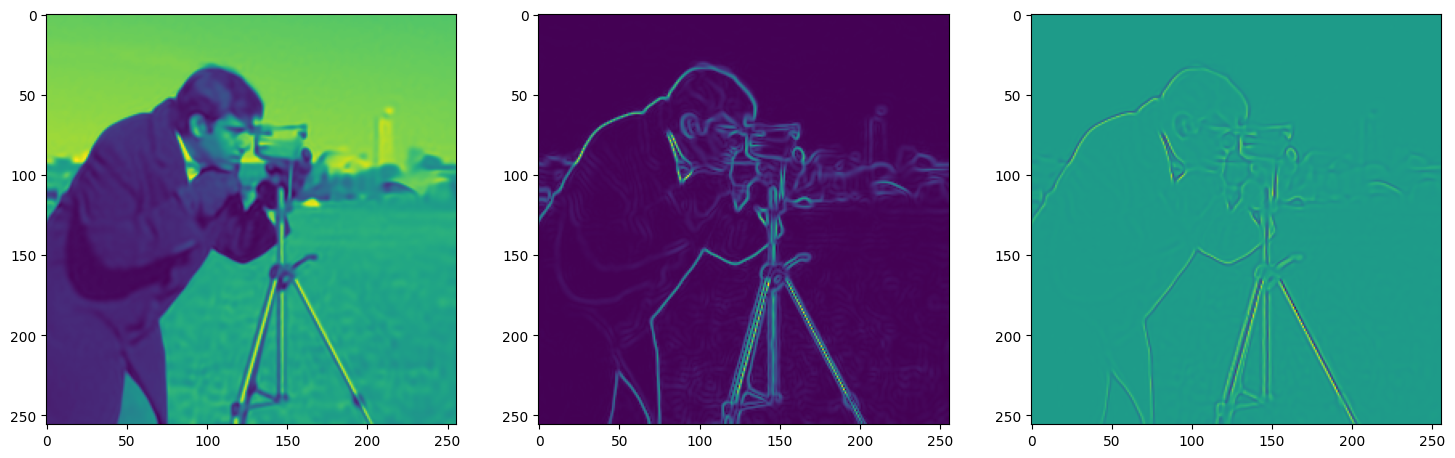
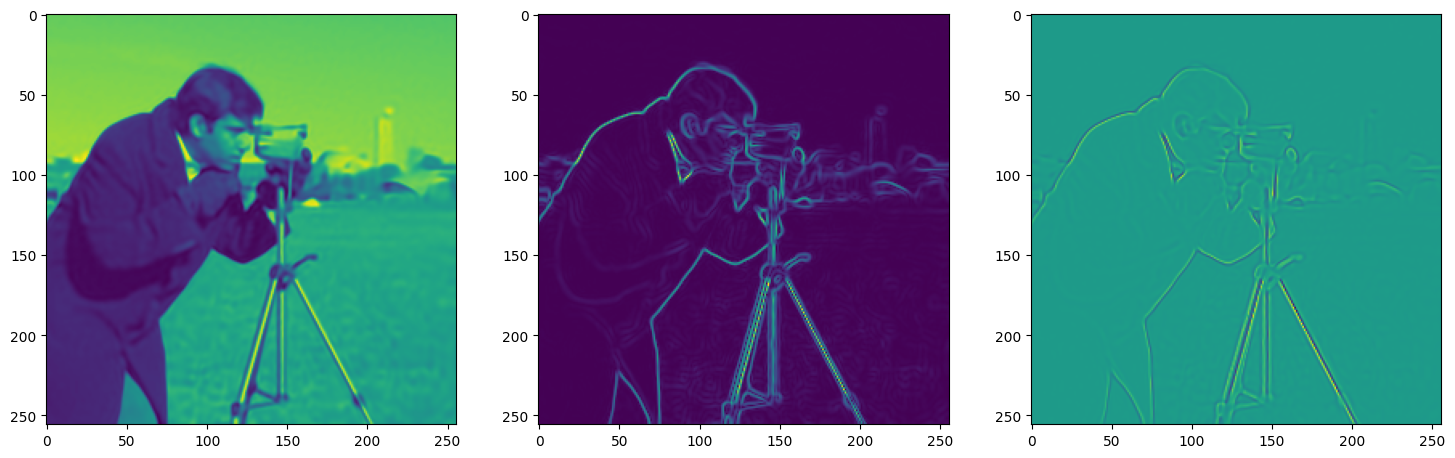
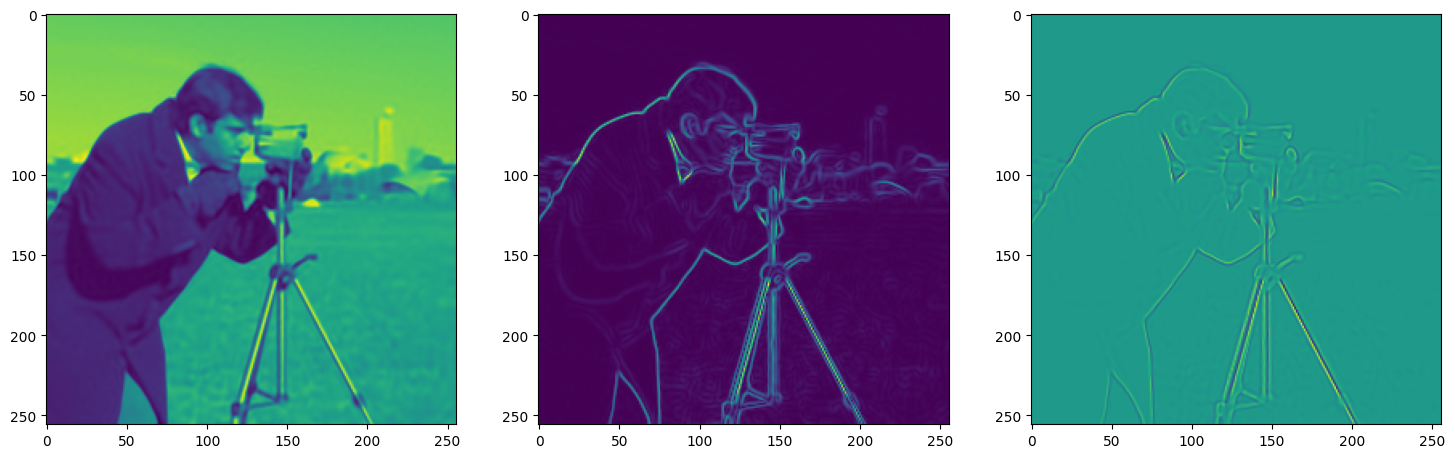
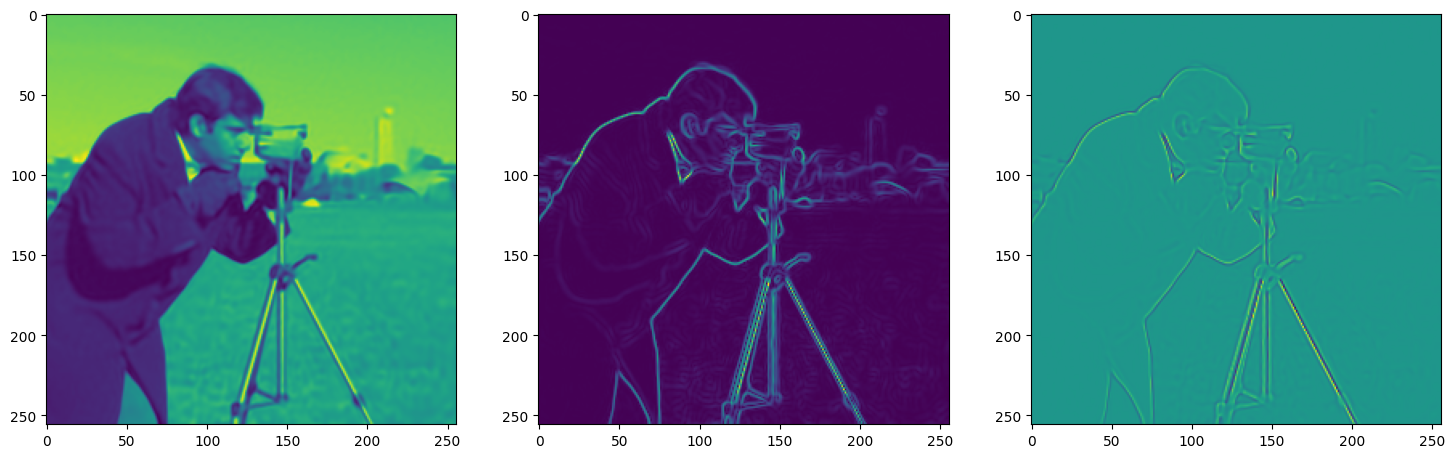
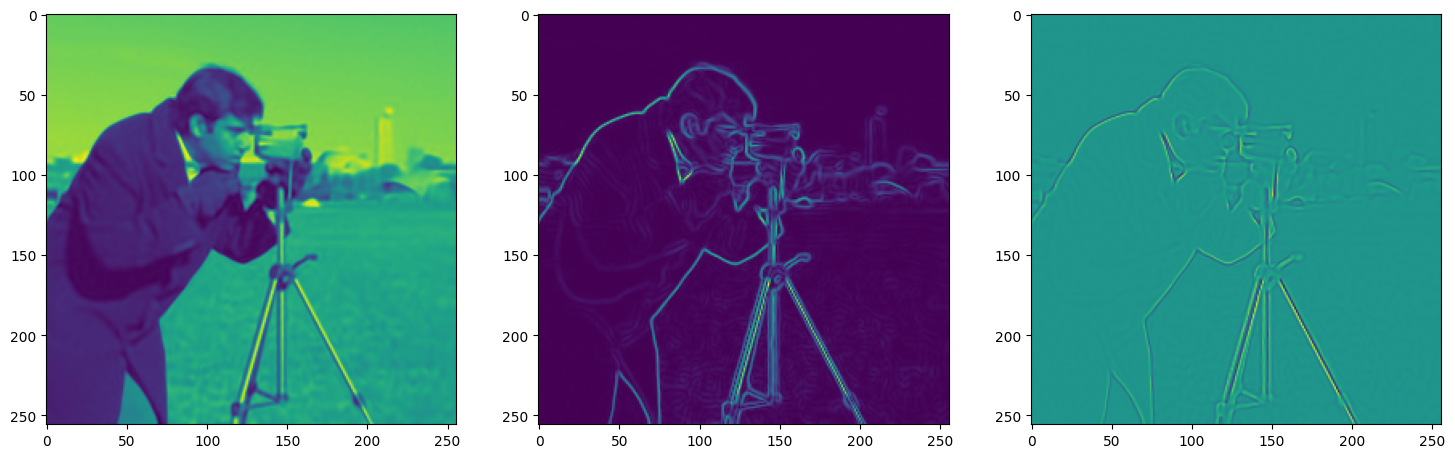
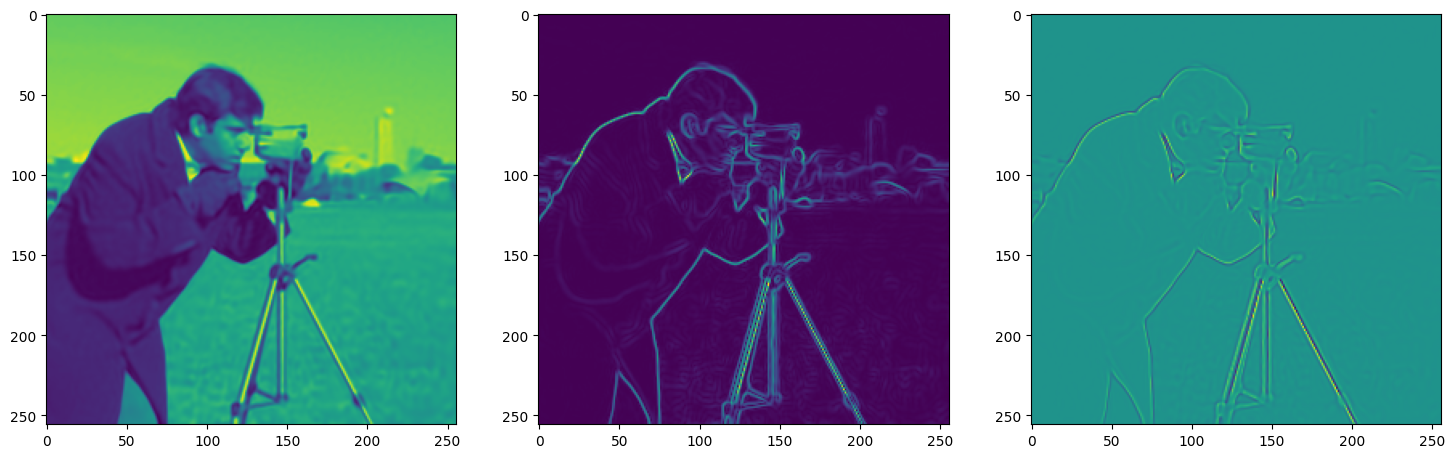
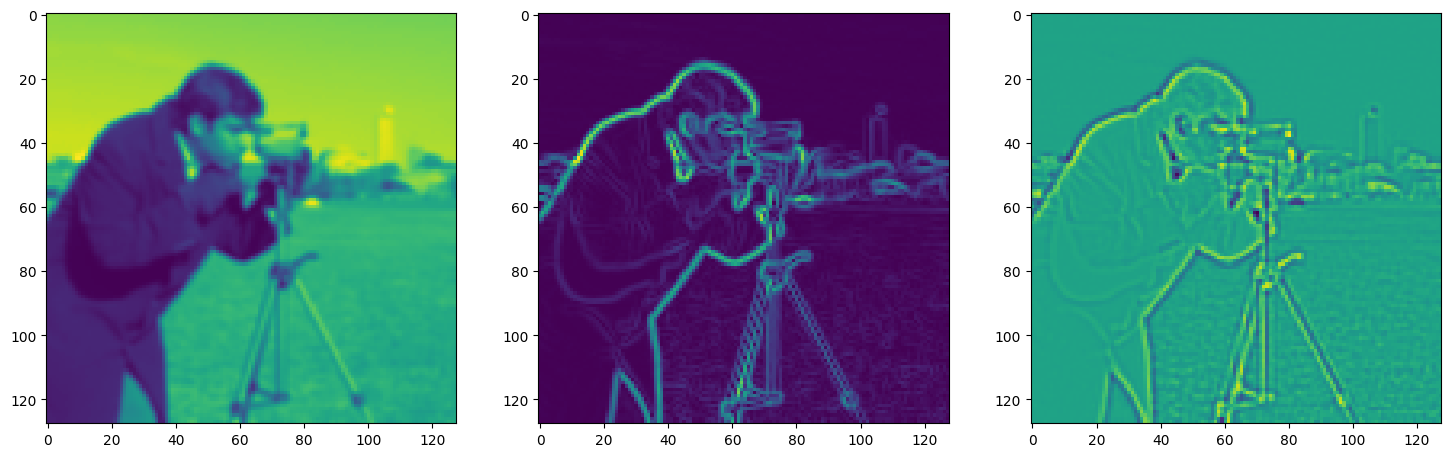
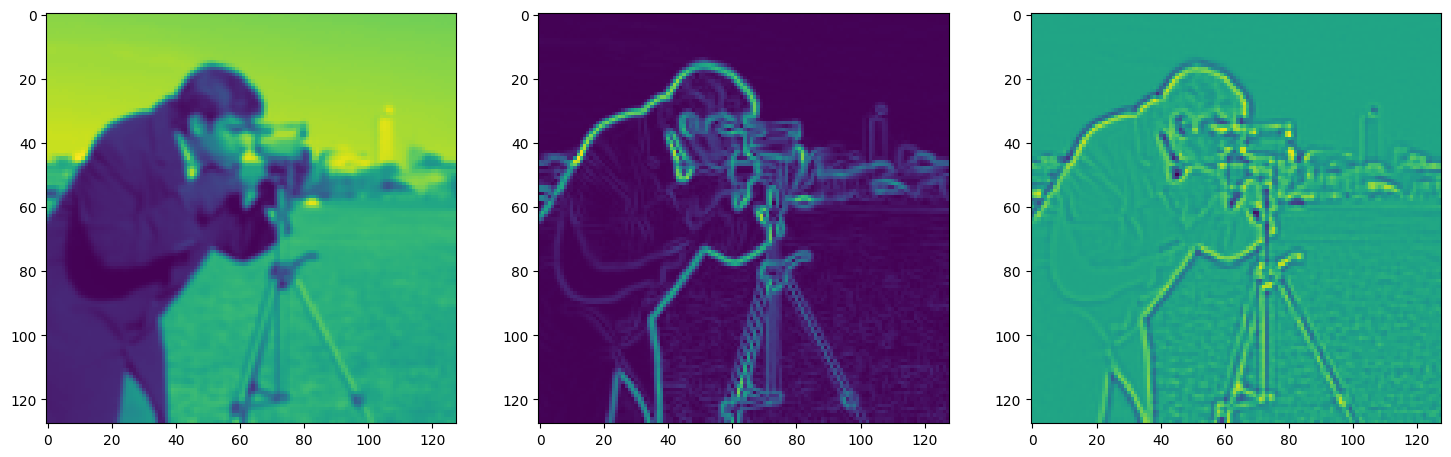
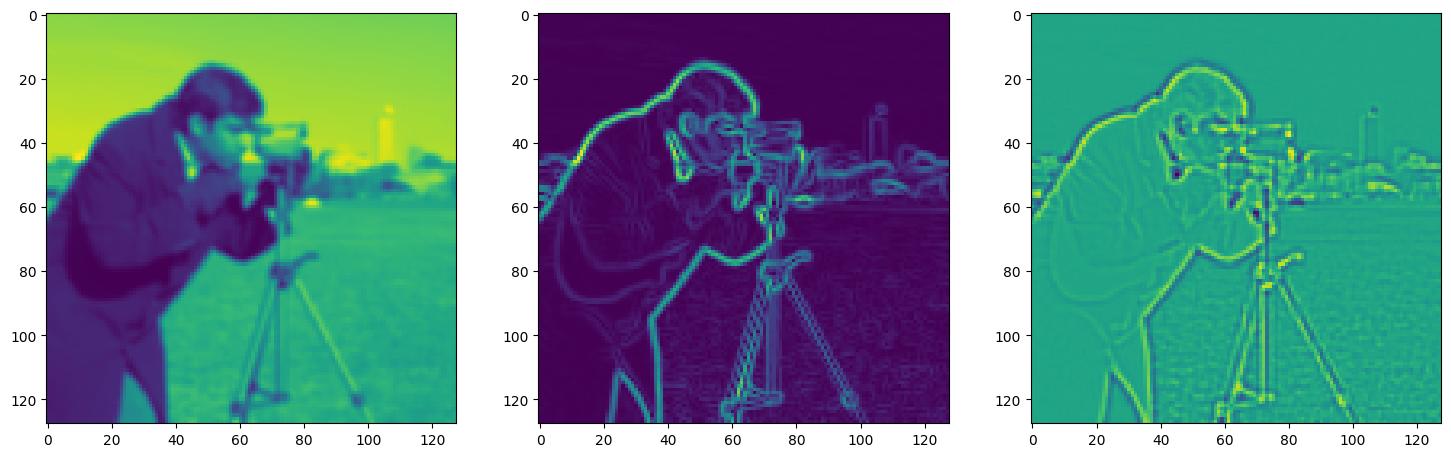
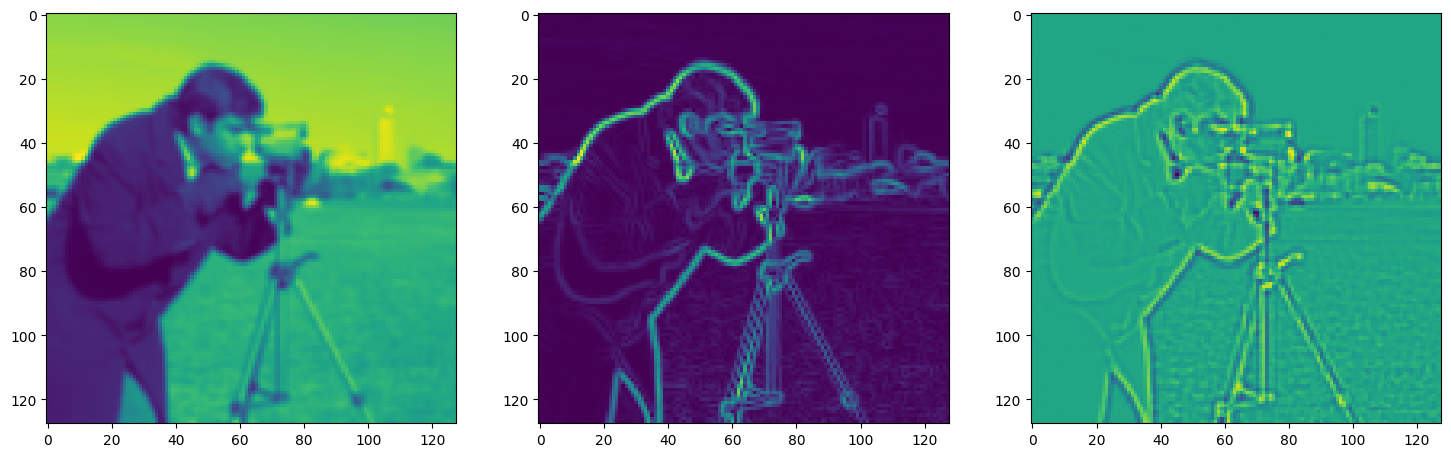
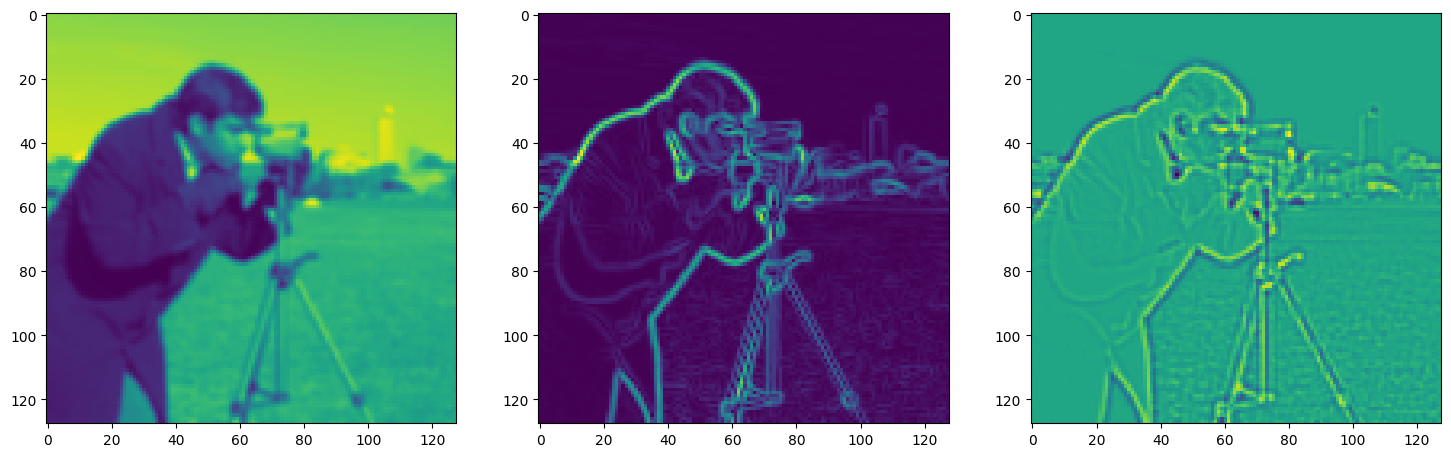
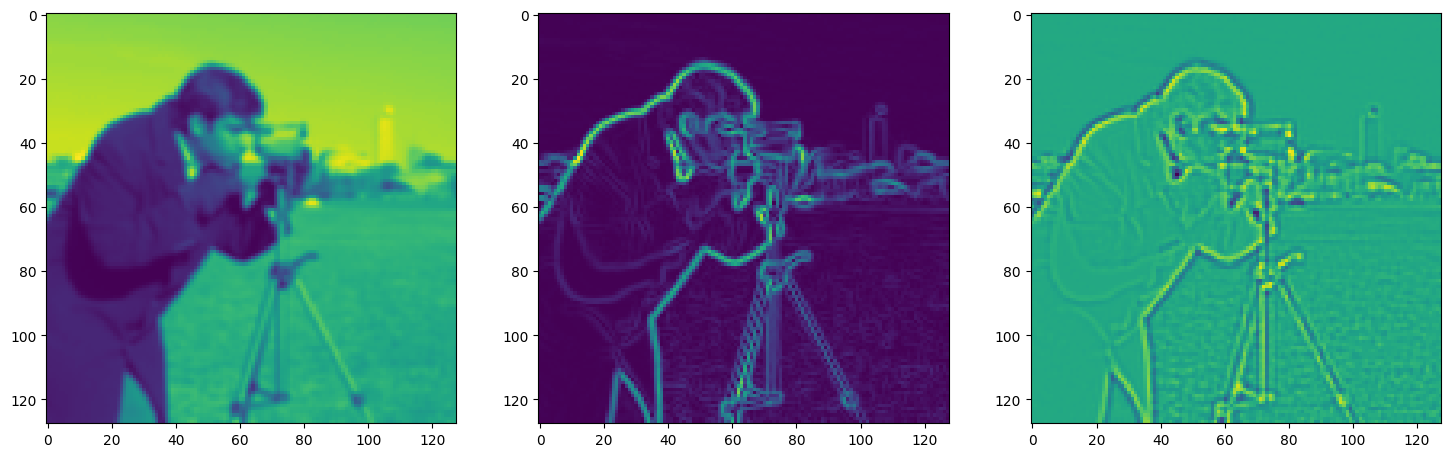
We now fit Siren in a simple training loop. Within only hundreds of iterations, the image and its gradients are approximated well.
total_steps = 500 # Since the whole image is our dataset, this just means 500 gradient descent steps.
steps_til_summary = 10

optim = torch.optim.Adam(lr=1e-4, params=img_siren.parameters())

model_input, ground_truth = next(iter(dataloader))
model_input, ground_truth = model_input.cuda(), ground_truth.cuda()

for step in range(total_steps):
    model_output, coords = img_siren(model_input)
    loss = ((model_output - ground_truth)2).mean()

    if not step % steps_til_summary:
        print("Step %d, Total loss %0.6f" % (step, loss))
        img_grad = gradient(model_output, coords)
        img_laplacian = laplace(model_output, coords)

        fig, axes = plt.subplots(1,3, figsize=(18,6))
        axes[0].imshow(model_output.cpu().view(256,256).detach().numpy())
        axes[1].imshow(img_grad.norm(dim=-1).cpu().view(256,256).detach().numpy())
        axes[2].imshow(img_laplacian.cpu().view(256,256).detach().numpy())
        plt.show()

    optim.zero_grad()
    loss.backward()
    optim.step()
Step 0, Total loss 0.321211
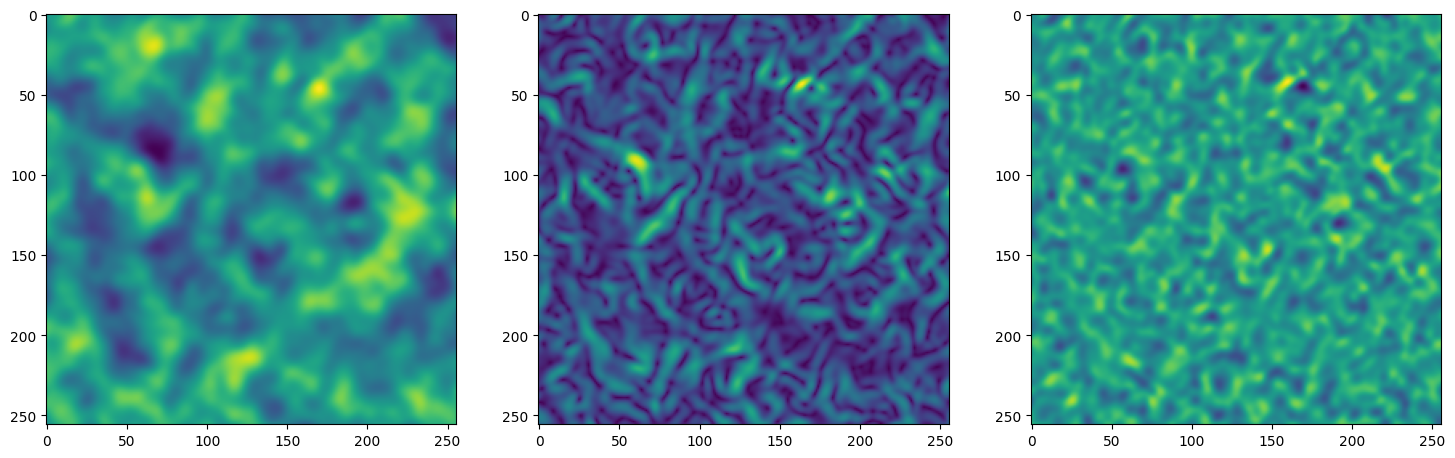
Step 10, Total loss 0.052471
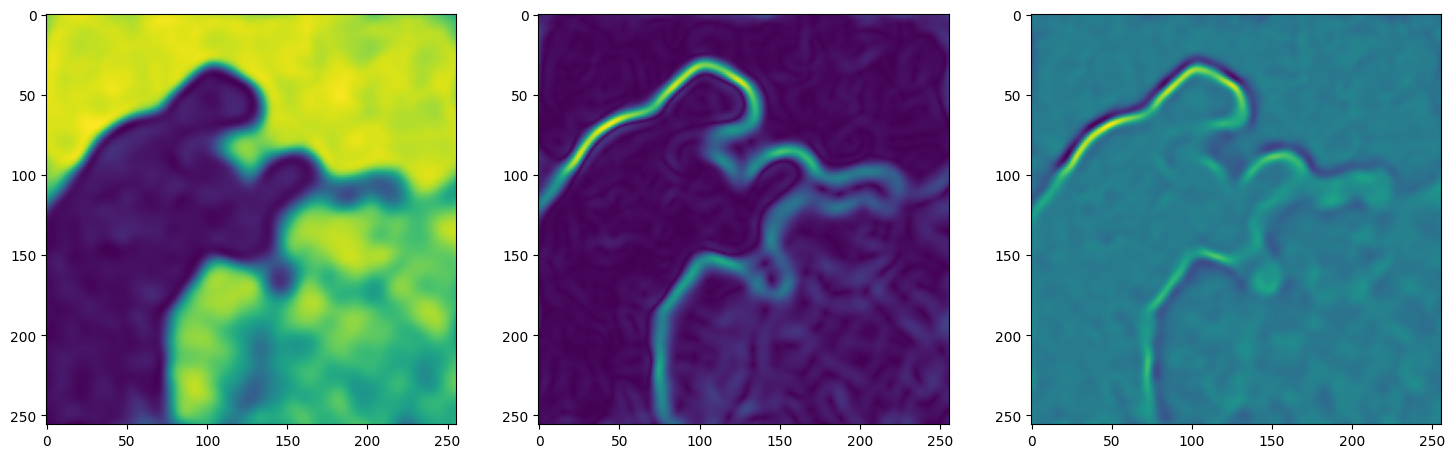
Step 20, Total loss 0.023199
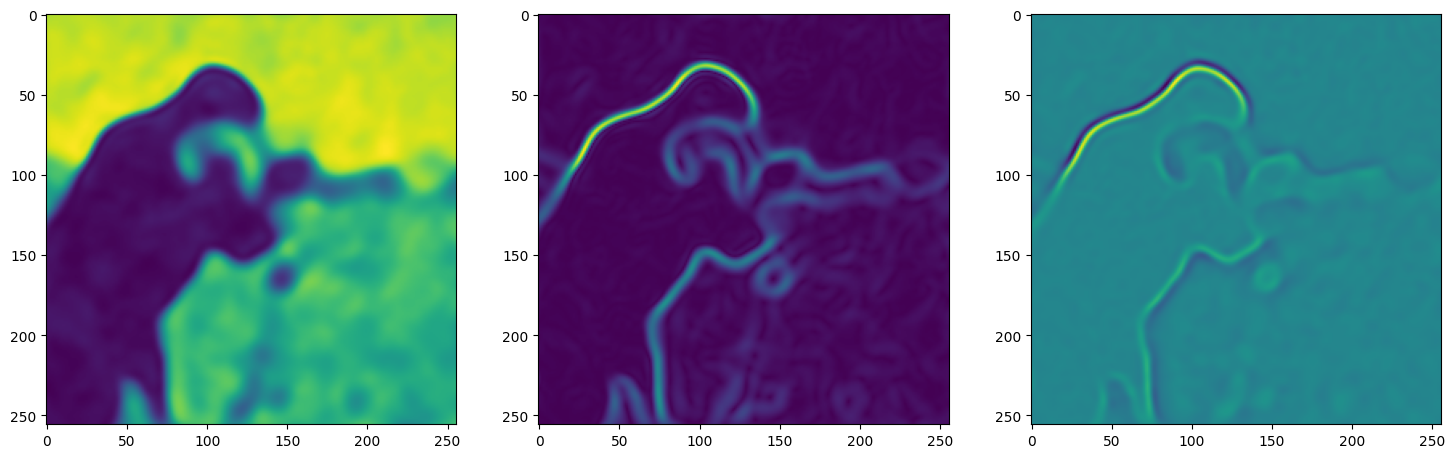
Step 30, Total loss 0.017426
Step 40, Total loss 0.014491
Step 50, Total loss 0.012846
Step 60, Total loss 0.011681
Step 70, Total loss 0.010782
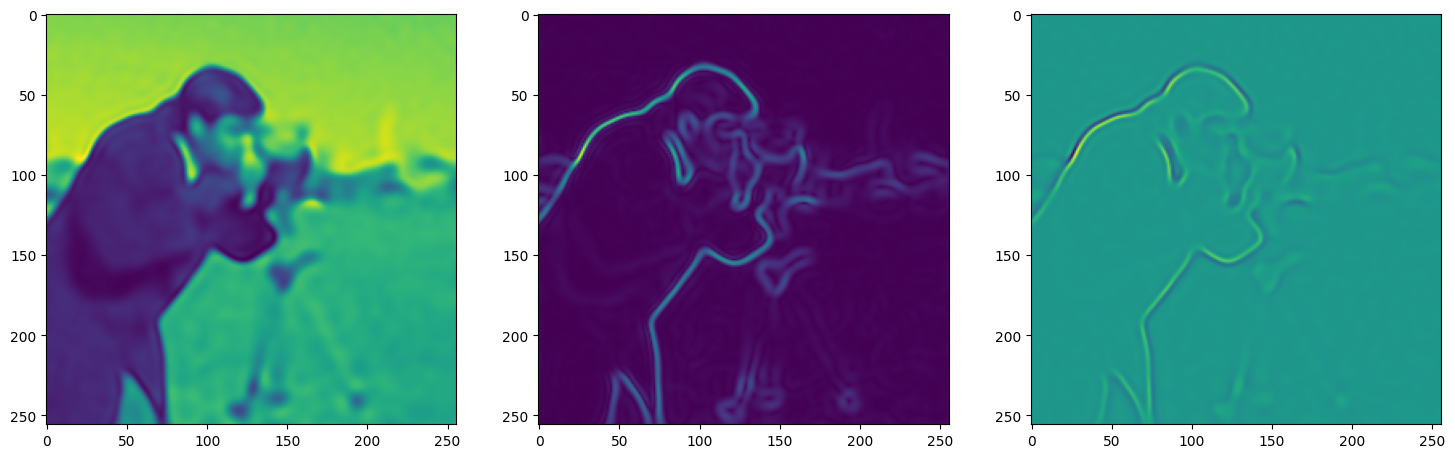
Step 80, Total loss 0.010053
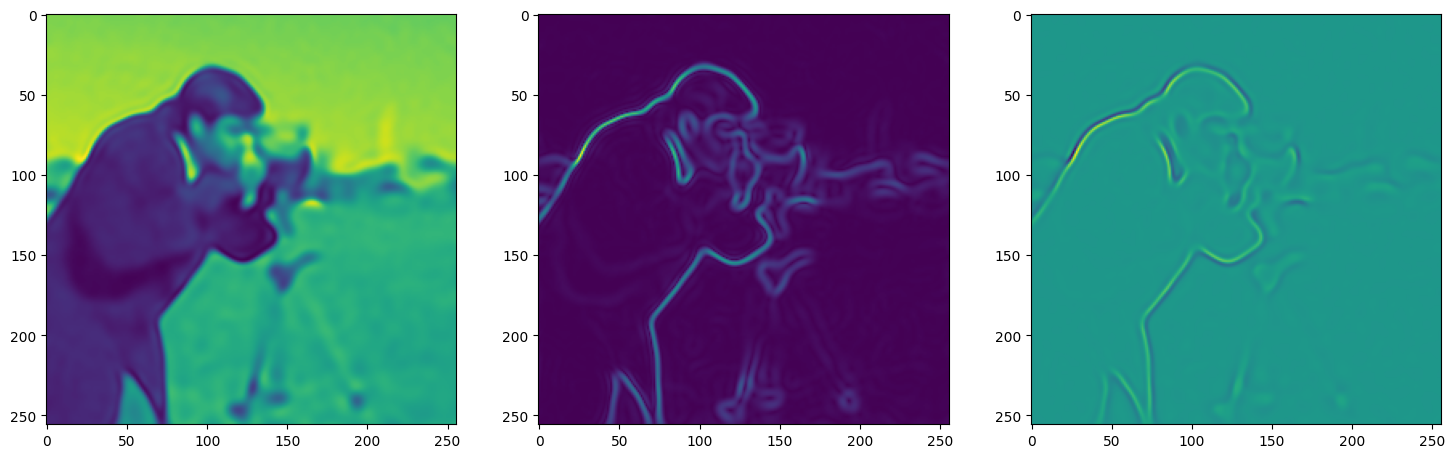
Step 90, Total loss 0.009424
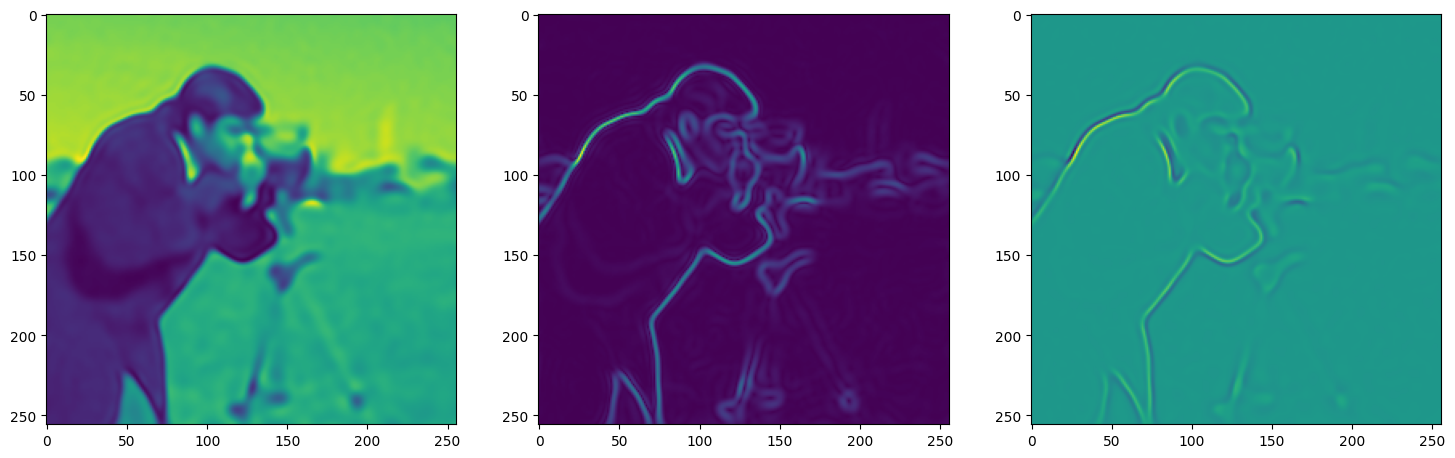
Step 100, Total loss 0.008857
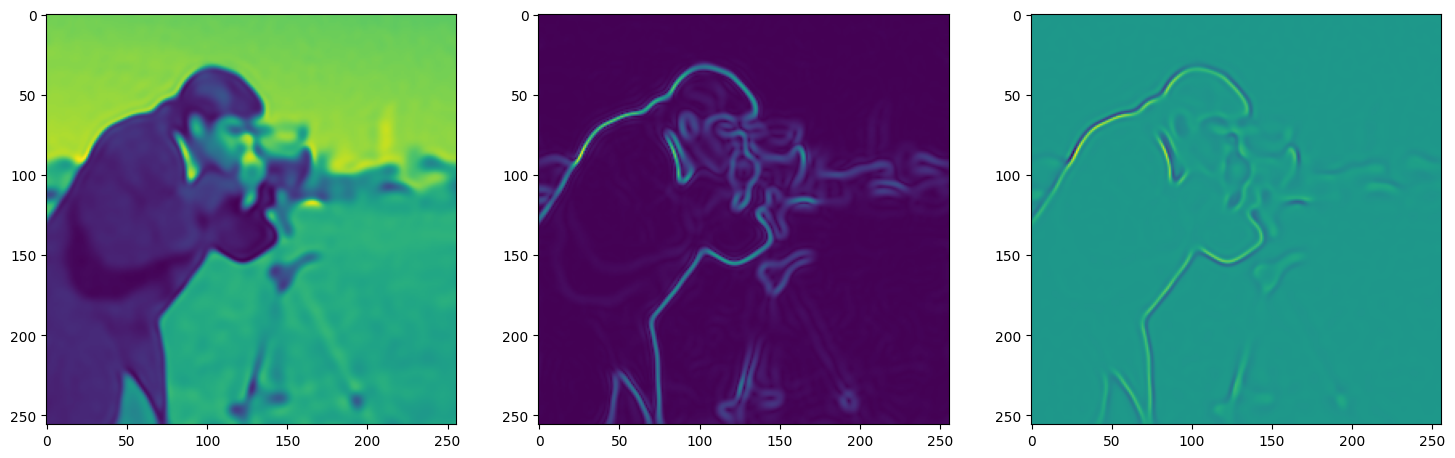
Step 110, Total loss 0.008327
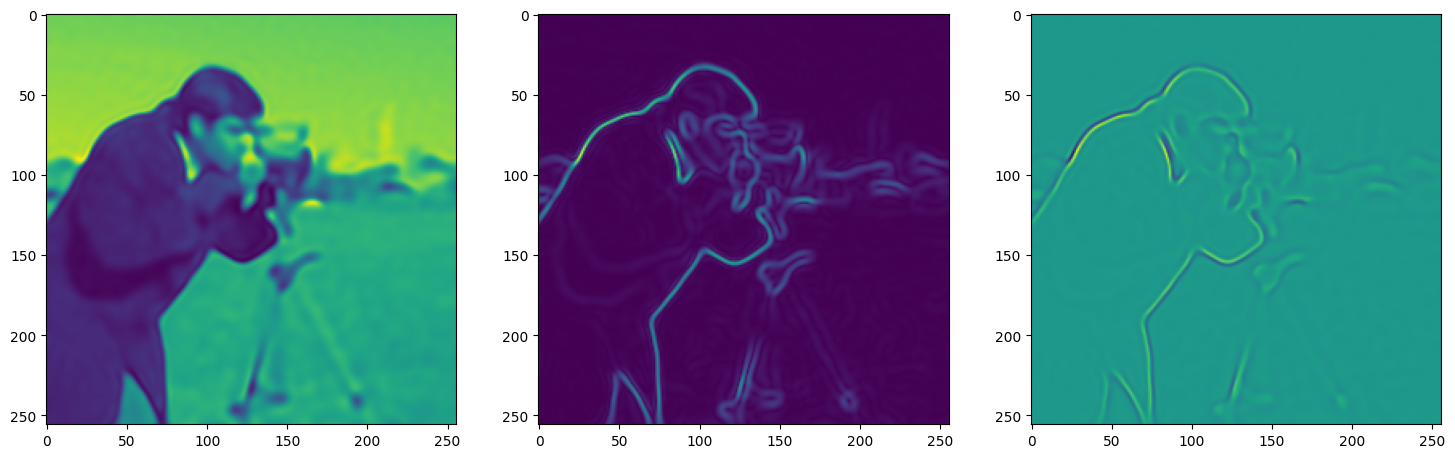
Step 120, Total loss 0.007813
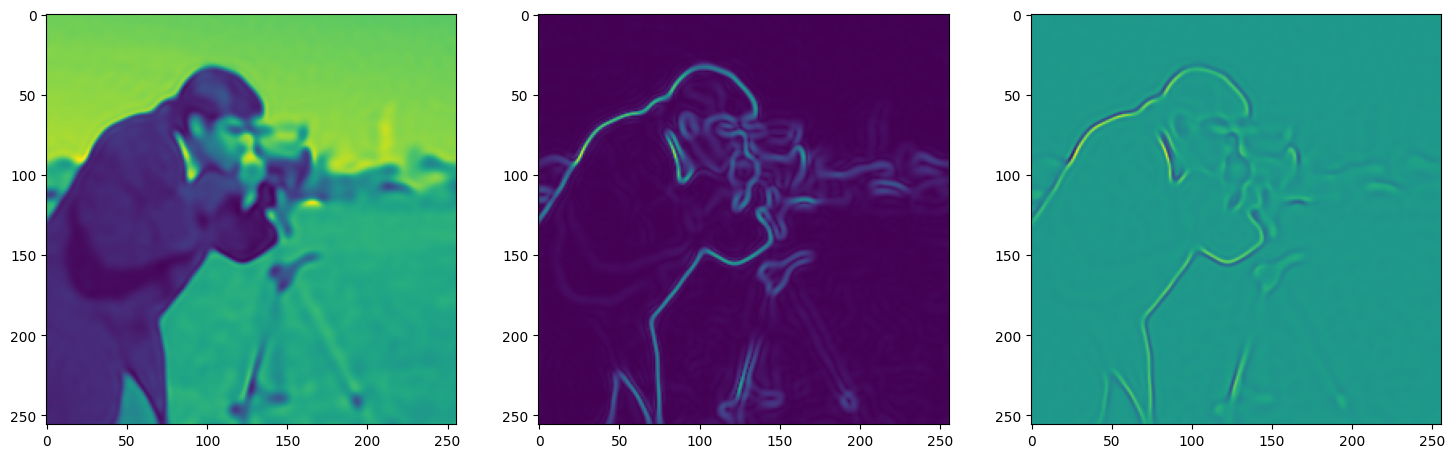
Step 130, Total loss 0.007307
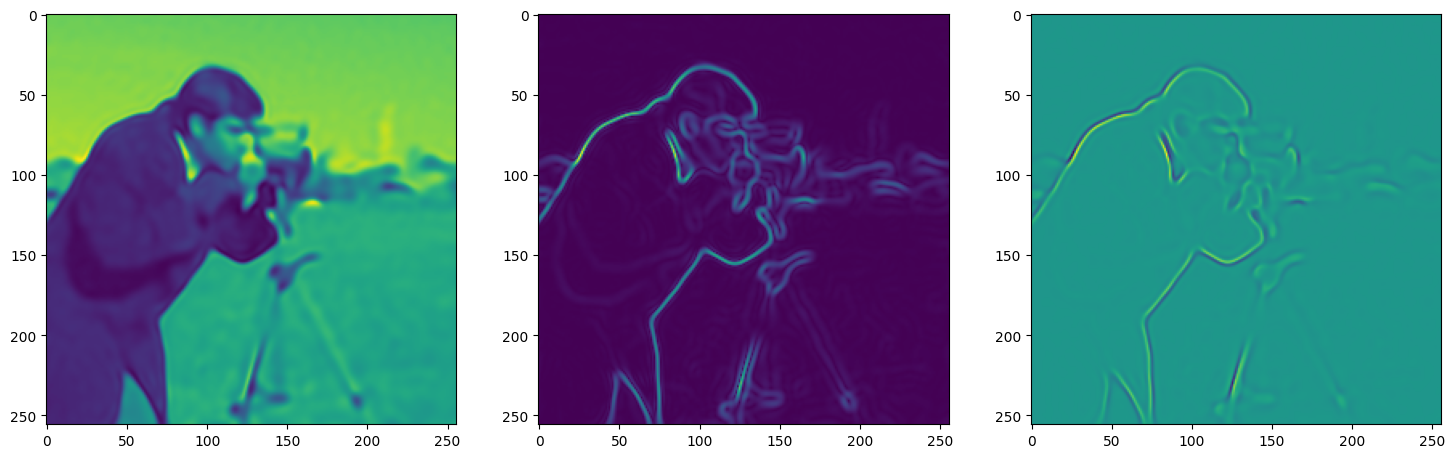
Step 140, Total loss 0.006818
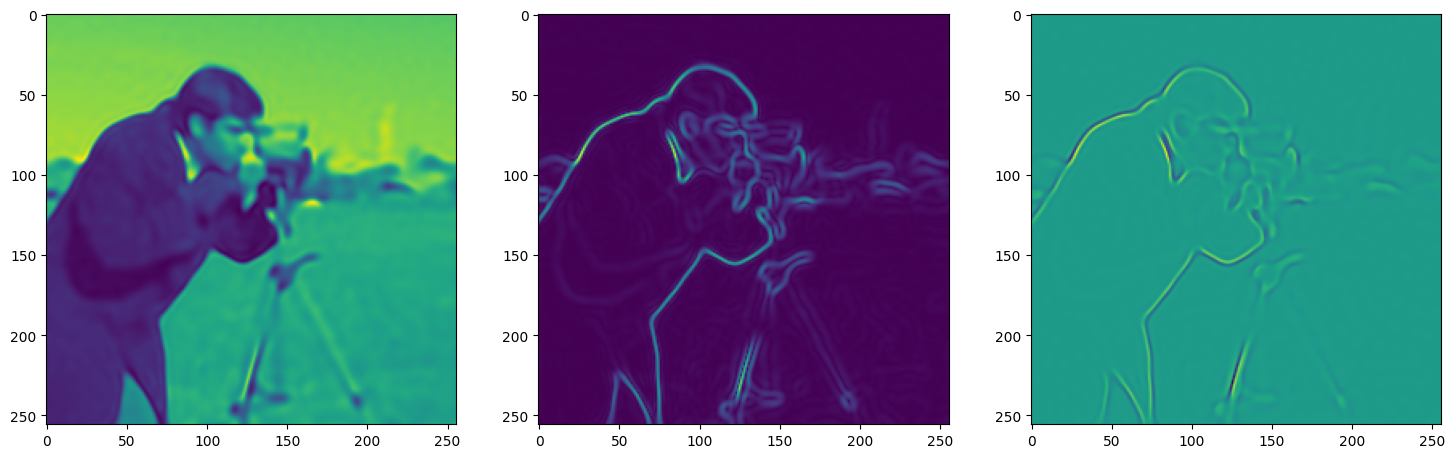
Step 150, Total loss 0.006365
Step 160, Total loss 0.005955
Step 170, Total loss 0.005584
Step 180, Total loss 0.005240
Step 190, Total loss 0.004916
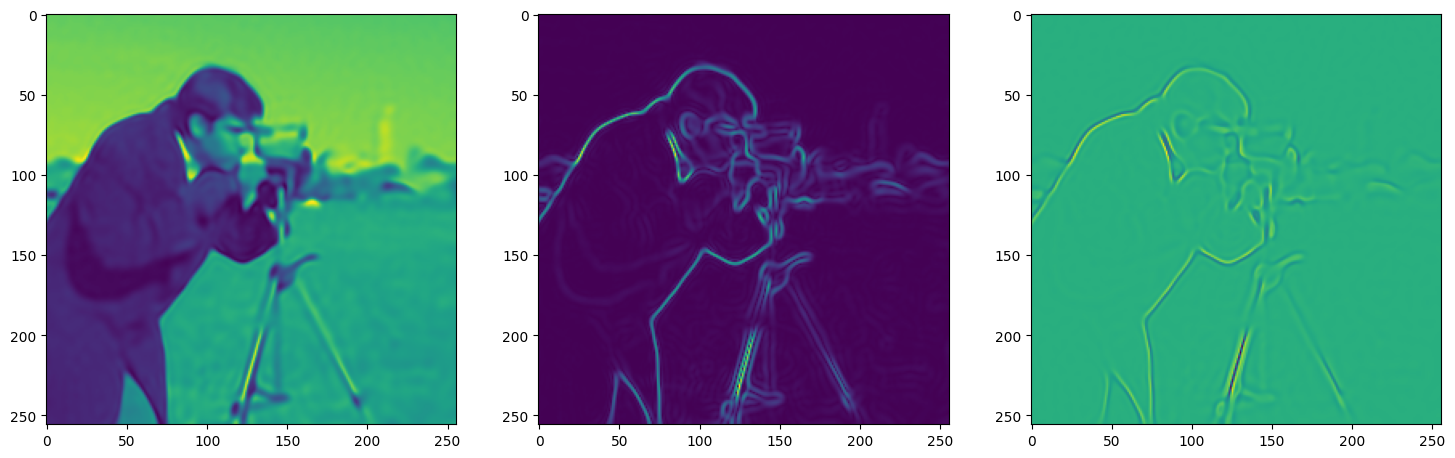
Step 200, Total loss 0.004606
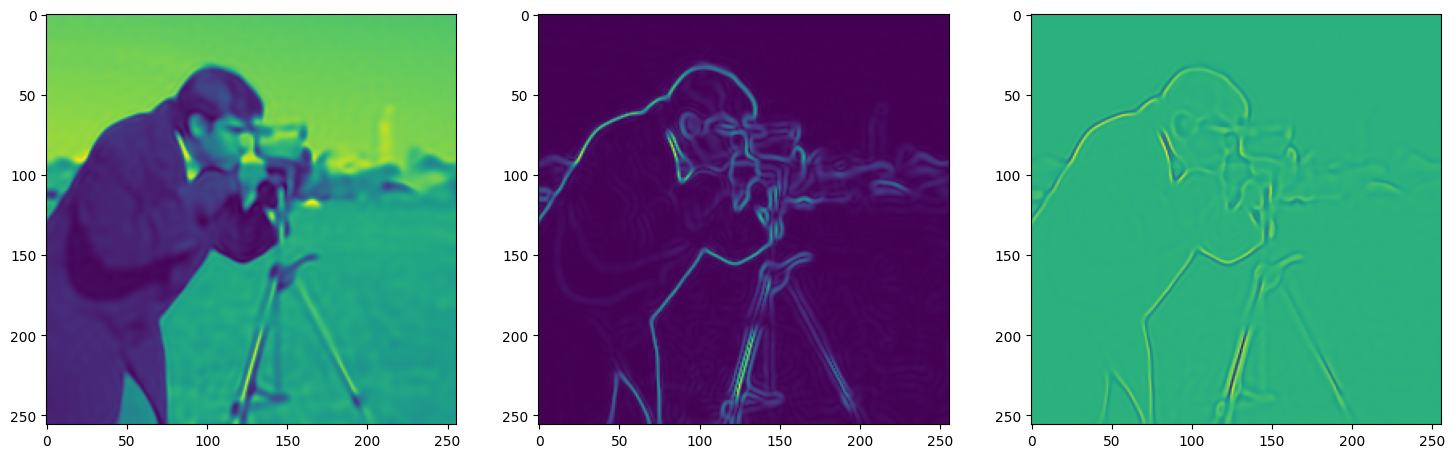
Step 210, Total loss 0.004304
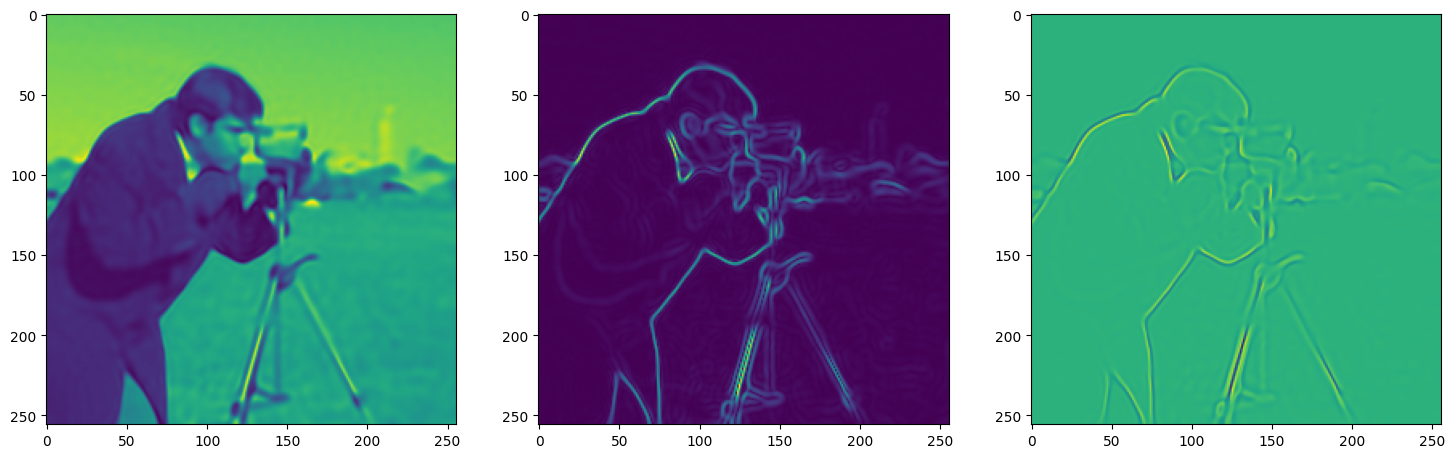
Step 220, Total loss 0.004006
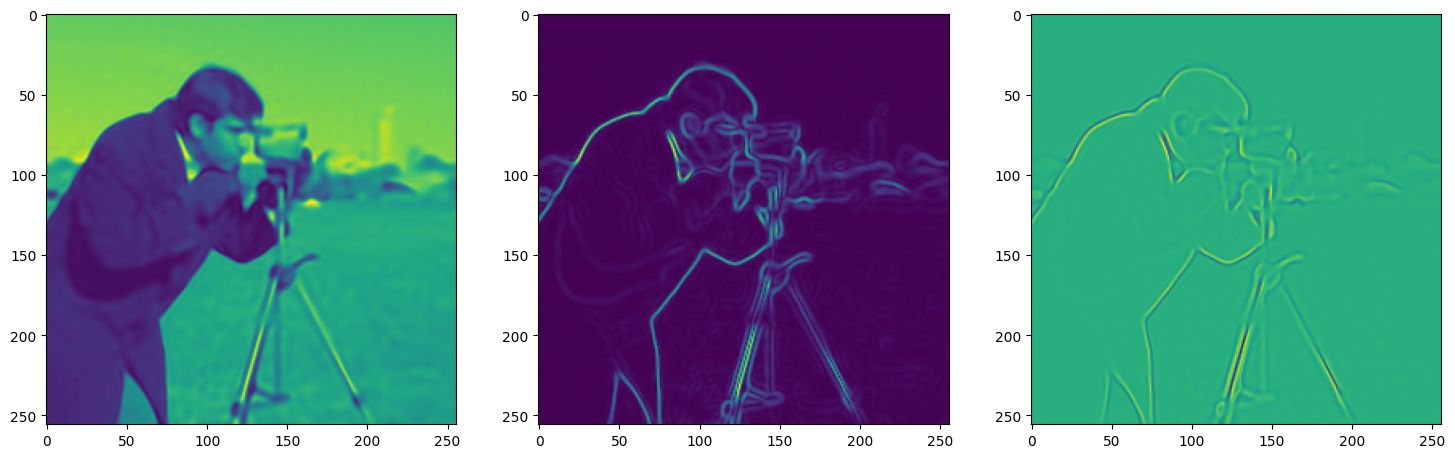
Step 230, Total loss 0.003715
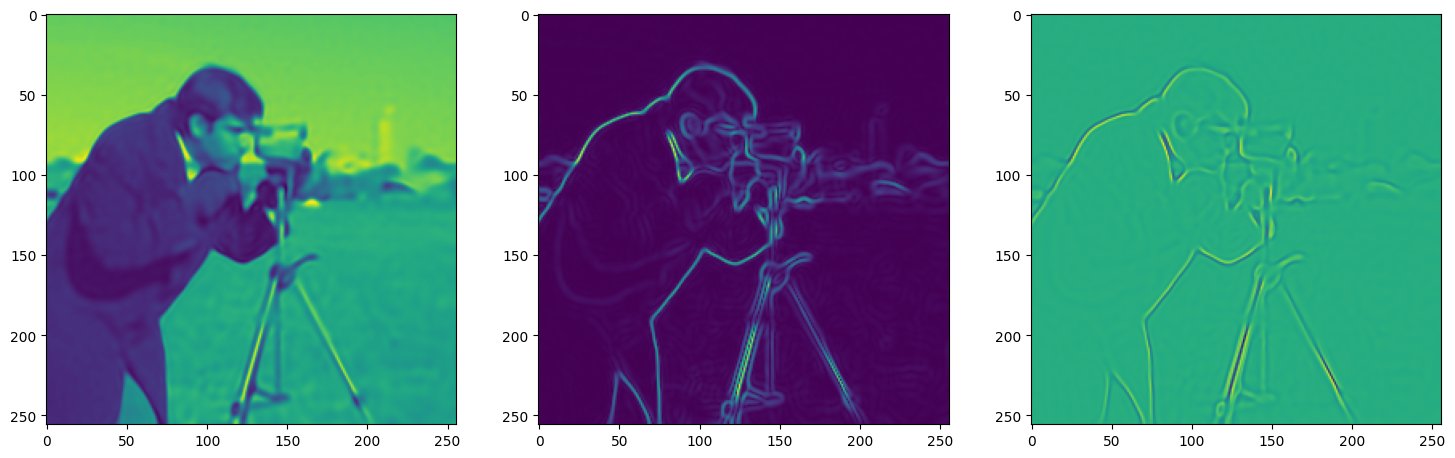
Step 240, Total loss 0.003428
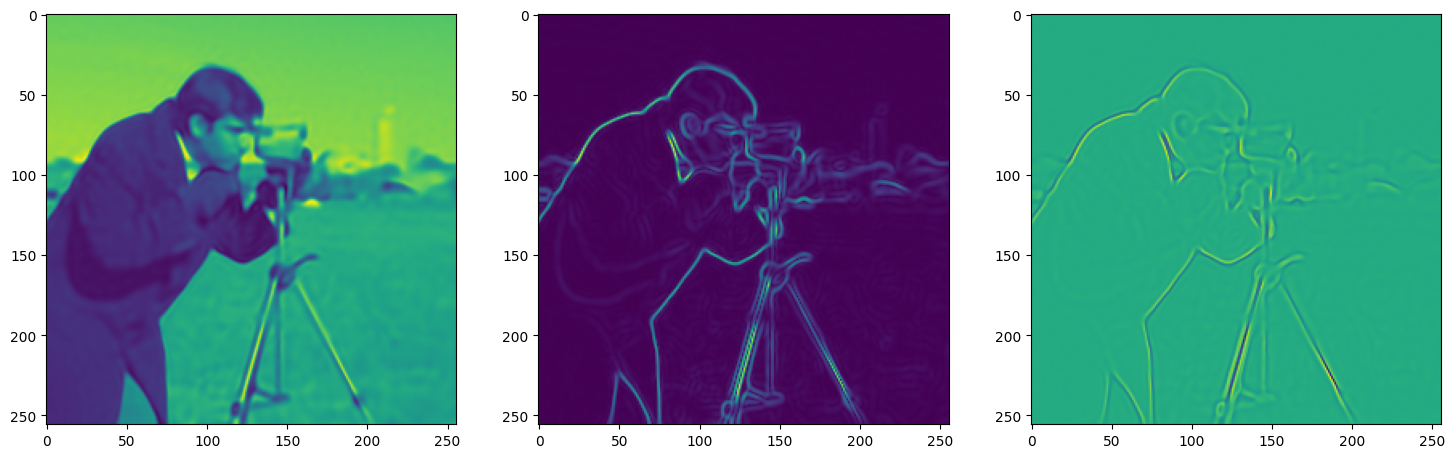
Step 250, Total loss 0.003152
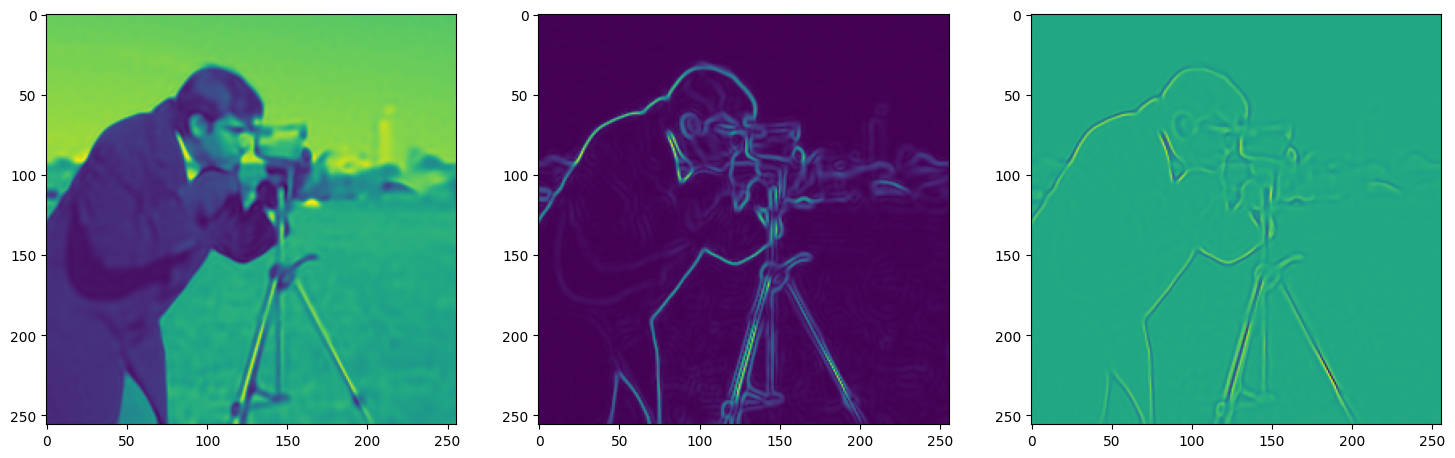
Step 260, Total loss 0.003466
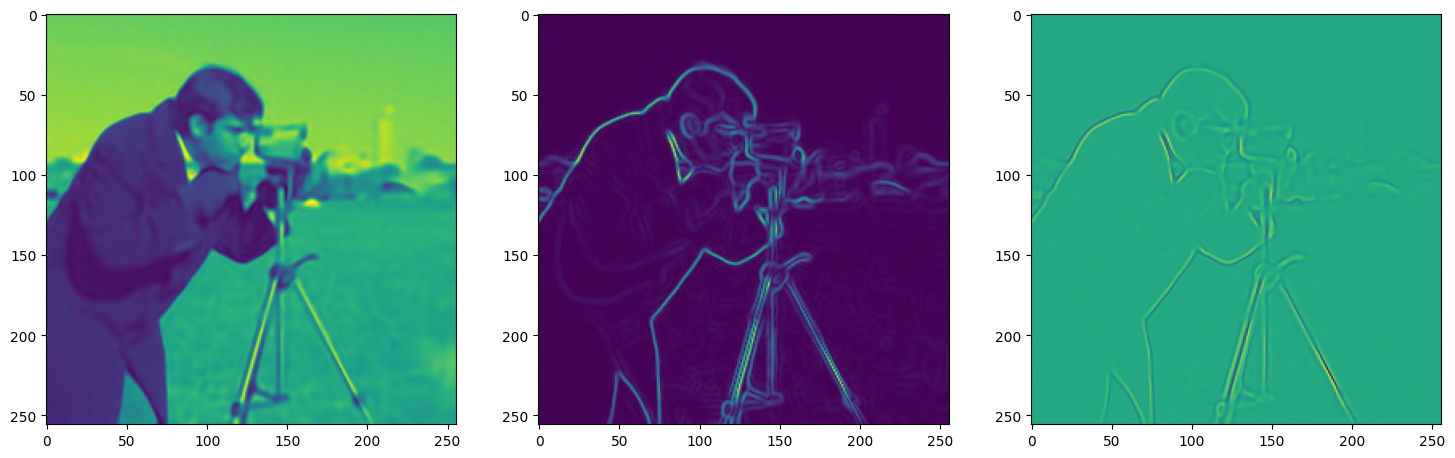
Step 270, Total loss 0.002759
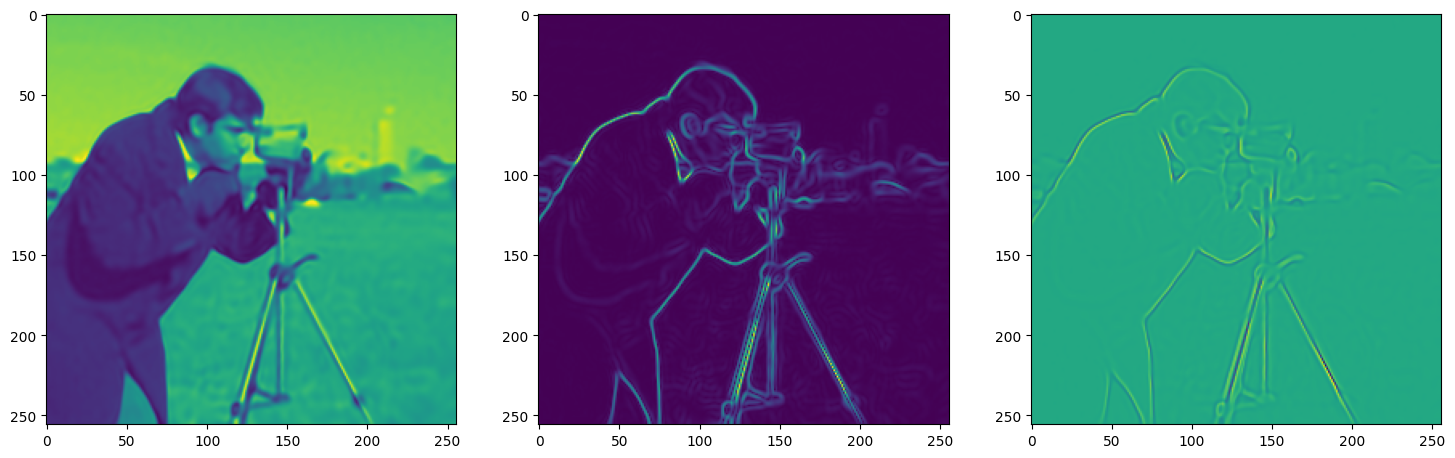
Step 280, Total loss 0.002549
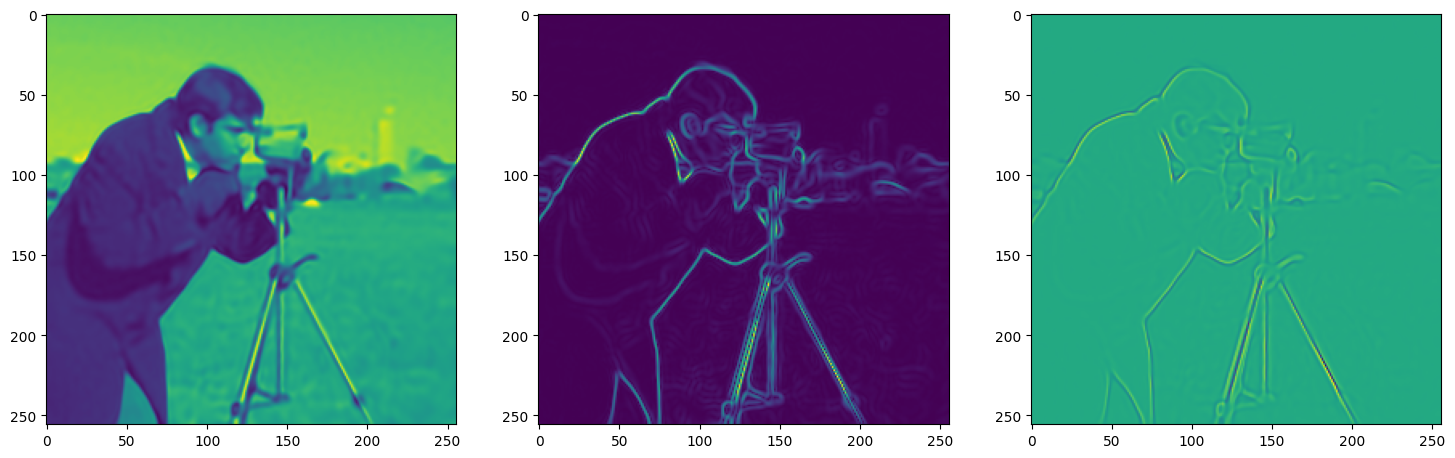
Step 290, Total loss 0.002363
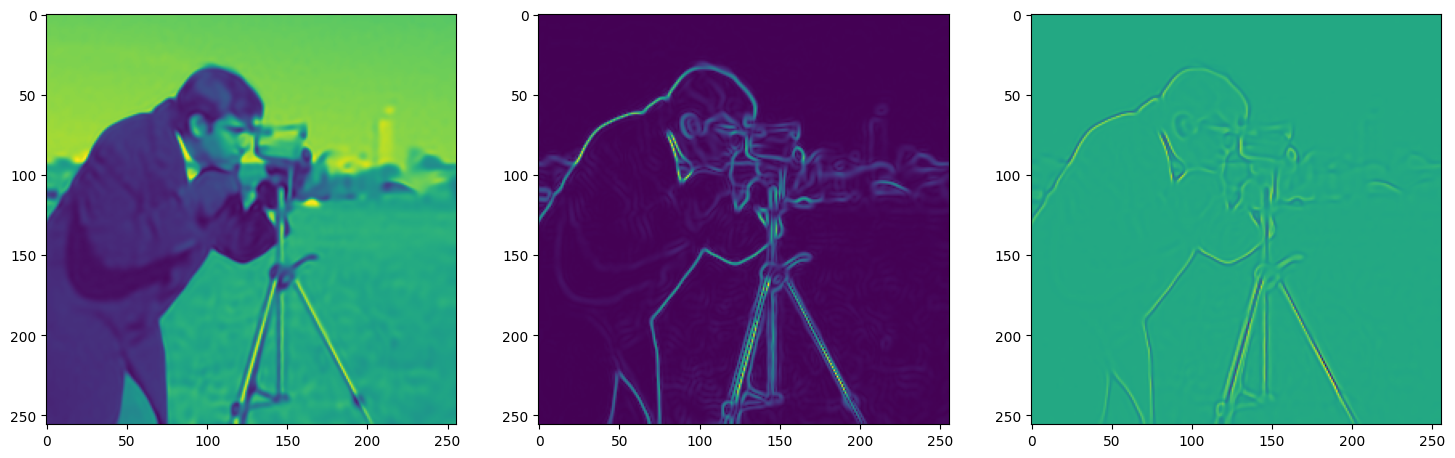
Step 300, Total loss 0.002219
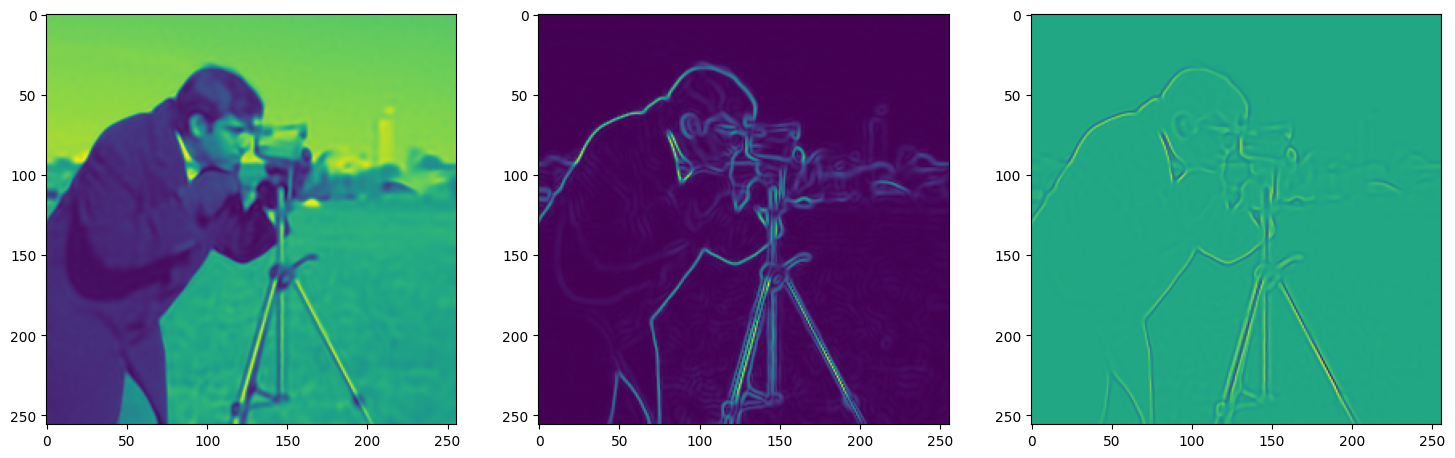
Step 310, Total loss 0.002100
Step 320, Total loss 0.001995
Step 330, Total loss 0.001902
Step 340, Total loss 0.001819
Step 350, Total loss 0.001745
Step 360, Total loss 0.001677
Step 370, Total loss 0.001615
Step 380, Total loss 0.001558
Step 390, Total loss 0.001506
Step 400, Total loss 0.001458
Step 410, Total loss 0.001413
Step 420, Total loss 0.001371
Step 430, Total loss 0.001331
Step 440, Total loss 0.001297
Step 450, Total loss 0.001268
Step 460, Total loss 0.001228
Step 470, Total loss 0.001195
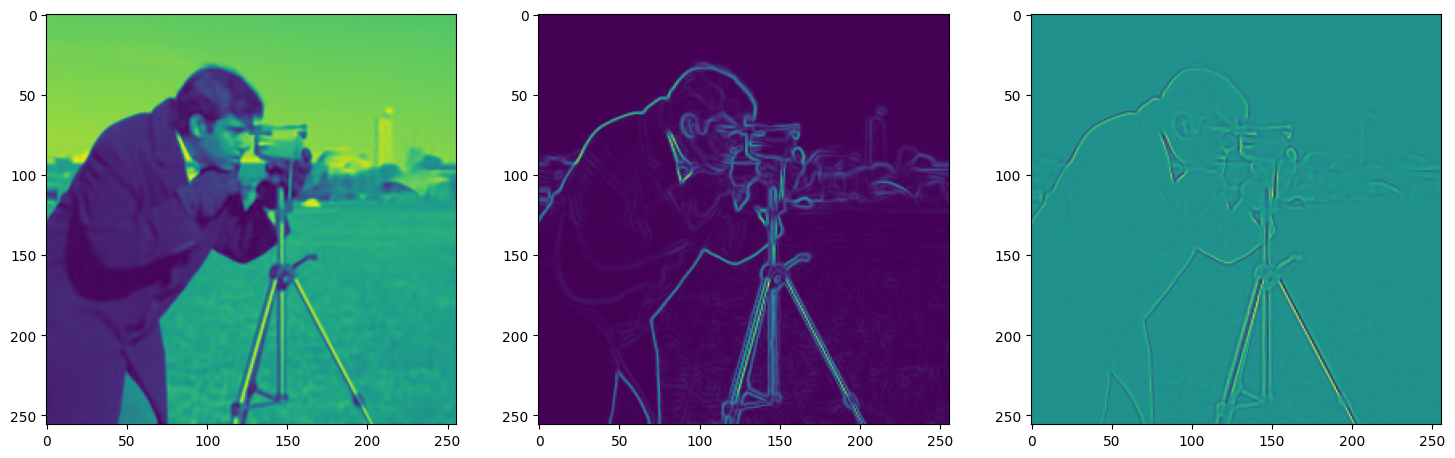
Step 480, Total loss 0.001164
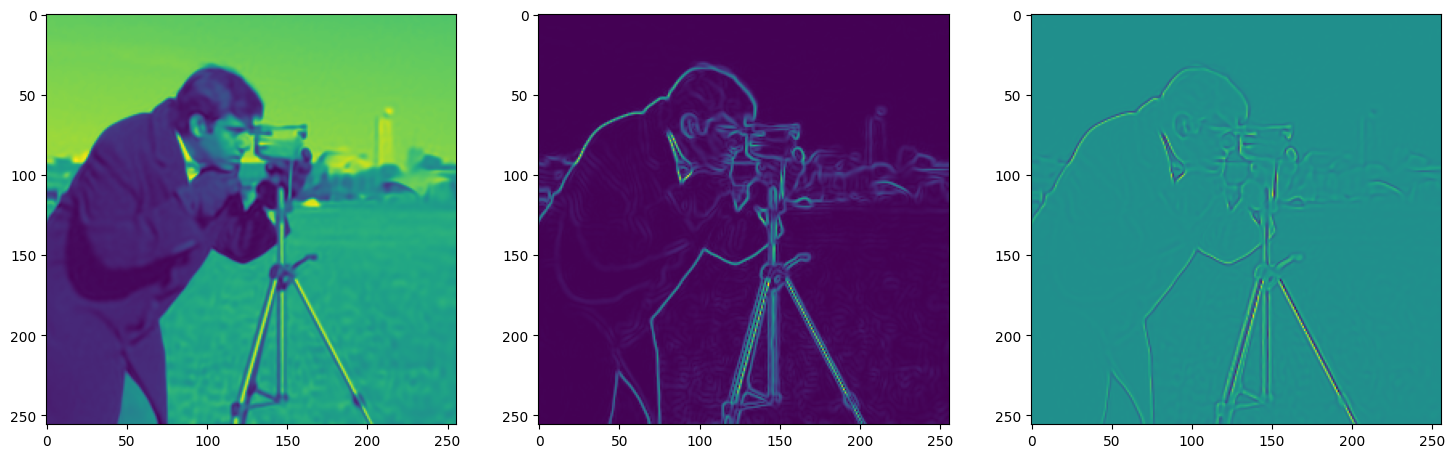
Step 490, Total loss 0.001136
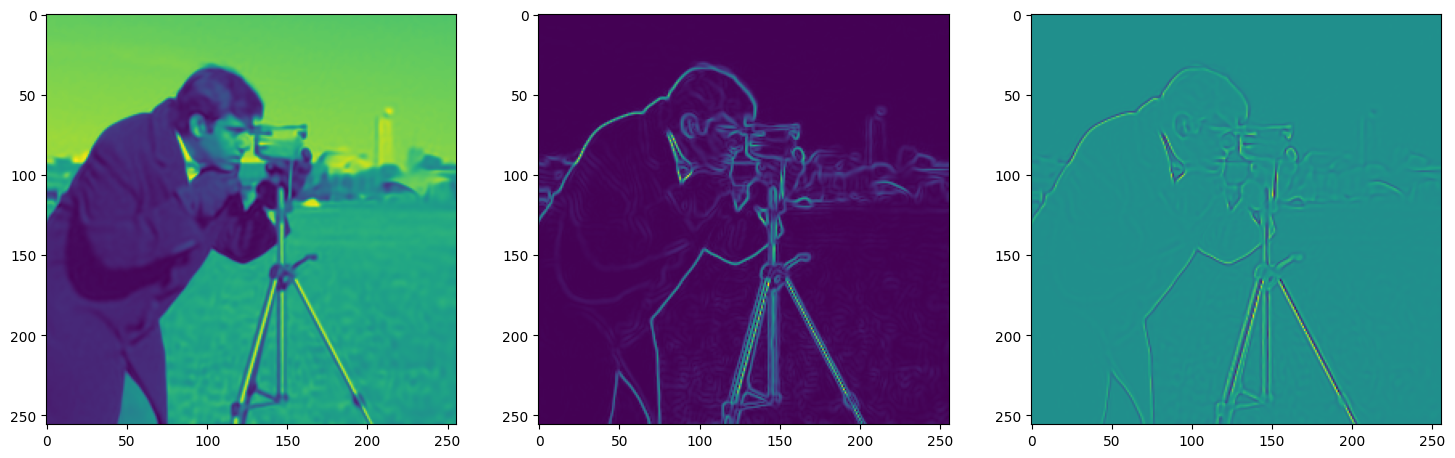
Case study: Siren periodicity & out-of-range behavior#
It is known that the sum of two periodic signals is itself periodic with a period that is equal to the least common multiple of the periods of the two summands, if and only if the two periods are rational multiples of each other. If the ratio of the two periods is irrational, then their sum will not be periodic itself.
Due to the floating-point representation in neural network libraries, this case cannot occur in practice, and all functions parameterized by Siren indeed have to be periodic.
Yet, the period of the resulting function may in practice be several orders of magnitudes larger than the period of each Siren neuron!
Let’s test this with two sines.
with torch.no_grad():
    coords = get_mgrid(210, 1) * 5 * np.pi

    sin_1 = torch.sin(coords)
    sin_2 = torch.sin(coords * 2)
    sum = sin_1 + sin_2

    fig, ax = plt.subplots(figsize=(16,2))
    ax.plot(coords, sum)
    ax.plot(coords, sin_1)
    ax.plot(coords, sin_2)
    plt.title("Rational multiple")
    plt.show()

    sin_1 = torch.sin(coords)
    sin_2 = torch.sin(coords * np.pi)
    sum = sin_1 + sin_2

    fig, ax = plt.subplots(figsize=(16,2))
    ax.plot(coords, sum)
    ax.plot(coords, sin_1)
    ax.plot(coords, sin_2)
    plt.title("Pseudo-irrational multiple")
    plt.show()


Though the second plot looks periodic, closer inspection shows that the period of the blue line is indeed larger than the range we’re sampling here.
Let’s take a look at what the Siren we just trained looks like outside its training domain!
with torch.no_grad():
    out_of_range_coords = get_mgrid(1024, 2) * 50
    model_out, _ = img_siren(out_of_range_coords.cuda())

    fig, ax = plt.subplots(figsize=(16,16))
    ax.imshow(model_out.cpu().view(1024,1024).numpy())
    plt.show()
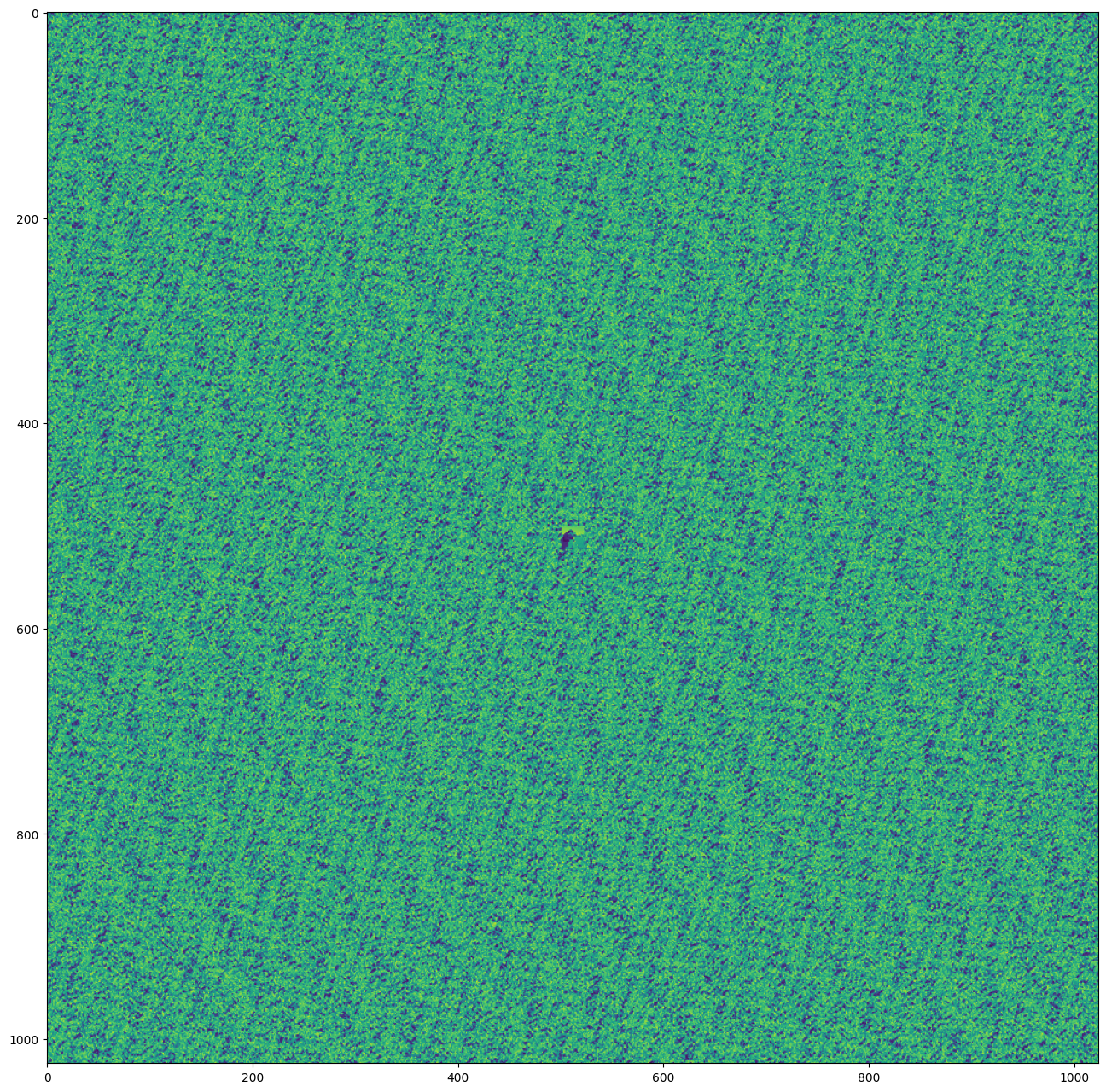
Though there is some self-similarity, the signal is not repeated on this range of (-50, 50).
Fitting an audio signal#
Here, we’ll use Siren to parameterize an audio signal - i.e., we seek to parameterize an audio waverform \(f(t)\) at time points \(t\) by a SIREN \(\Phi\).
That is we seek the function \(\Phi\) such that: \(\mathcal{L}\int_\Omega \lVert \Phi(t) - f(t) \rVert \mathrm{d}t\) is minimized, in which \(\Omega\) is the domain of the waveform.
For the audio, we’ll use the bach sonata:
import scipy.io.wavfile as wavfile
import io
from IPython.display import Audio

if not os.path.exists('gt_bach.wav'):
    !wget https://vsitzmann.github.io/siren/img/audio/gt_bach.wav
--2025-04-20 17:00:51--  https://vsitzmann.github.io/siren/img/audio/gt_bach.wav
Resolving vsitzmann.github.io (vsitzmann.github.io)... 185.199.110.153, 185.199.111.153, 185.199.108.153, ...
Connecting to vsitzmann.github.io (vsitzmann.github.io)|185.199.110.153|:443... connected.
HTTP request sent, awaiting response... 301 Moved Permanently
Location: https://www.vincentsitzmann.com/siren/img/audio/gt_bach.wav [following]
--2025-04-20 17:00:52--  https://www.vincentsitzmann.com/siren/img/audio/gt_bach.wav
Resolving www.vincentsitzmann.com (www.vincentsitzmann.com)... 185.199.108.153, 185.199.110.153, 185.199.109.153, ...
Connecting to www.vincentsitzmann.com (www.vincentsitzmann.com)|185.199.108.153|:443... connected.
HTTP request sent, awaiting response... 200 OK
Length: 1232886 (1.2M) [audio/wav]
Saving to: ‘gt_bach.wav’

gt_bach.wav         100%[===================>]   1.17M  25.5KB/s    in 49s

2025-04-20 17:01:43 (24.7 KB/s) - ‘gt_bach.wav’ saved [1232886/1232886]
Let’s build a little dataset that computes coordinates for audio files:
class AudioFile(torch.utils.data.Dataset):
    def __init__(self, filename):
        self.rate, self.data = wavfile.read(filename)
        self.data = self.data.astype(np.float32)
        self.timepoints = get_mgrid(len(self.data), 1)

    def get_num_samples(self):
        return self.timepoints.shape[0]

    def __len__(self):
        return 1

    def __getitem__(self, idx):
        amplitude = self.data
        scale = np.max(np.abs(amplitude))
        amplitude = (amplitude / scale)
        amplitude = torch.Tensor(amplitude).view(-1, 1)
        return self.timepoints, amplitude
Let’s instantiate the Siren. As this audio signal has a much higer spatial frequency on the range of -1 to 1, we increase the \(\omega_0\) in the first layer of siren.
bach_audio = AudioFile('gt_bach.wav')

dataloader = DataLoader(bach_audio, shuffle=True, batch_size=1, pin_memory=True, num_workers=0)

# Note that we increase the frequency of the first layer to match the higher frequencies of the
# audio signal. Equivalently, we could also increase the range of the input coordinates.
audio_siren = Siren(in_features=1, out_features=1, hidden_features=256,
                    hidden_layers=3, first_omega_0=3000, outermost_linear=True)
audio_siren.cuda()
Siren(
  (net): Sequential(
    (0): SineLayer(
      (linear): Linear(in_features=1, out_features=256, bias=True)
    )
    (1): SineLayer(
      (linear): Linear(in_features=256, out_features=256, bias=True)
    )
    (2): SineLayer(
      (linear): Linear(in_features=256, out_features=256, bias=True)
    )
    (3): SineLayer(
      (linear): Linear(in_features=256, out_features=256, bias=True)
    )
    (4): Linear(in_features=256, out_features=1, bias=True)
  )
)
Let’s have a quick listen to ground truth:
rate, _ = wavfile.read('gt_bach.wav')

model_input, ground_truth = next(iter(dataloader))
Audio(ground_truth.squeeze().numpy(),rate=rate)
We now fit the Siren to this signal.
total_steps = 1000
steps_til_summary = 100

optim = torch.optim.Adam(lr=1e-4, params=audio_siren.parameters())

model_input, ground_truth = next(iter(dataloader))
model_input, ground_truth = model_input.cuda(), ground_truth.cuda()

for step in range(total_steps):
    model_output, coords = audio_siren(model_input)
    loss = F.mse_loss(model_output, ground_truth)

    if not step % steps_til_summary:
        print("Step %d, Total loss %0.6f" % (step, loss))

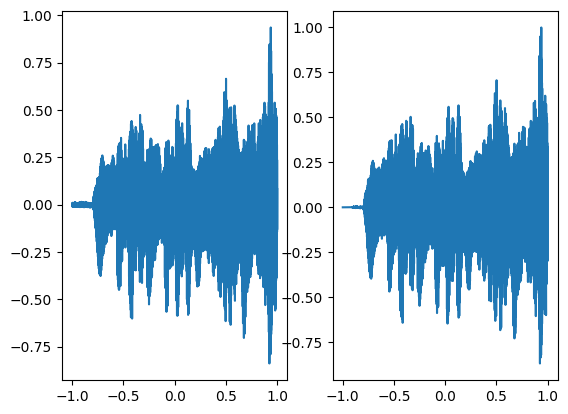
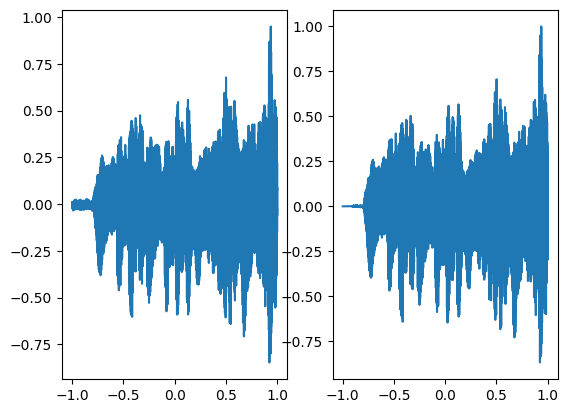
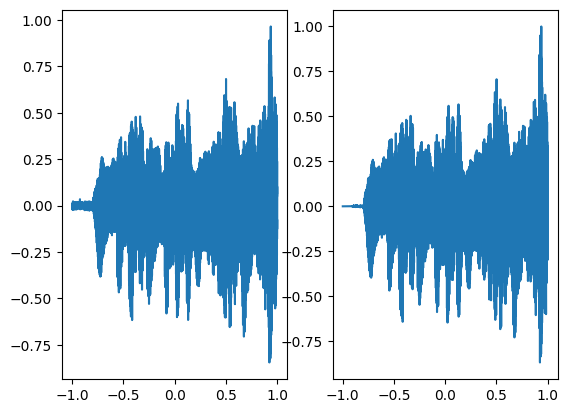
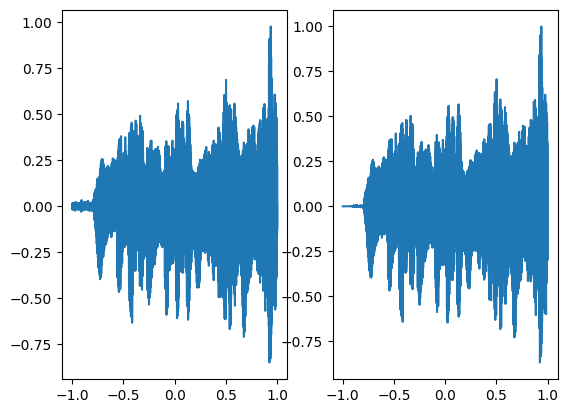
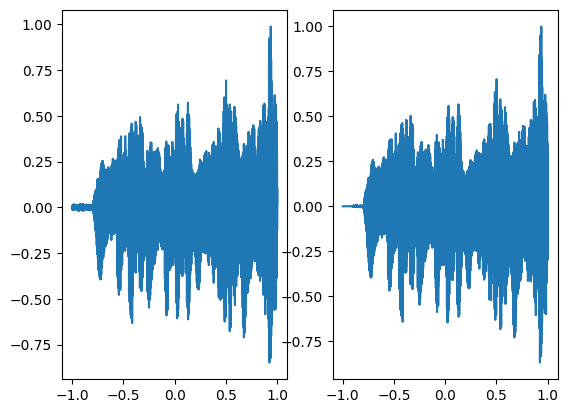
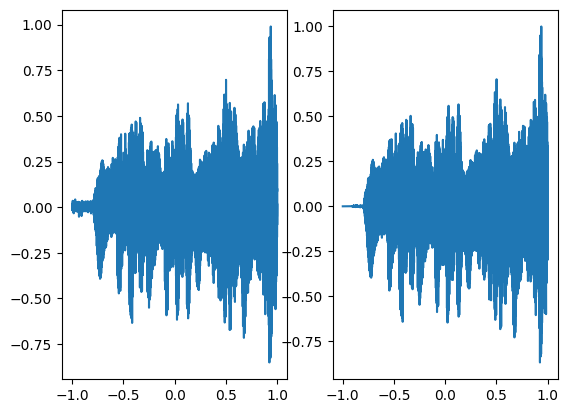
        fig, axes = plt.subplots(1,2)
        axes[0].plot(coords.squeeze().detach().cpu().numpy(),model_output.squeeze().detach().cpu().numpy())
        axes[1].plot(coords.squeeze().detach().cpu().numpy(),ground_truth.squeeze().detach().cpu().numpy())
        plt.show()

    optim.zero_grad()
    loss.backward()
    optim.step()
Step 0, Total loss 0.025330
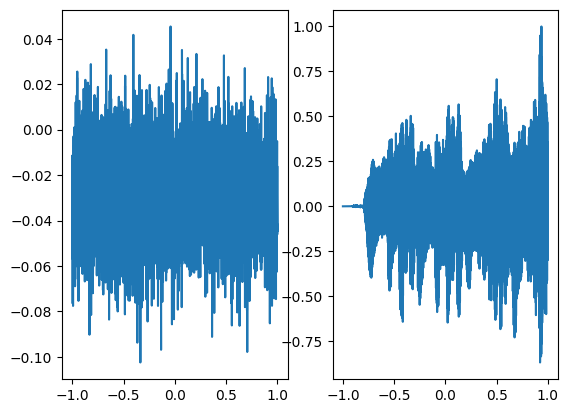
Step 100, Total loss 0.003217
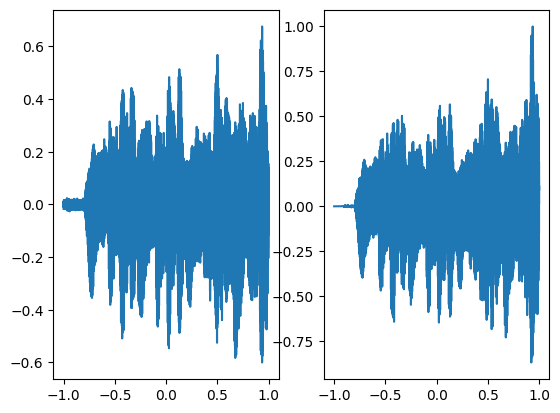
Step 200, Total loss 0.001231
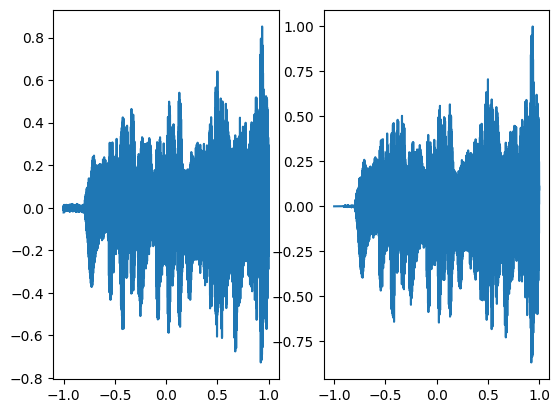
Step 300, Total loss 0.001289
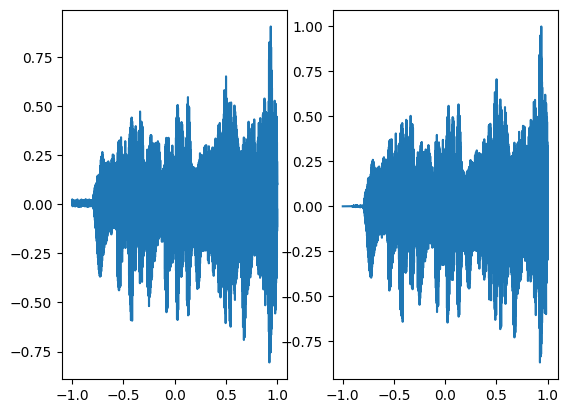
Step 400, Total loss 0.000717
Step 500, Total loss 0.000654
Step 600, Total loss 0.000469
Step 700, Total loss 0.000492
Step 800, Total loss 0.000264
Step 900, Total loss 0.000193
final_model_output, coords = audio_siren(model_input)
Audio(final_model_output.cpu().detach().squeeze().numpy(),rate=rate)
As we can see, within few iterations, Siren has approximated the audio signal very well!
Solving Poisson’s equation#
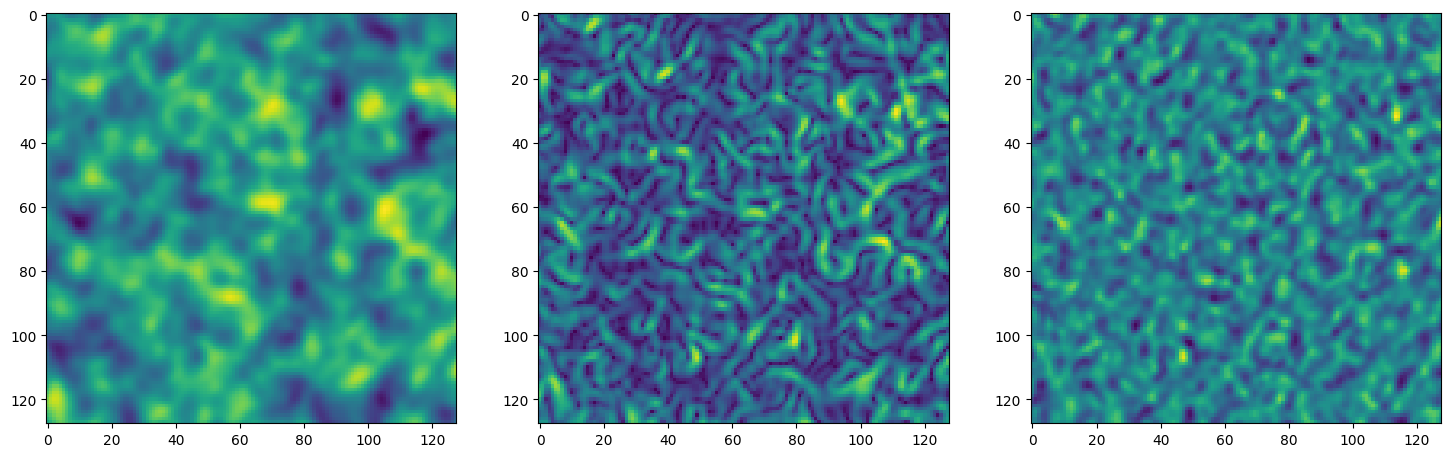
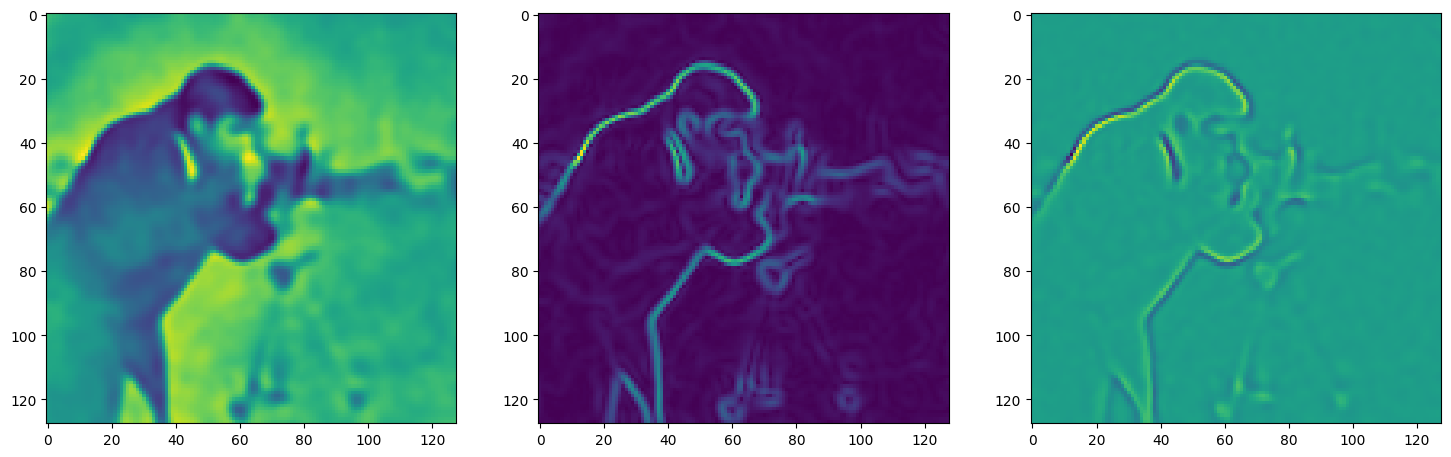
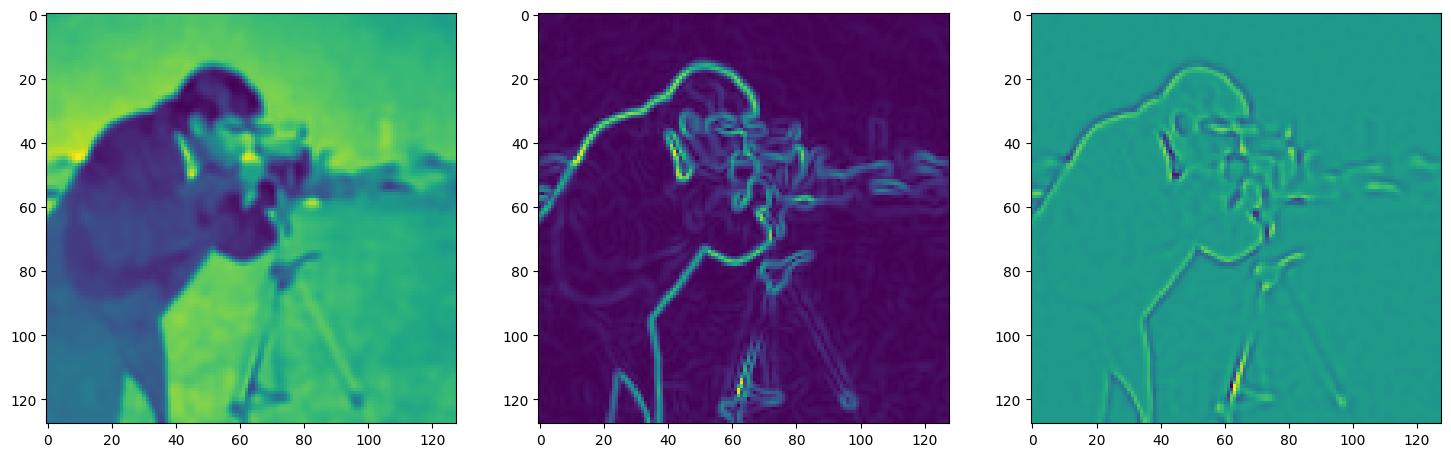
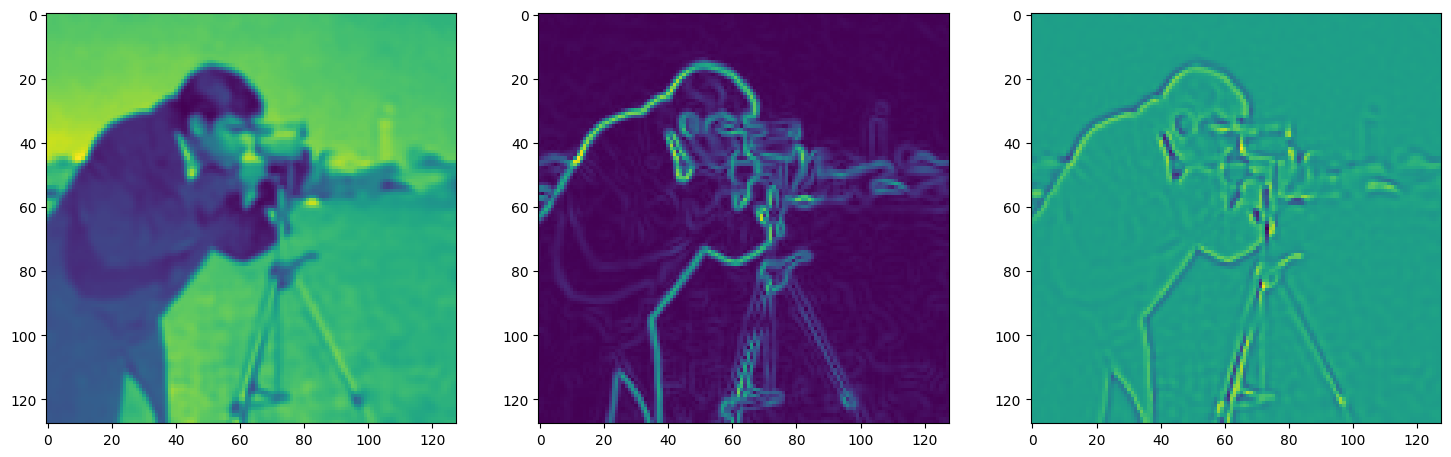
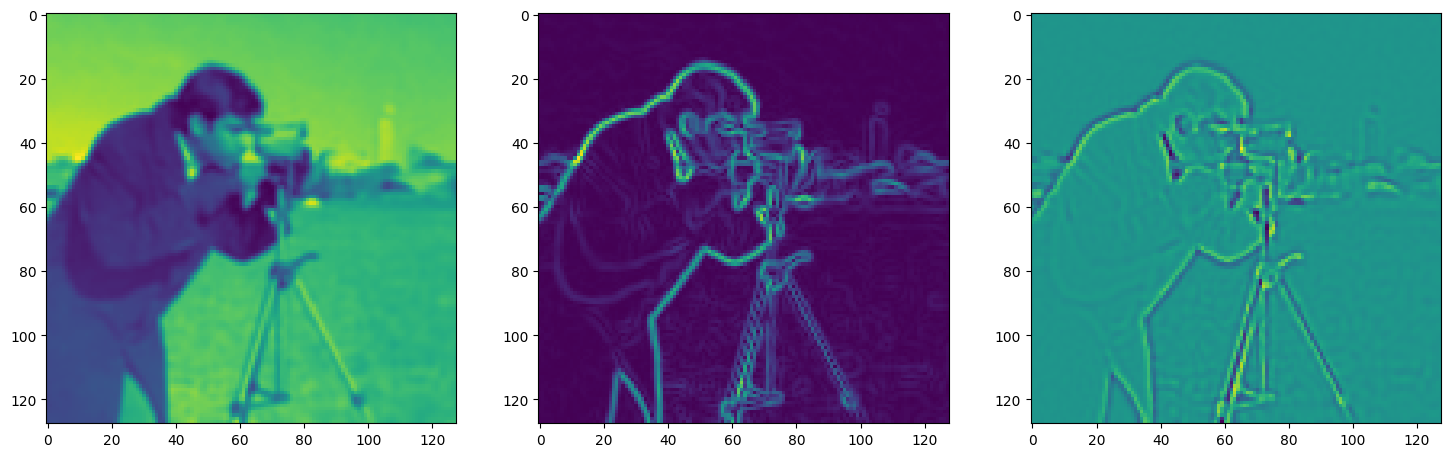
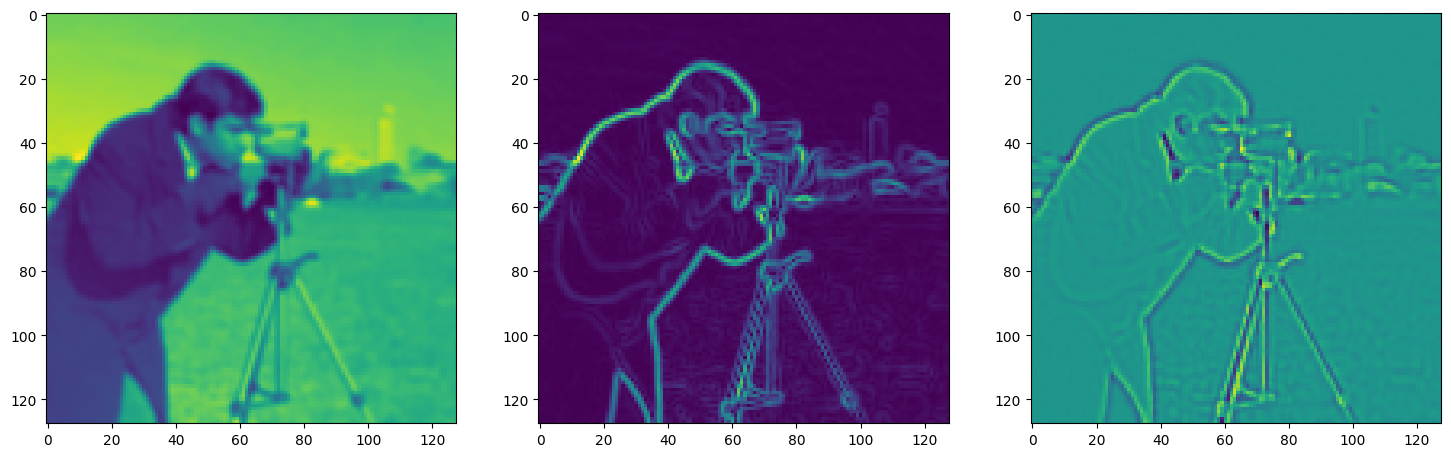
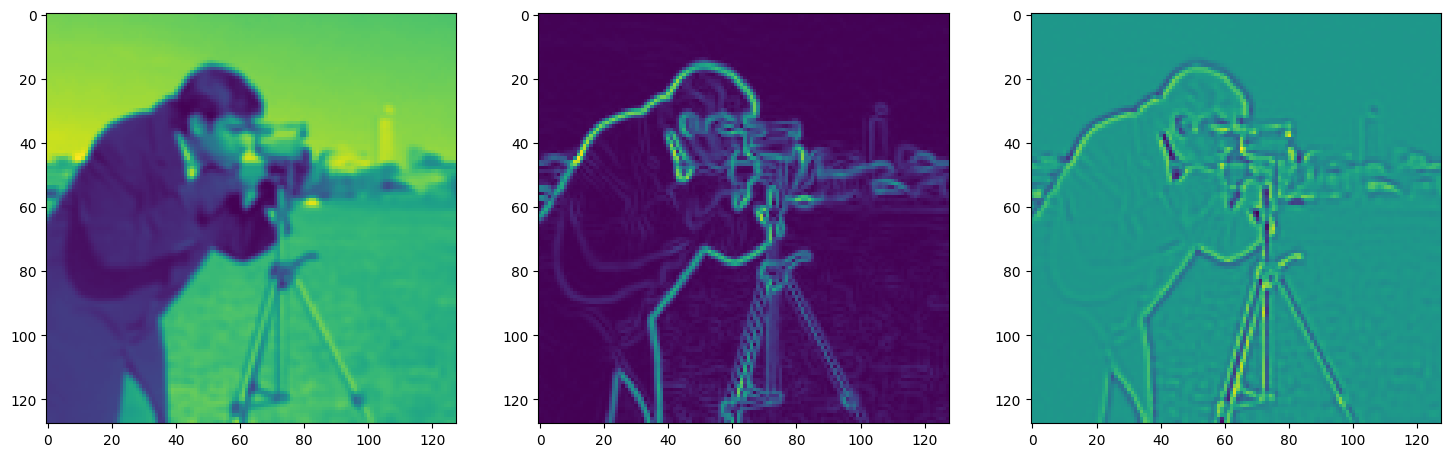
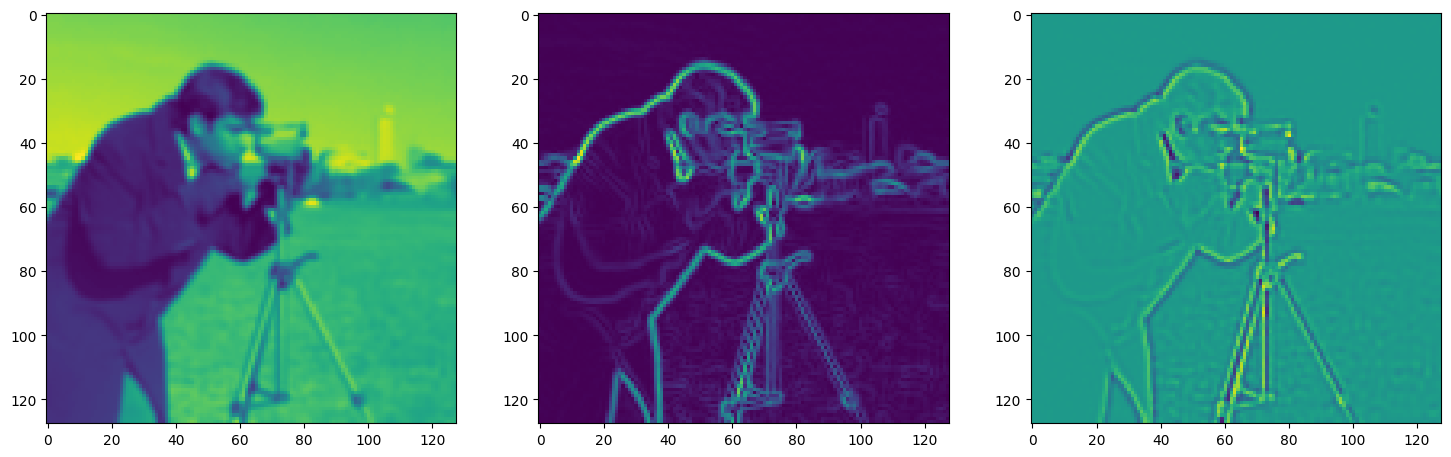
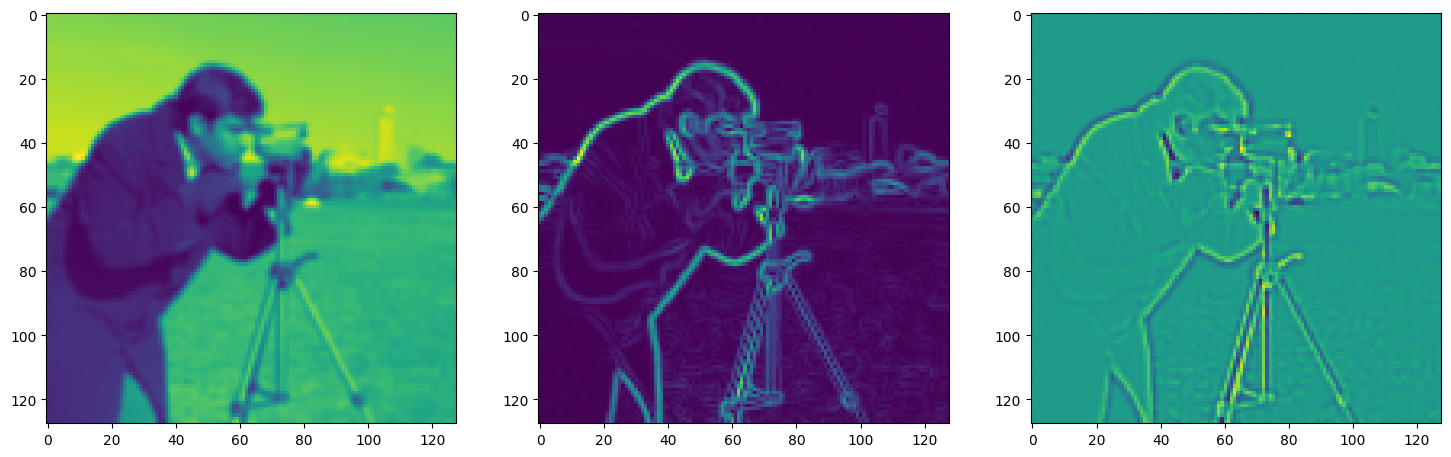
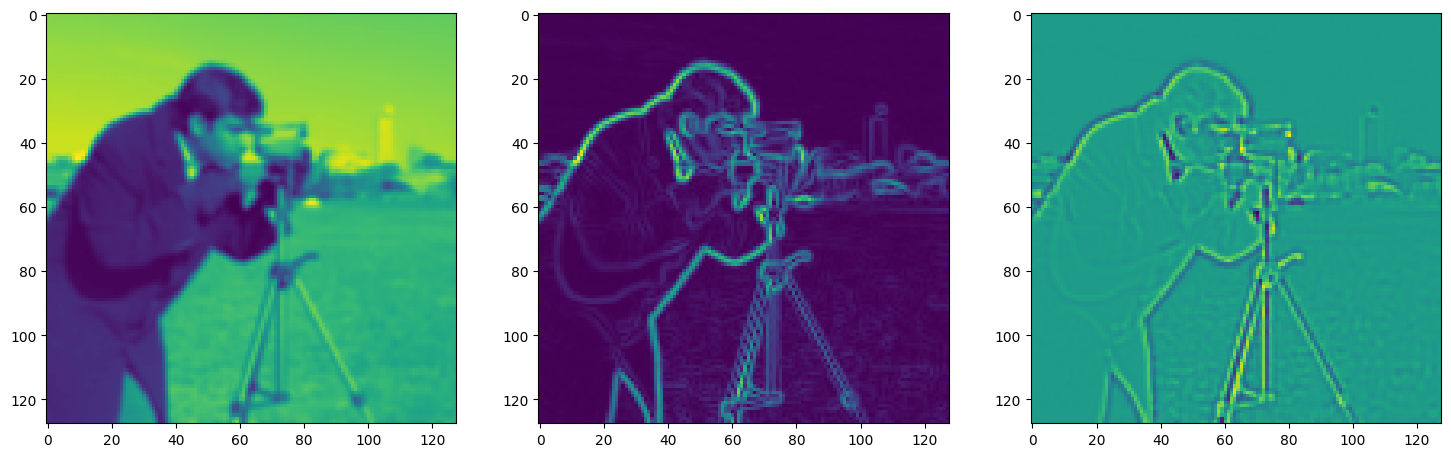
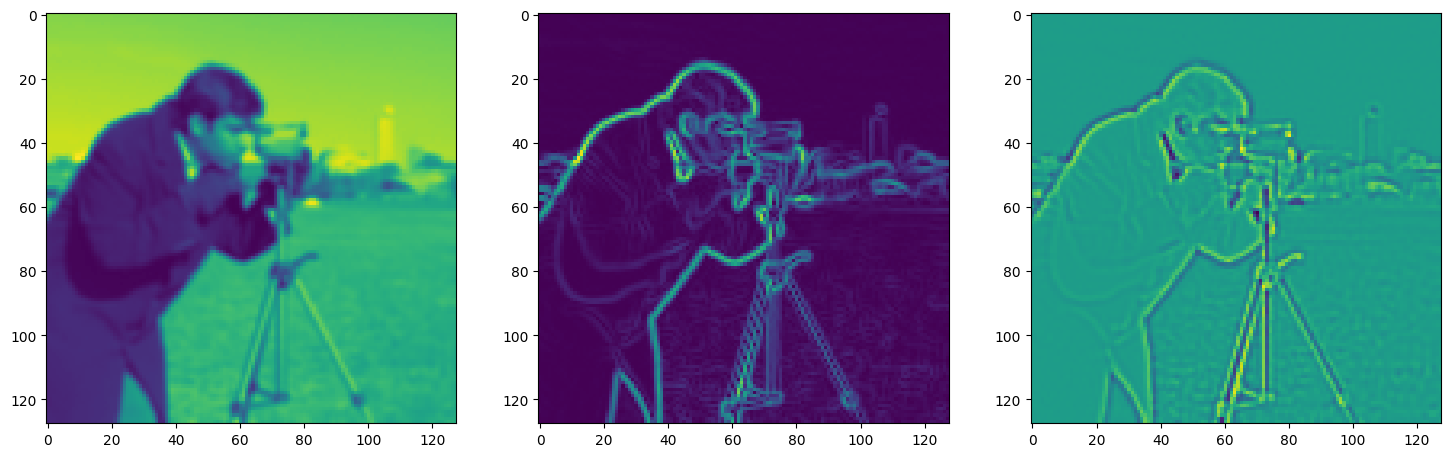
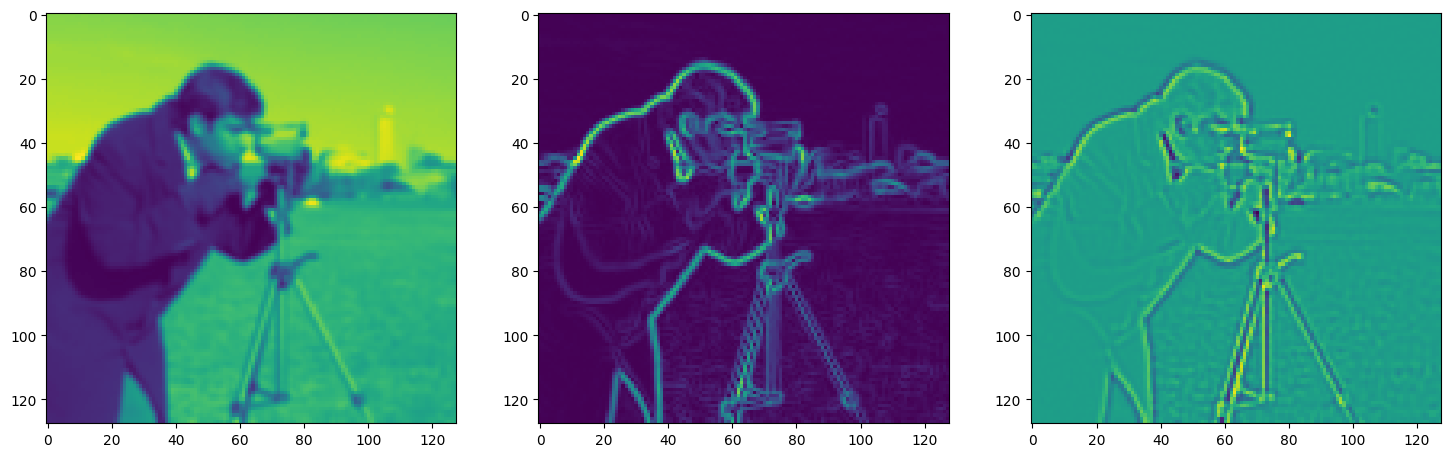
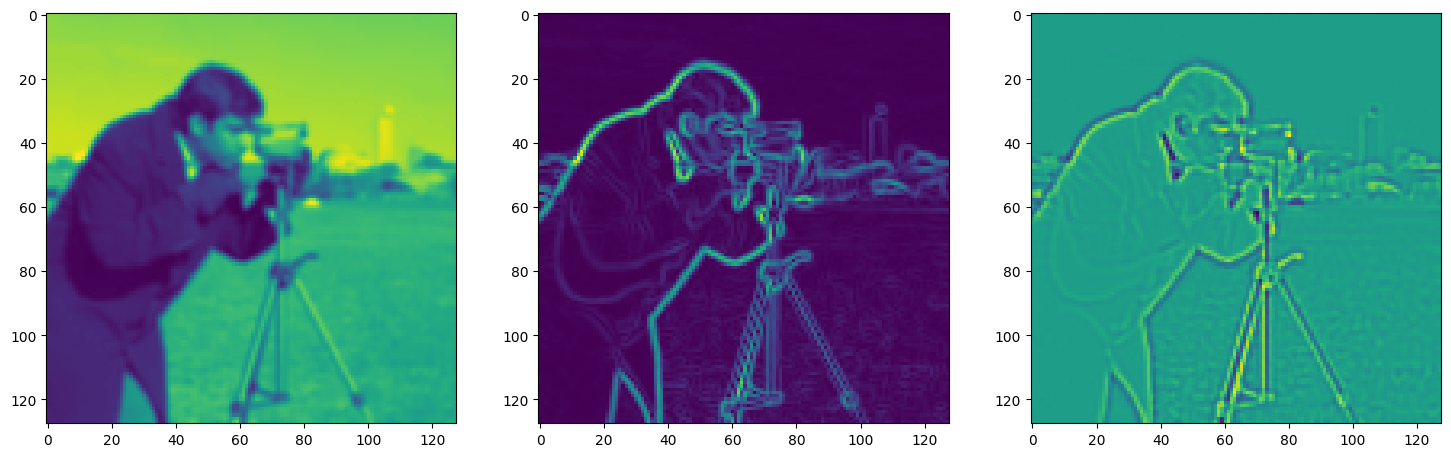
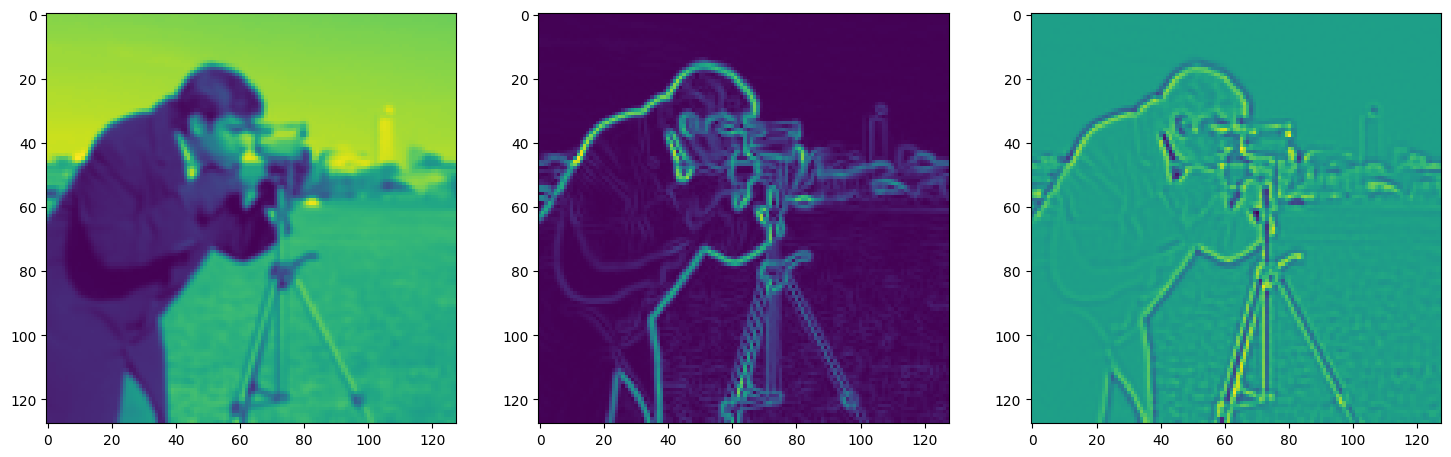
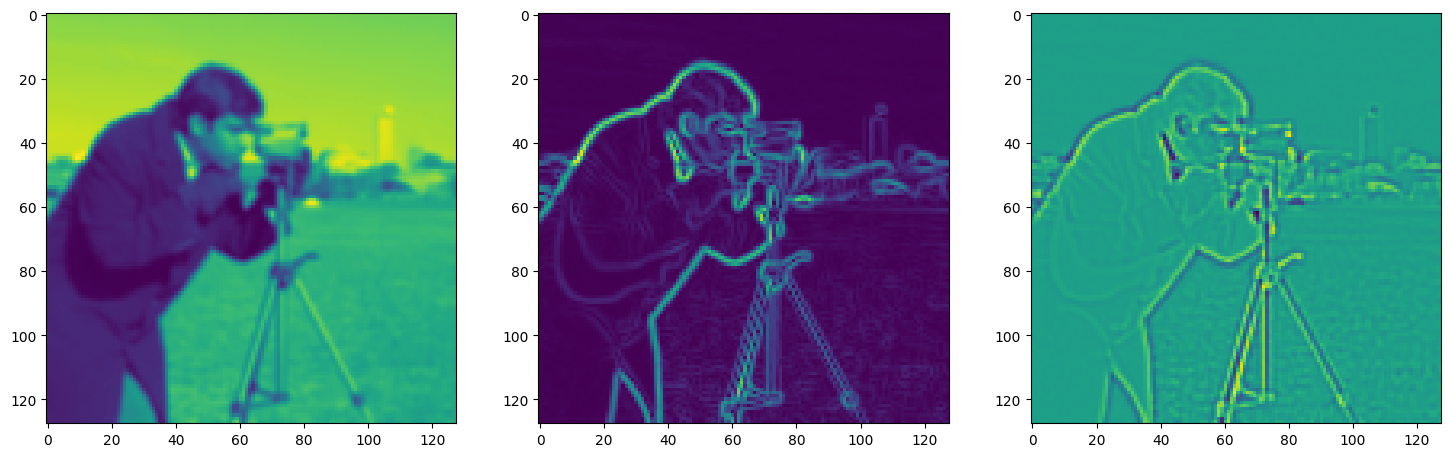
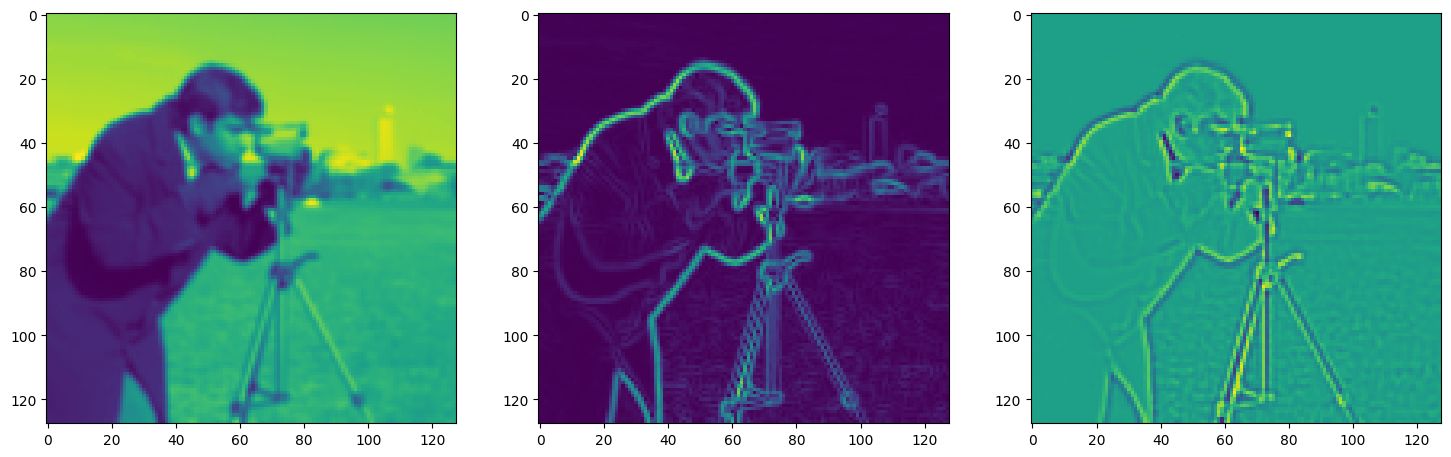
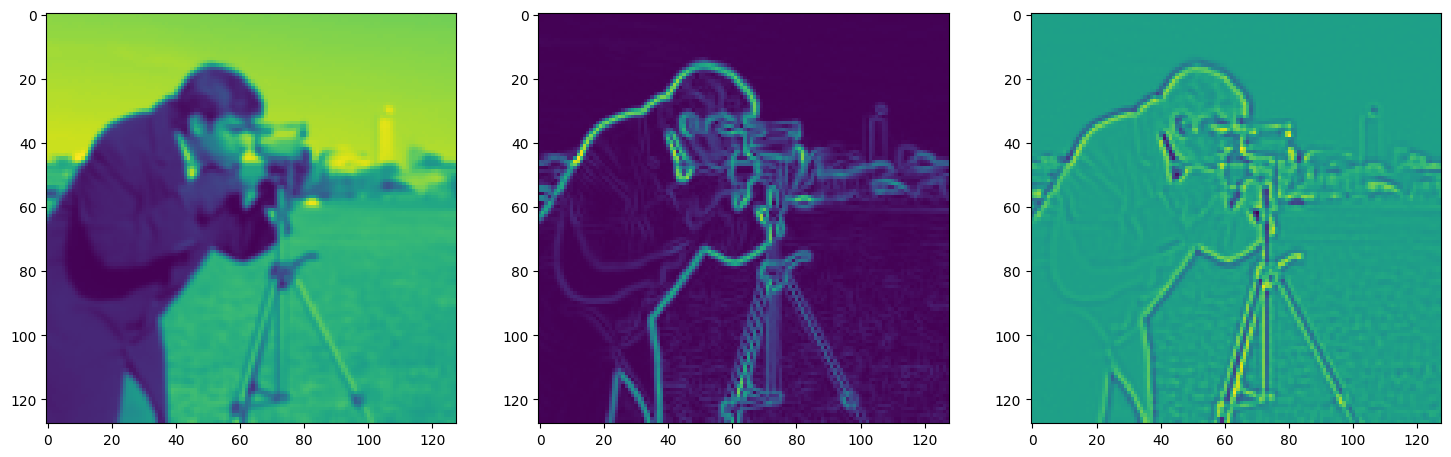
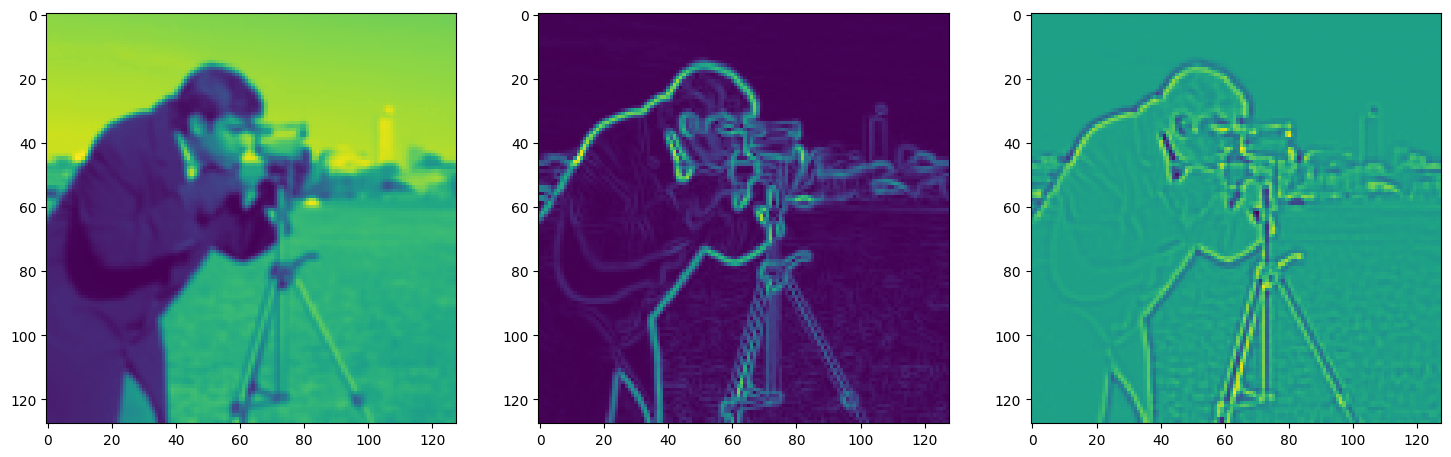
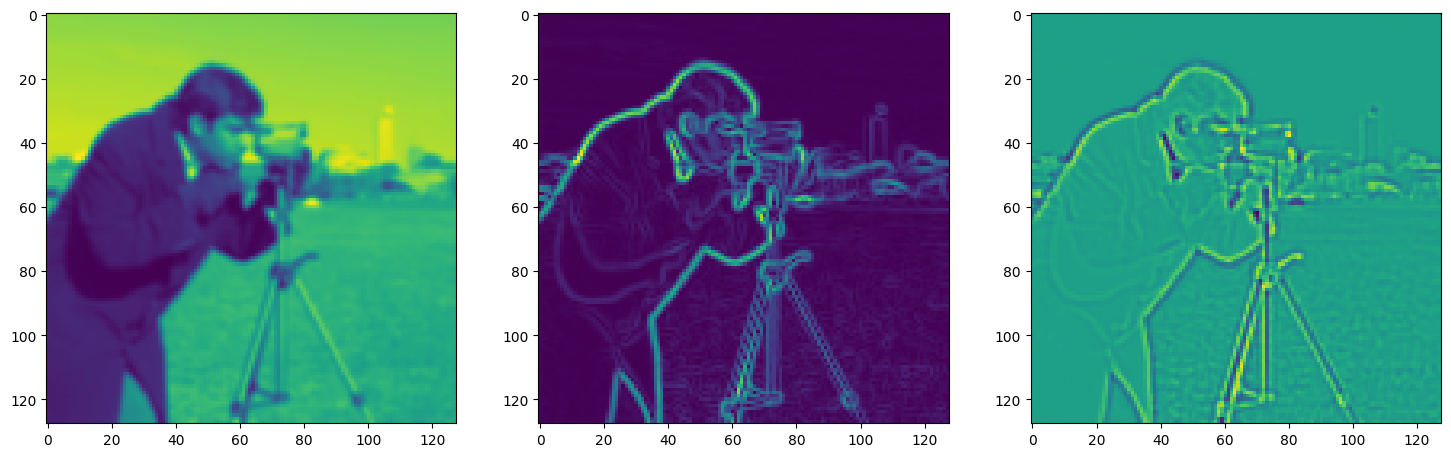
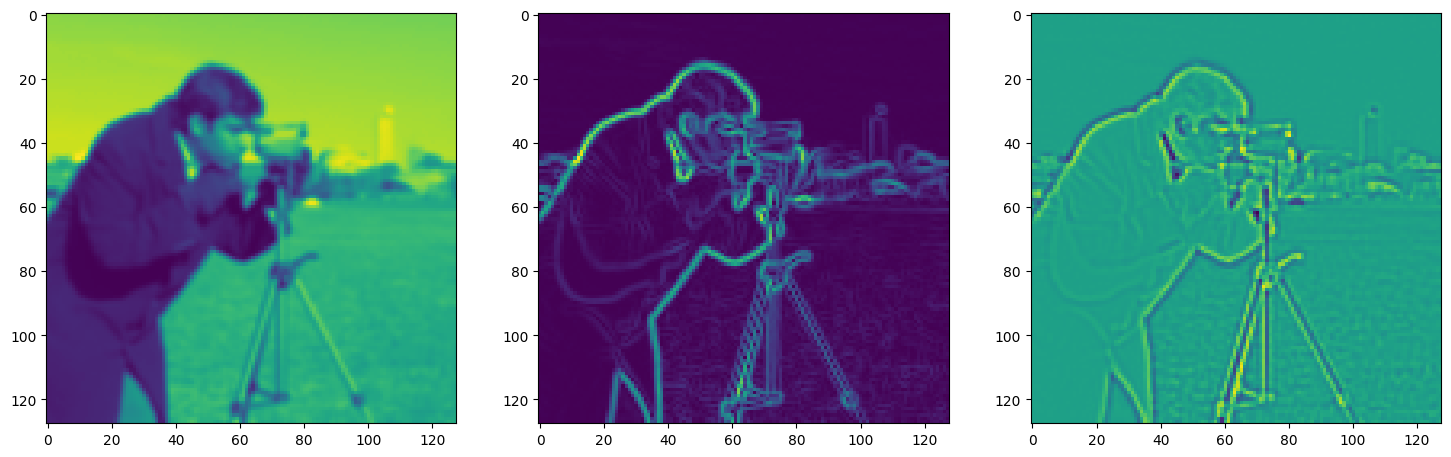
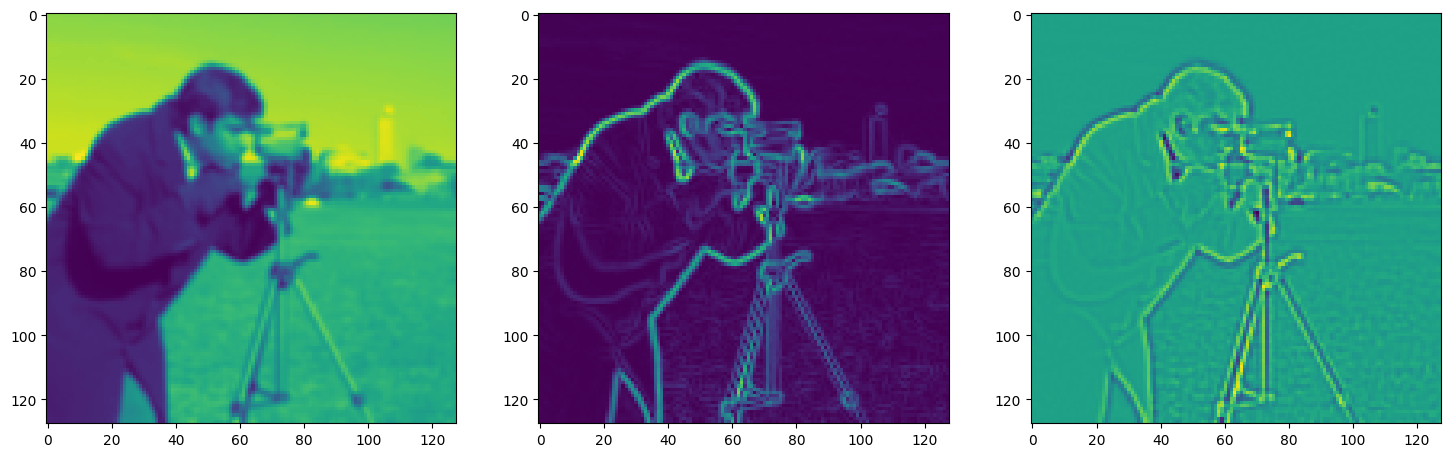
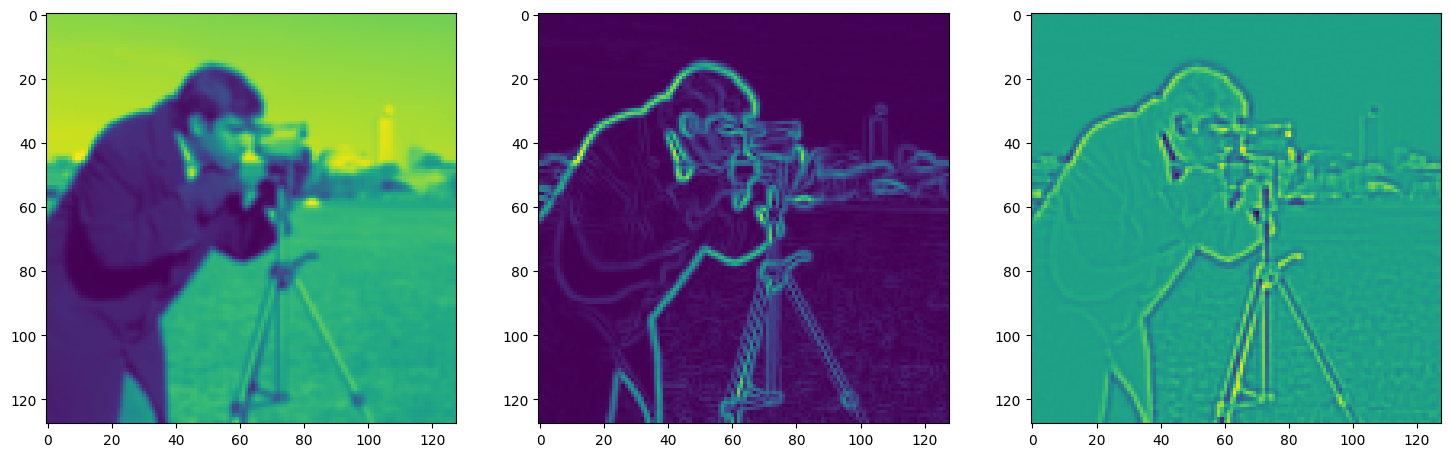
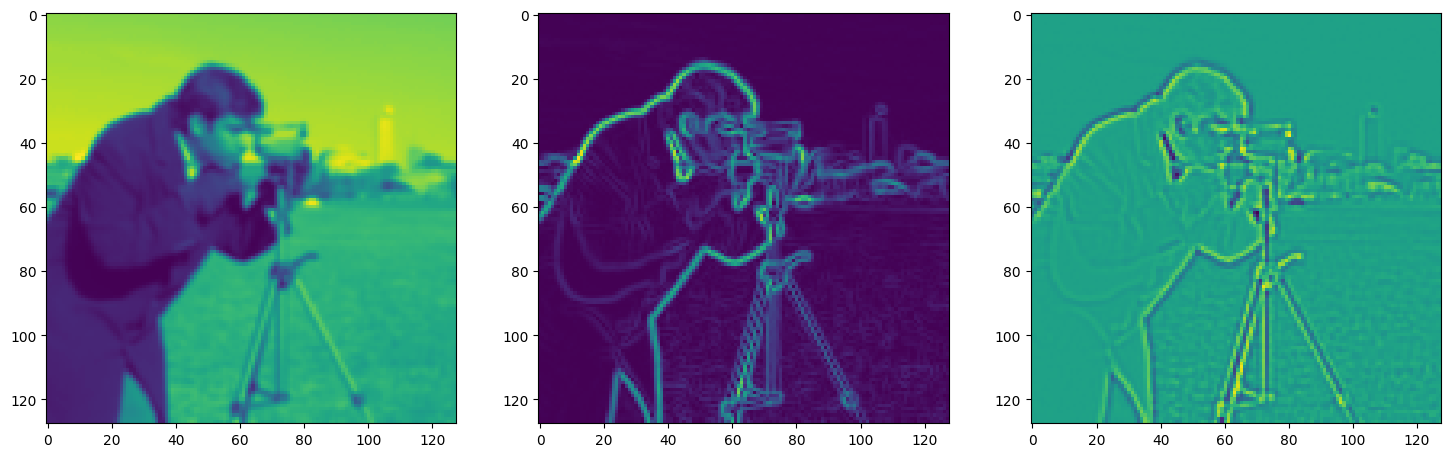
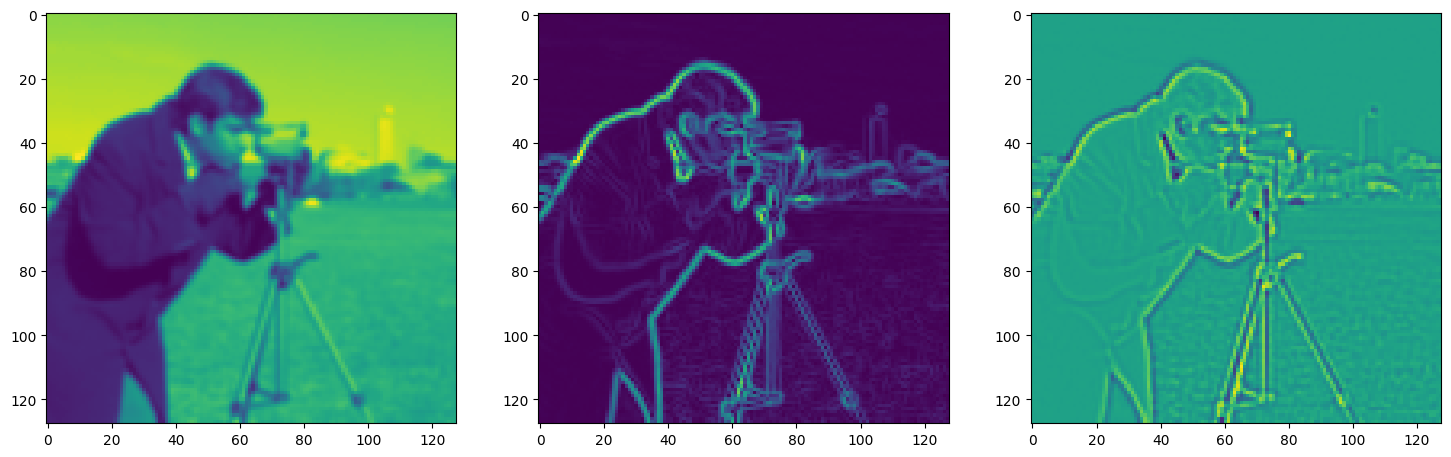
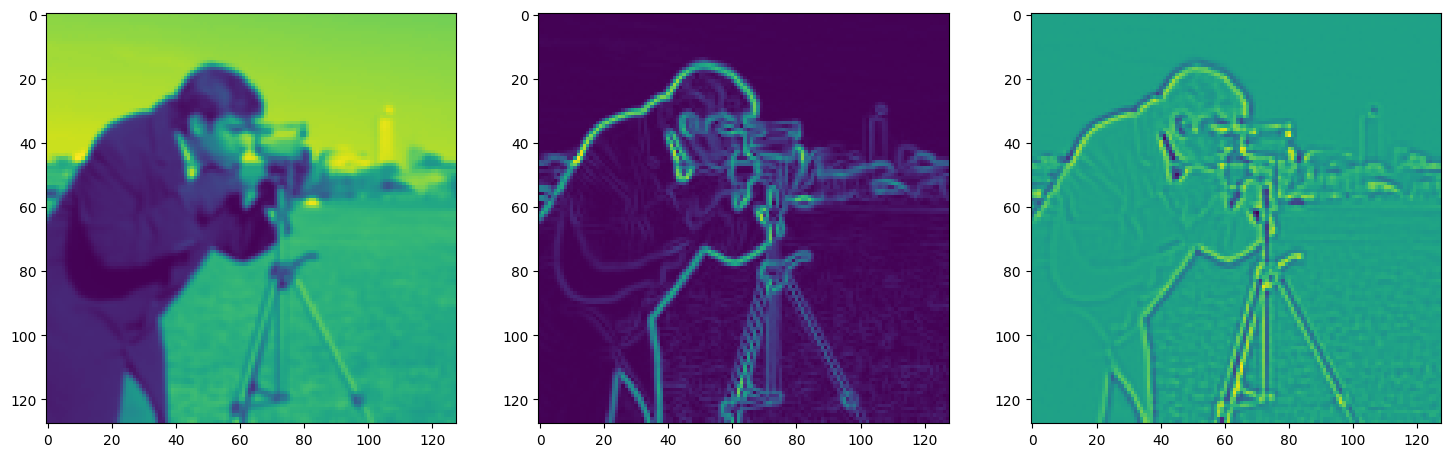
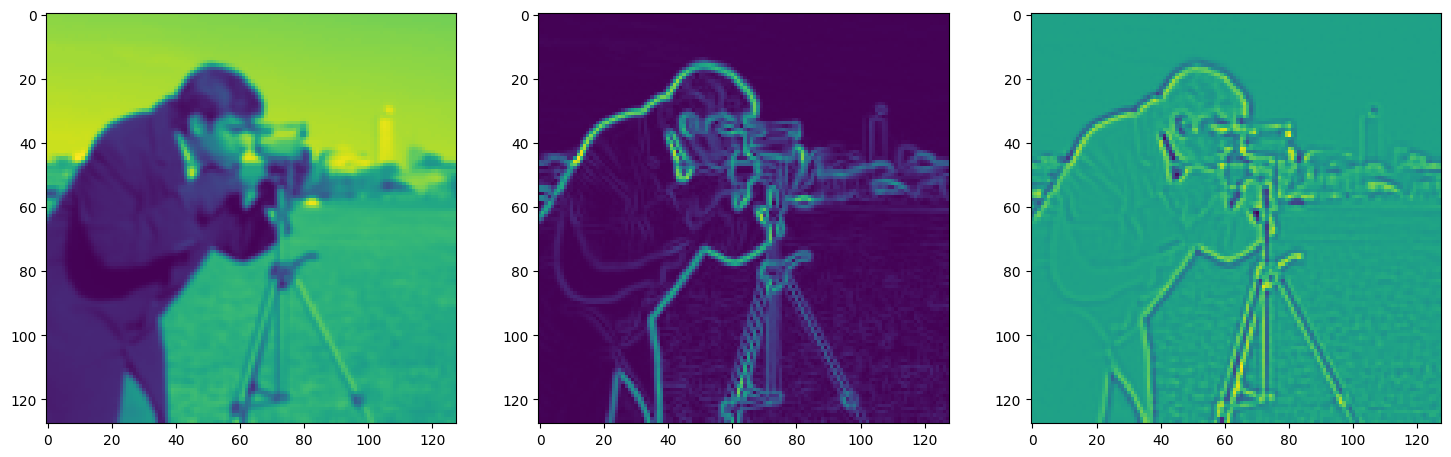
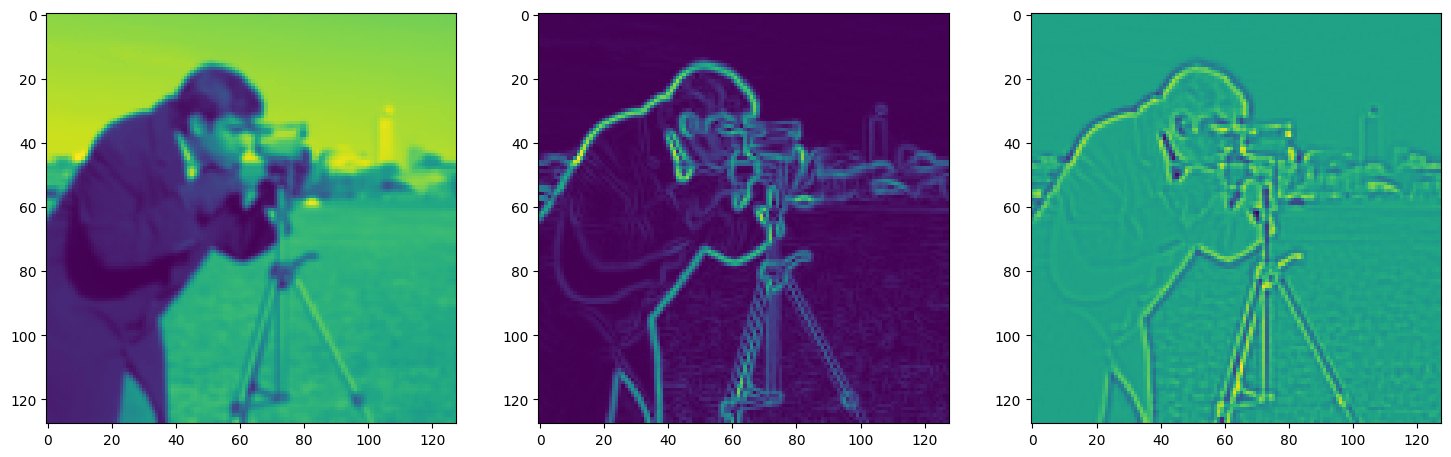
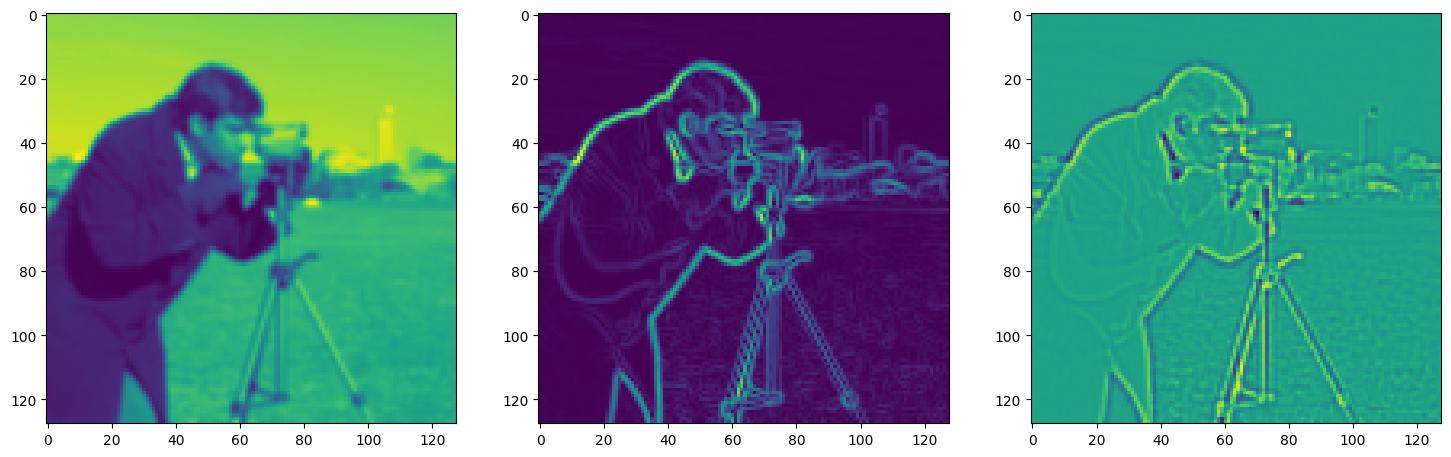
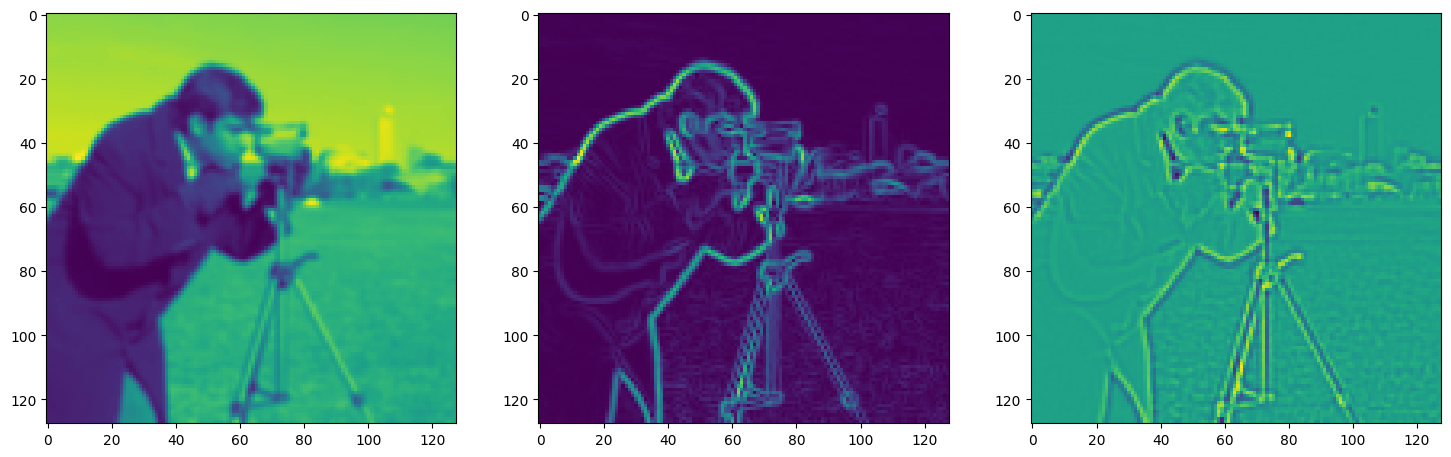
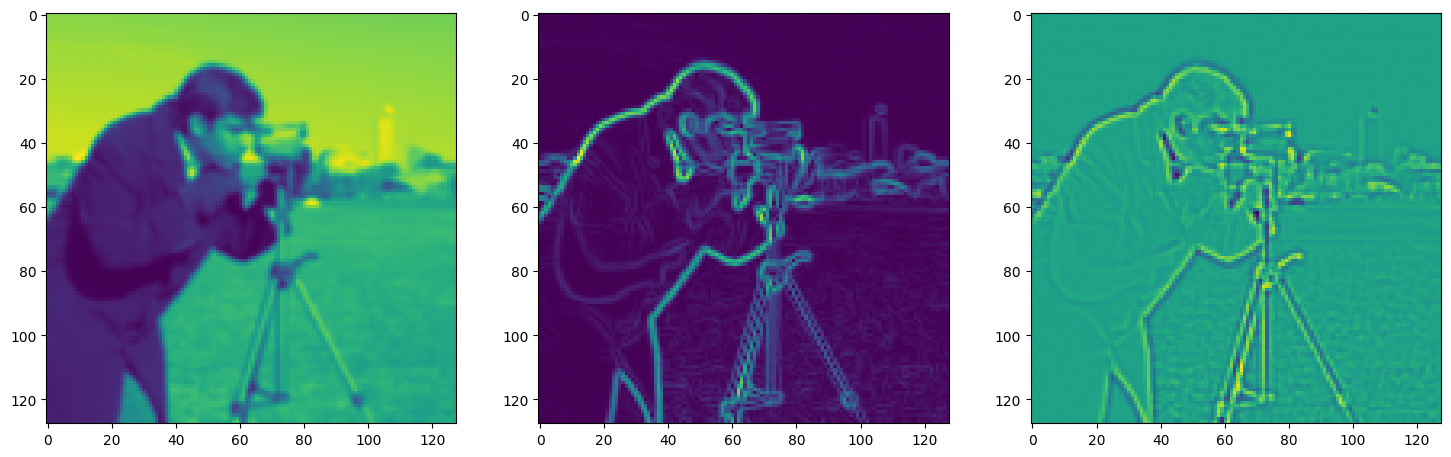
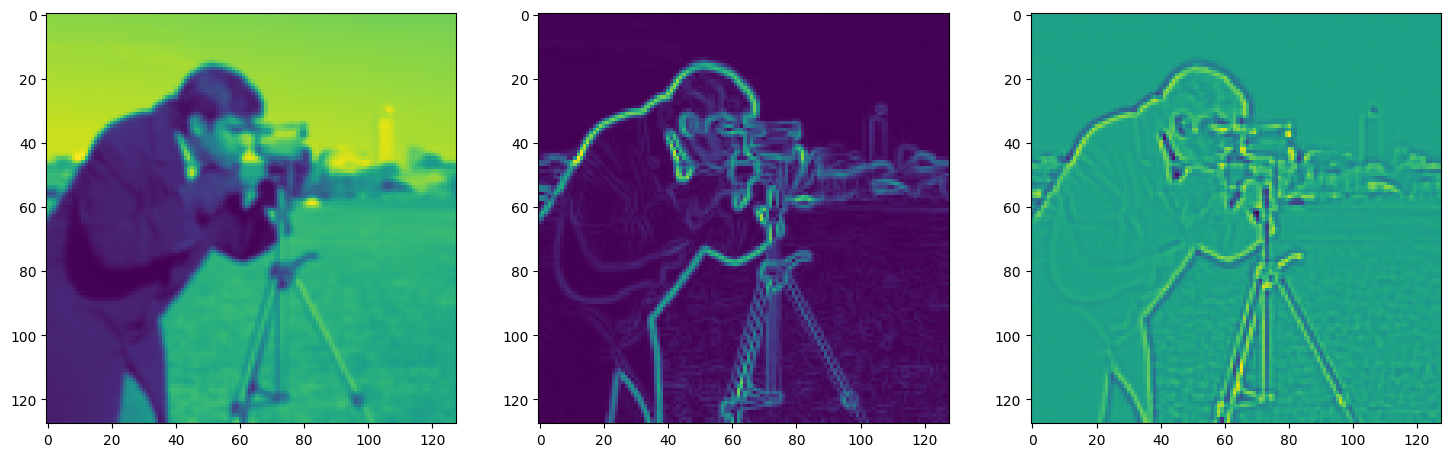
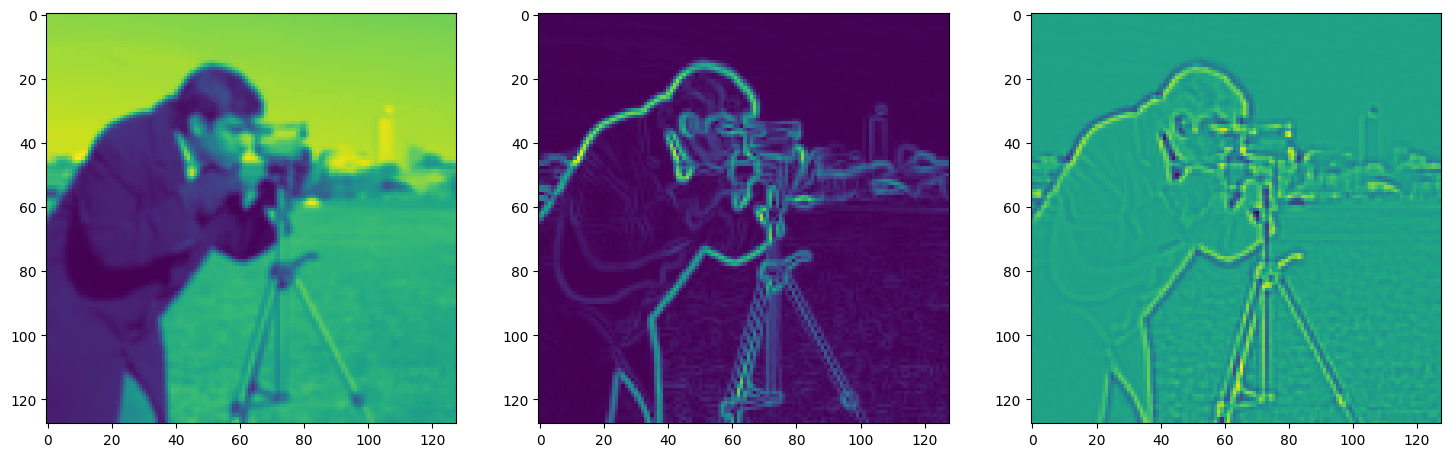
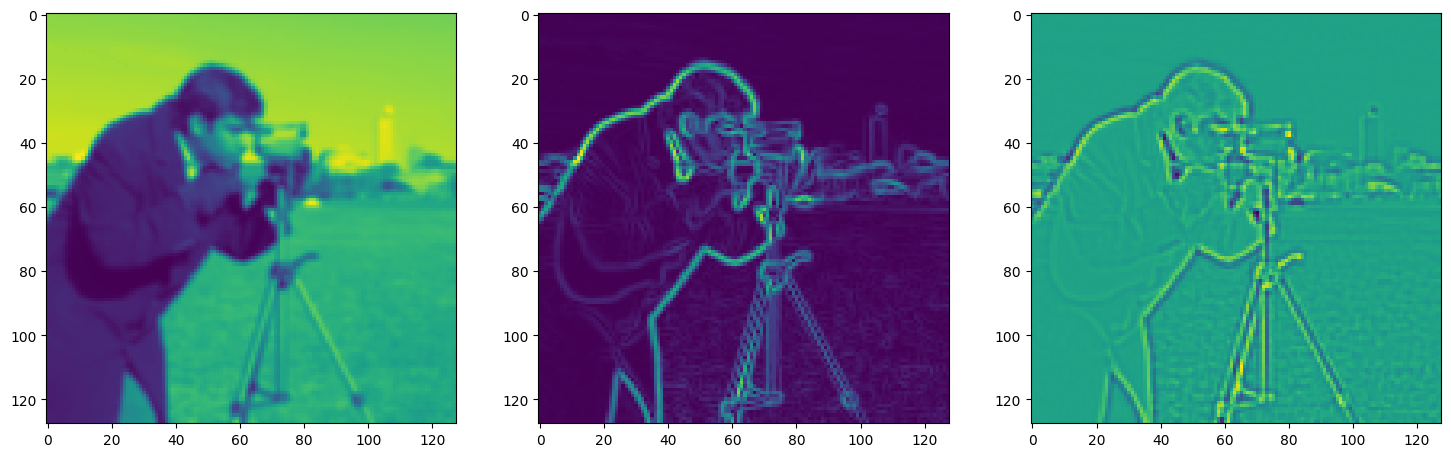
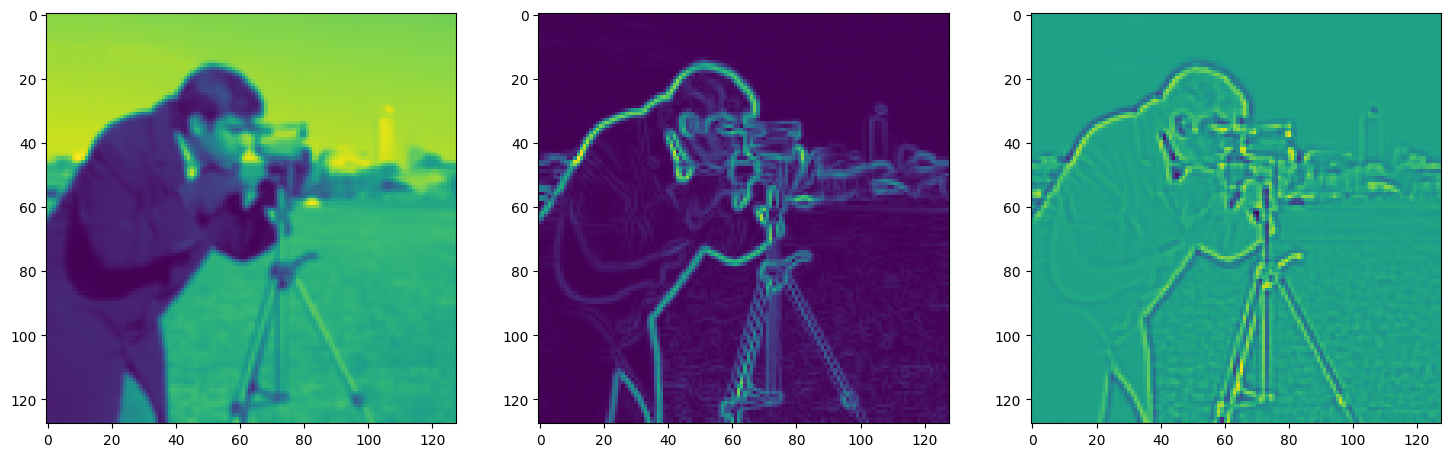
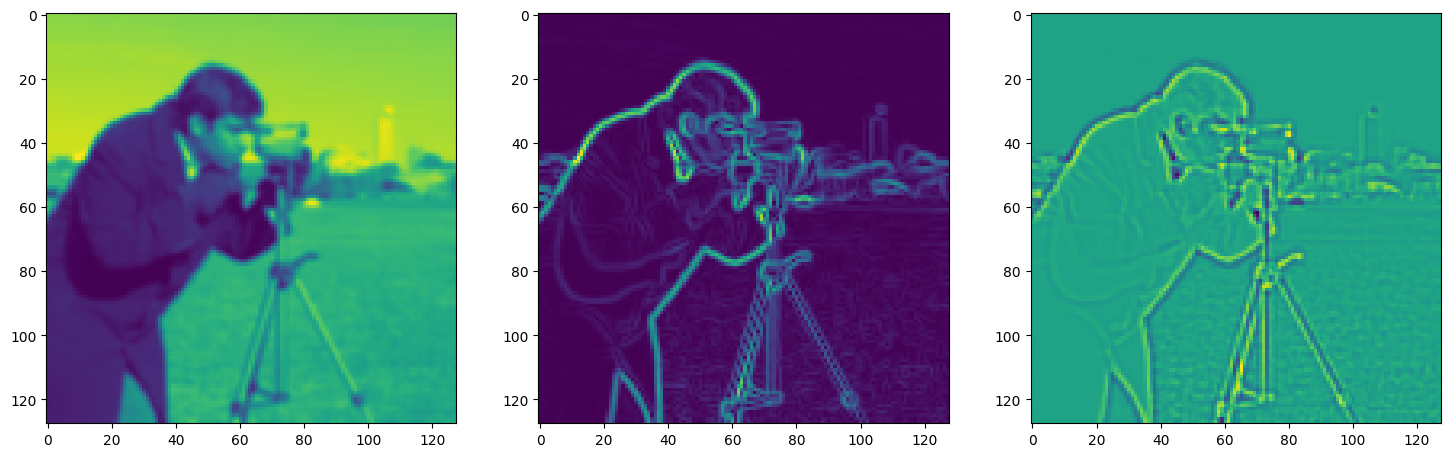
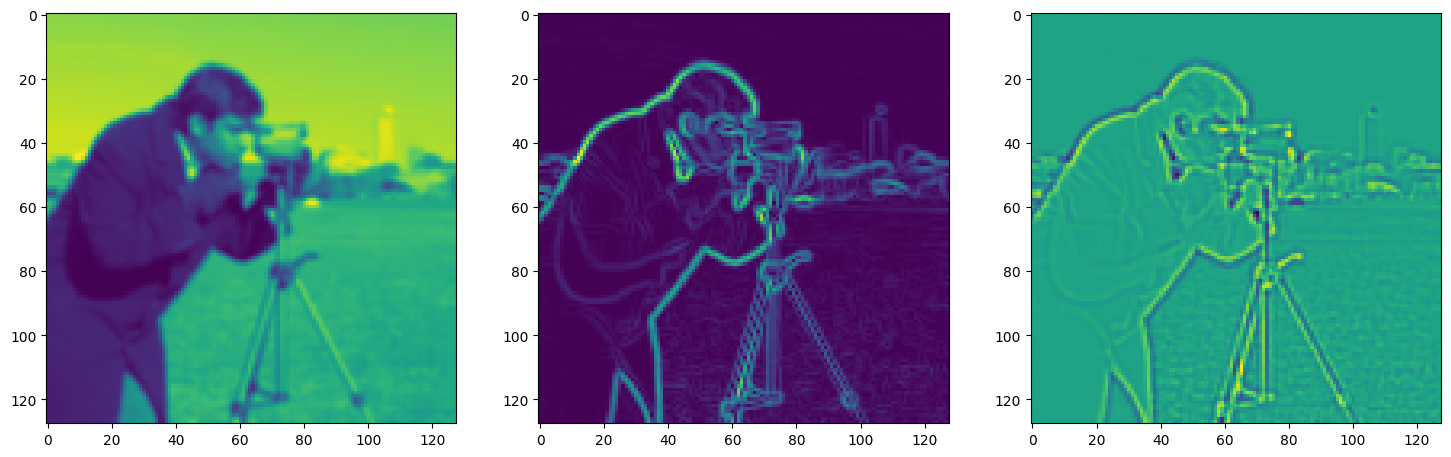
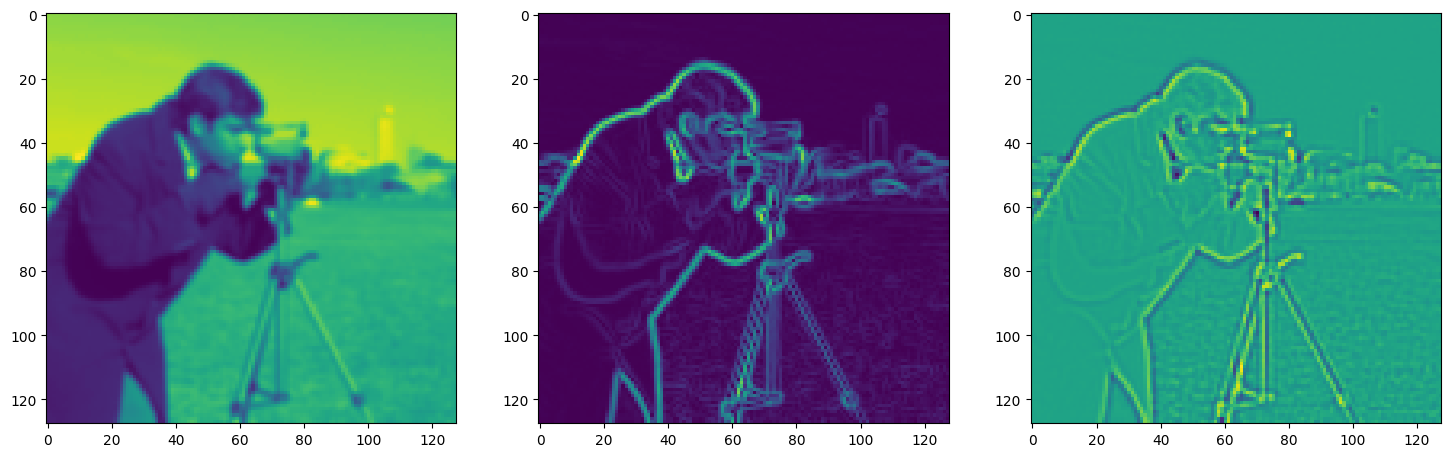
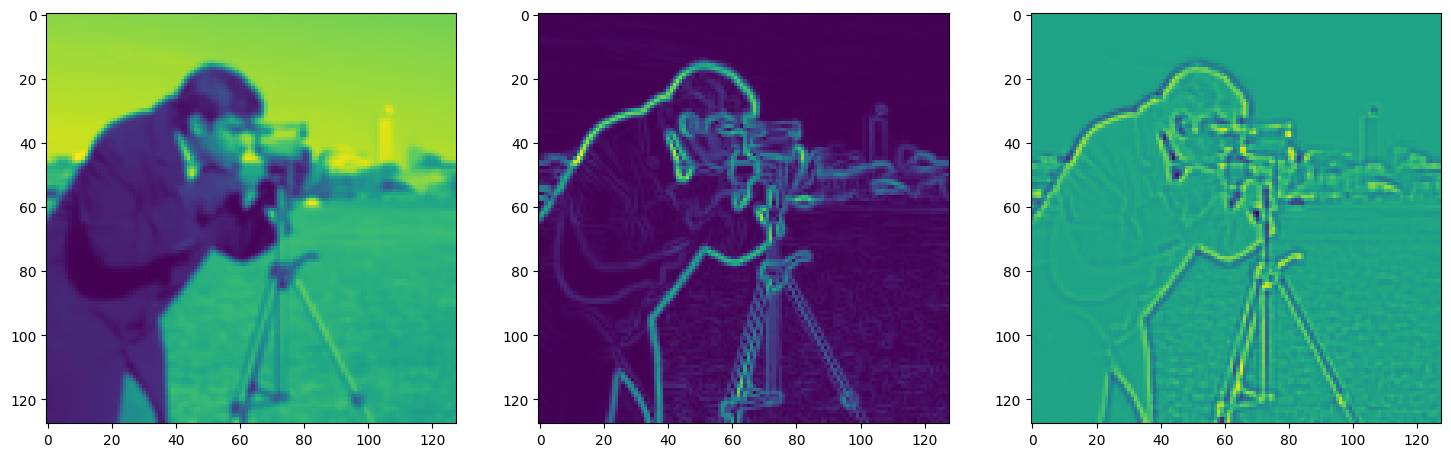
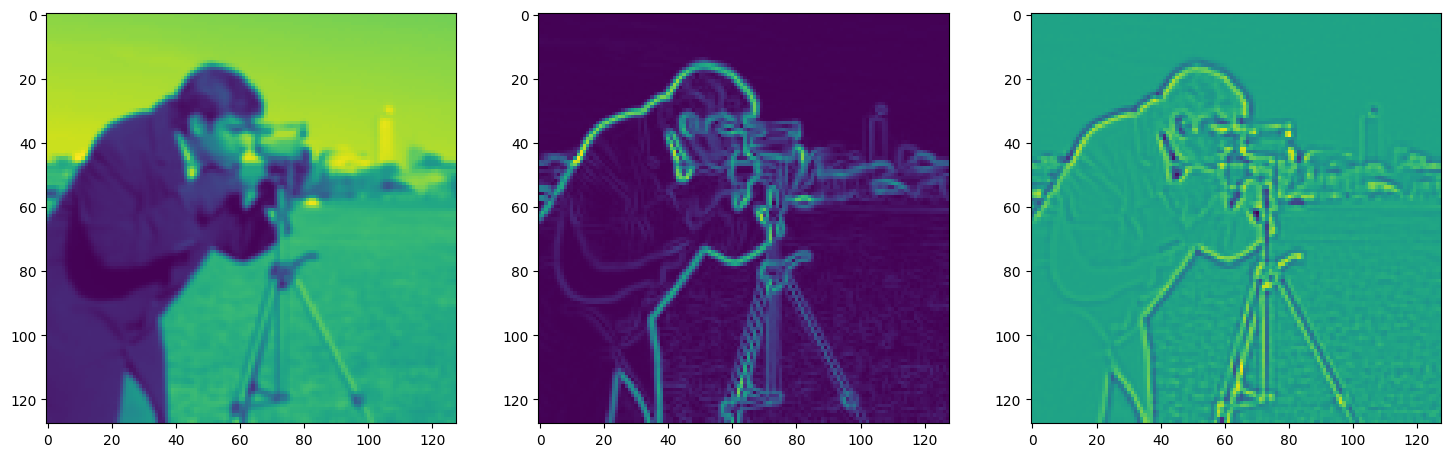
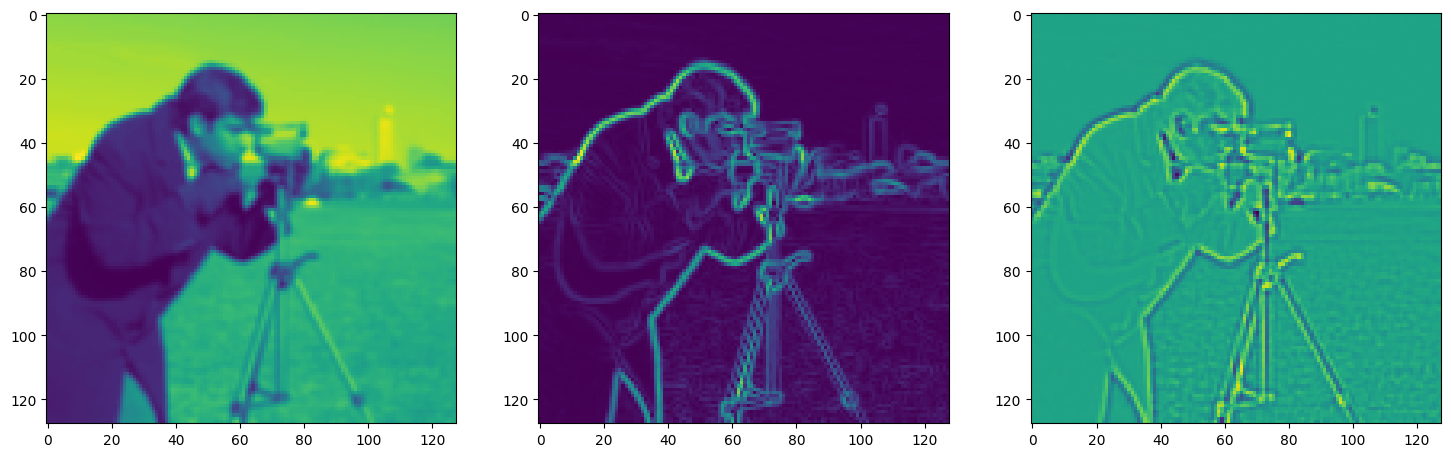
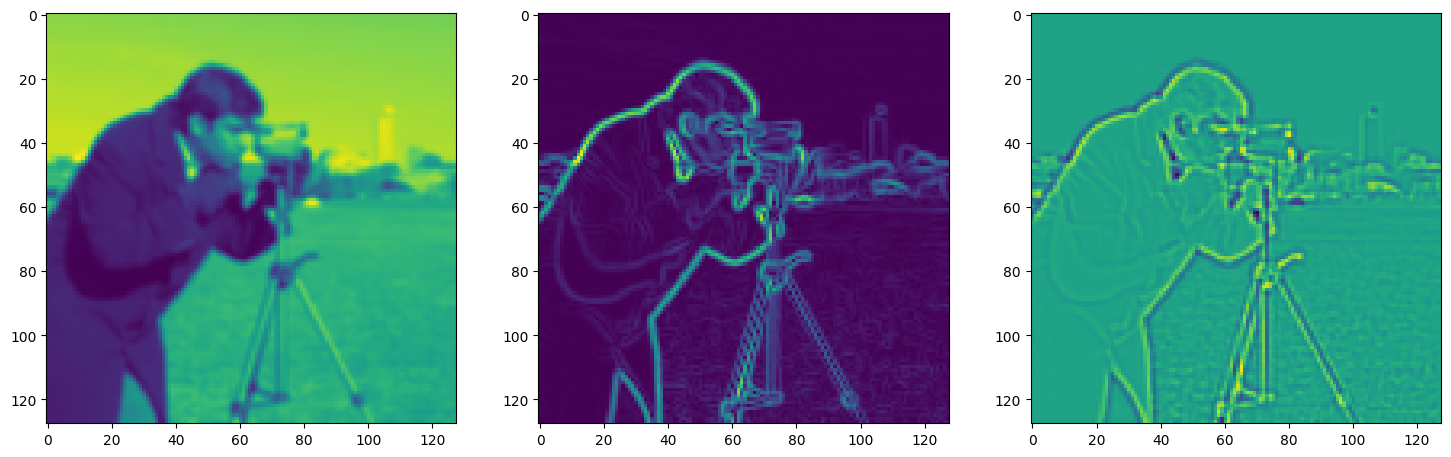
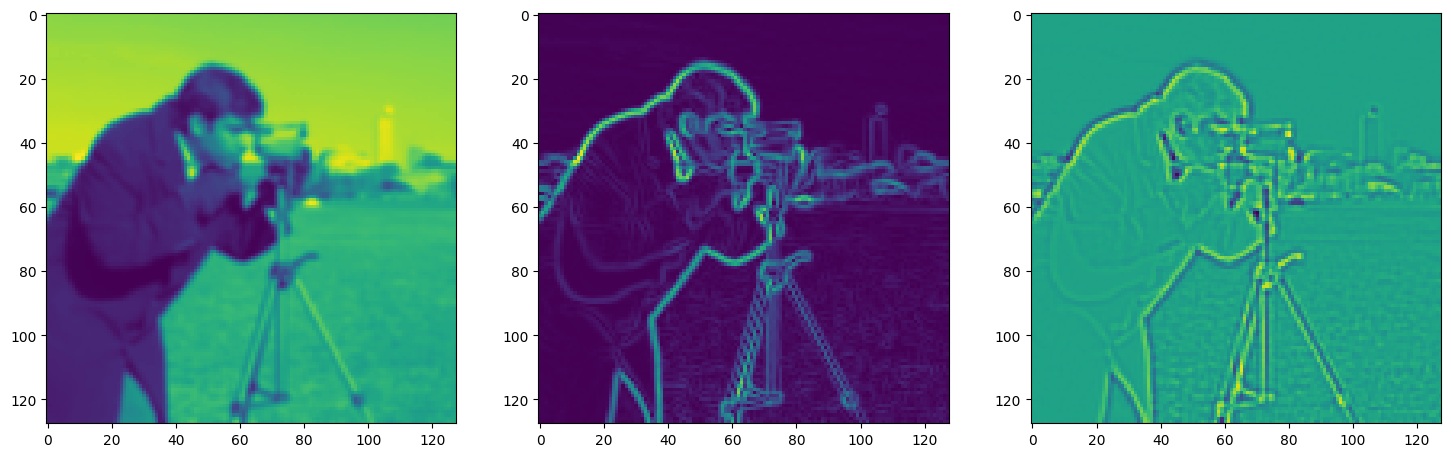
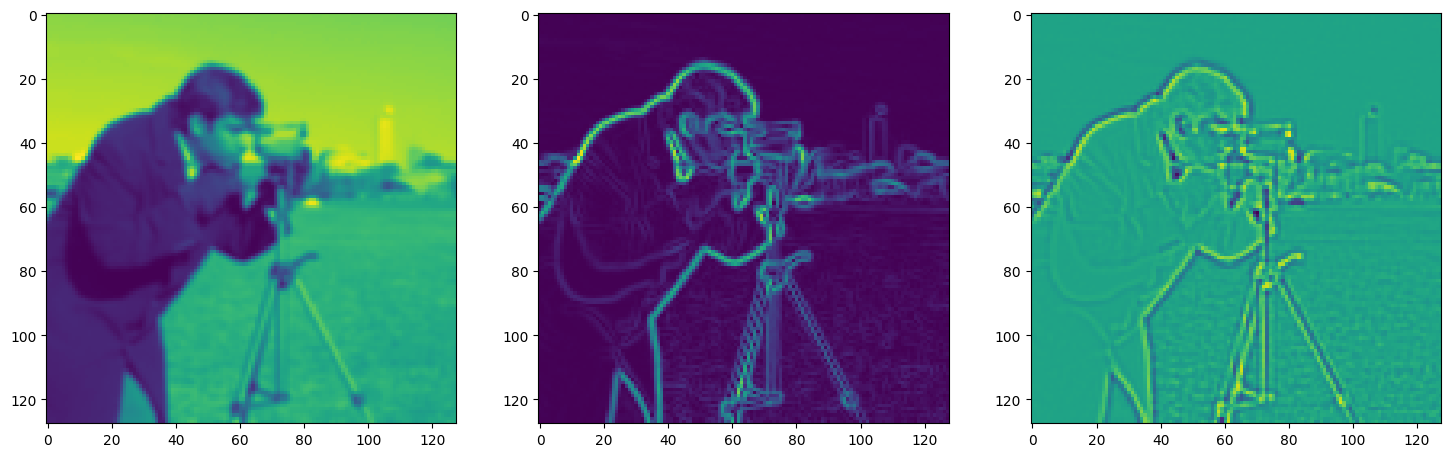
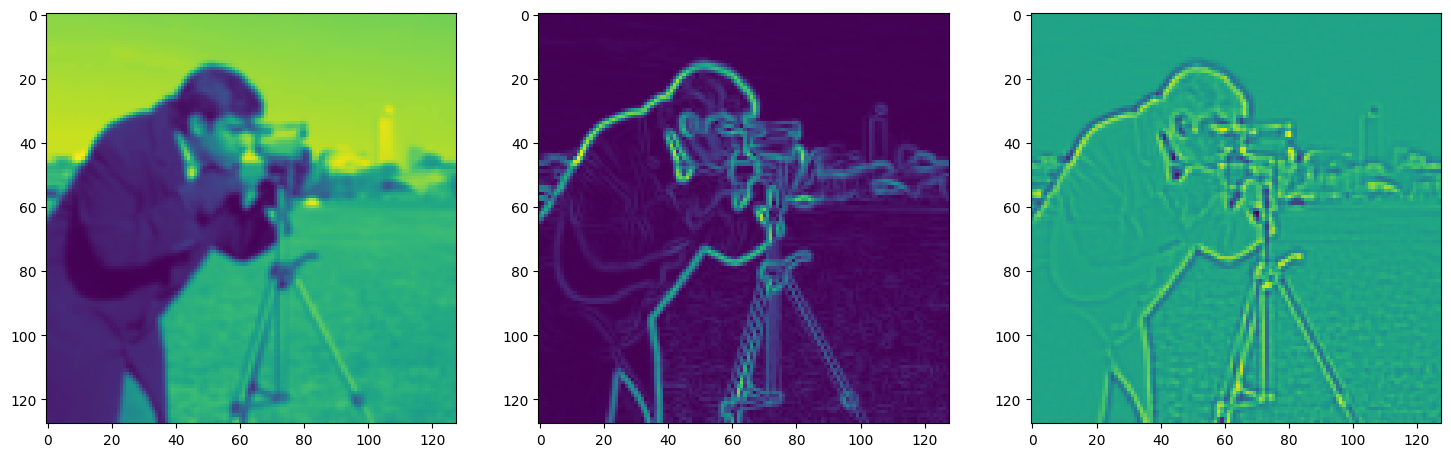
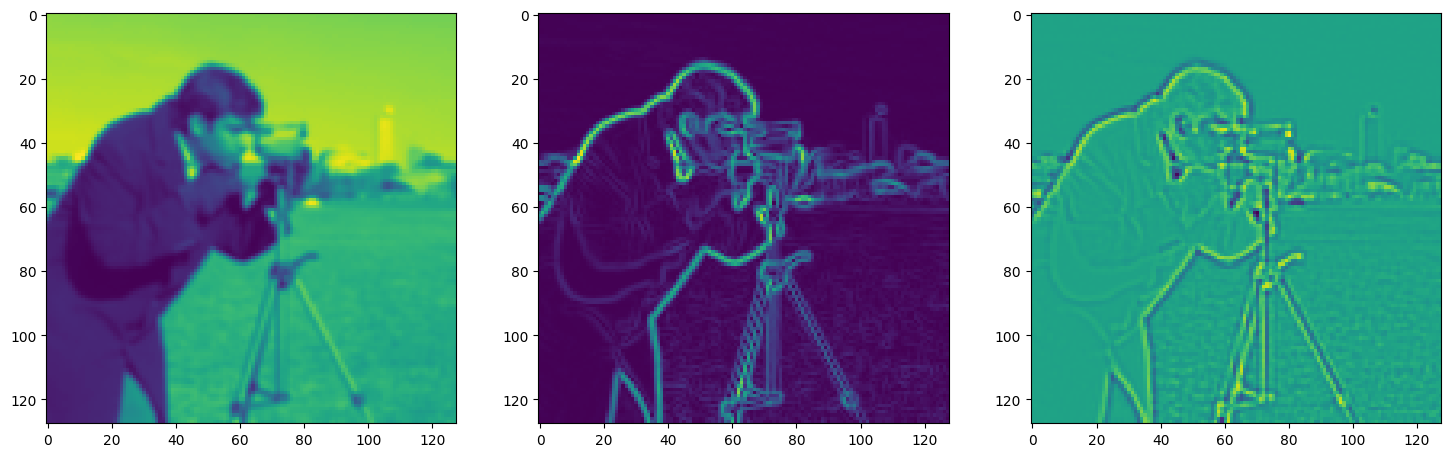
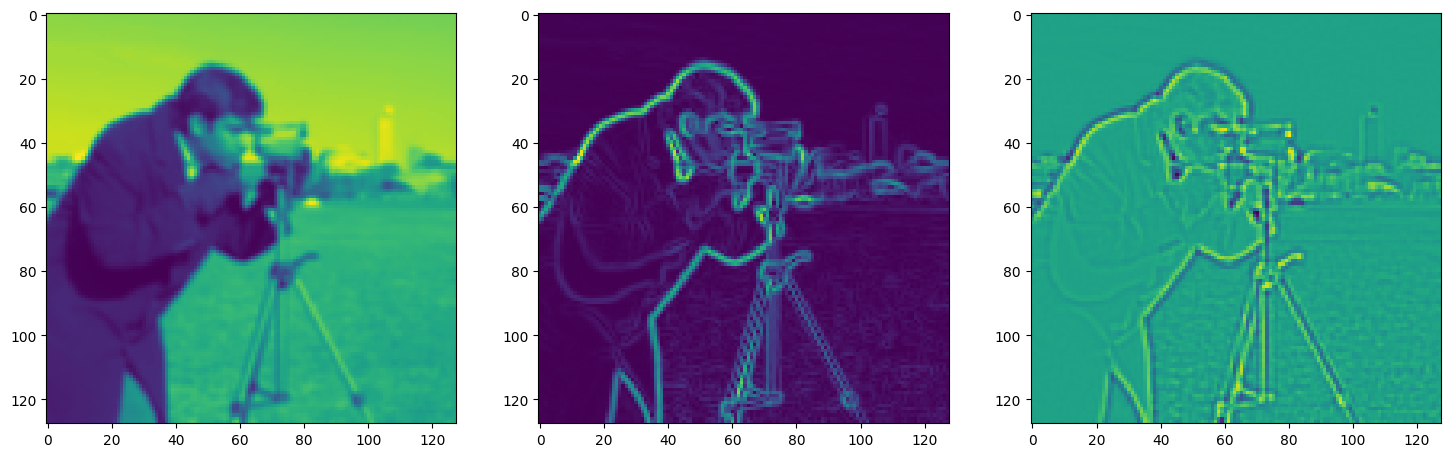
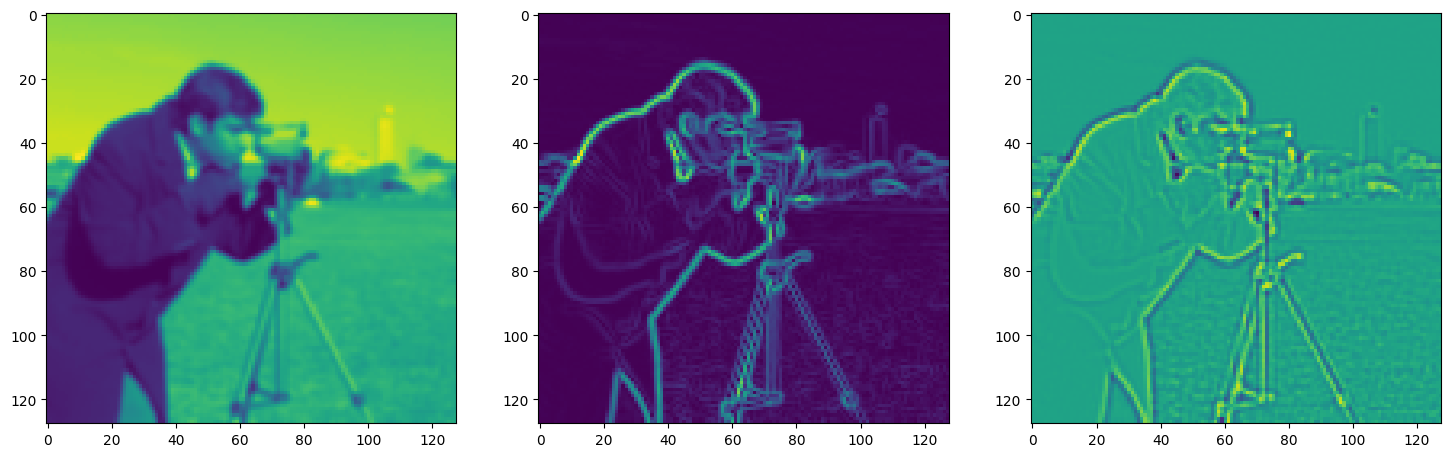
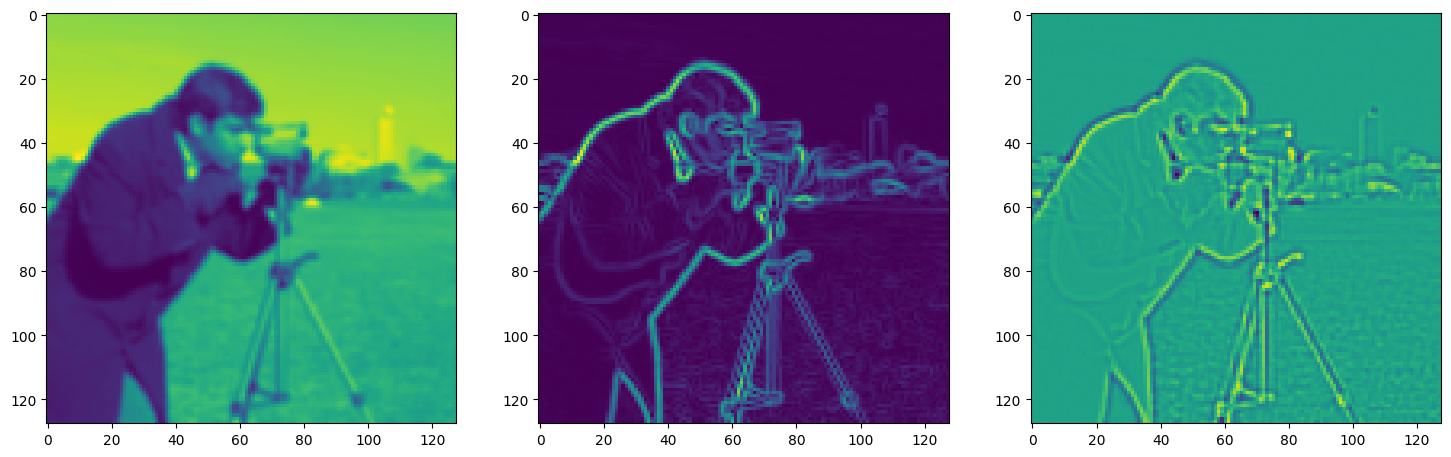
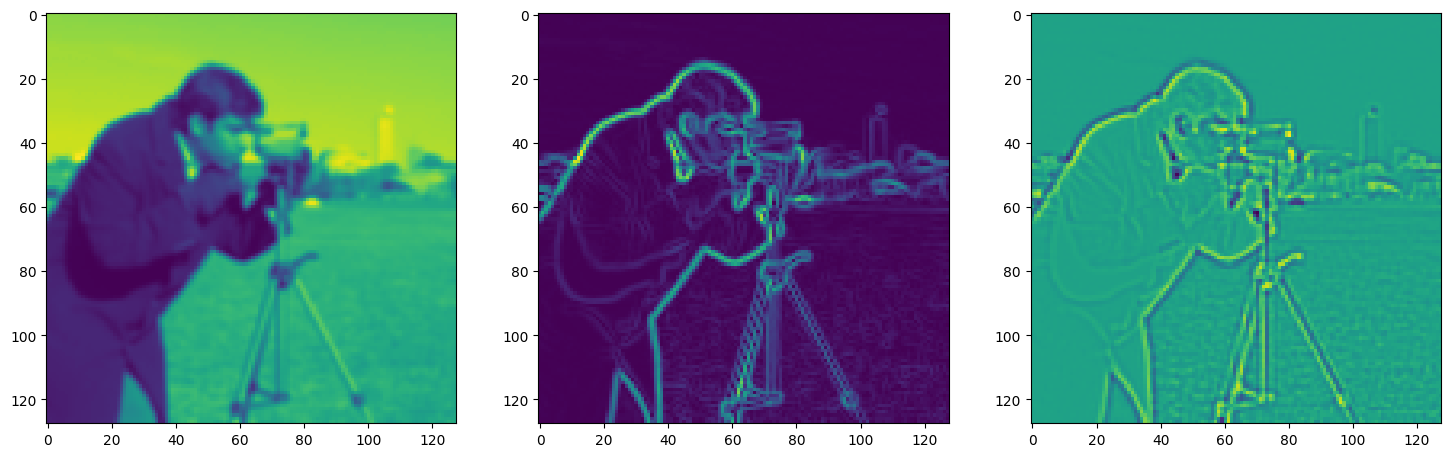
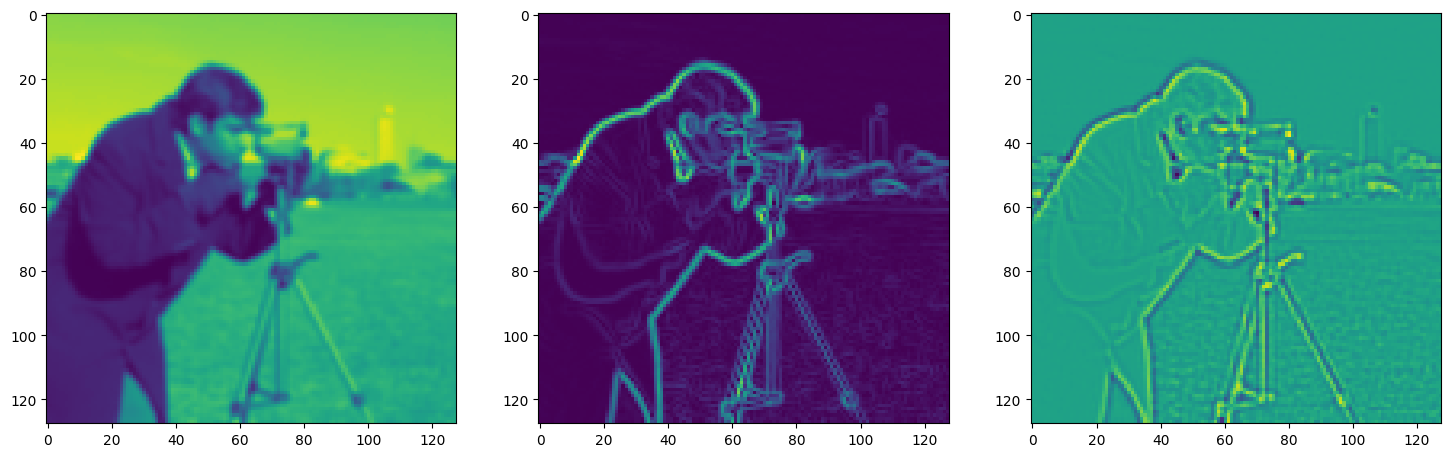
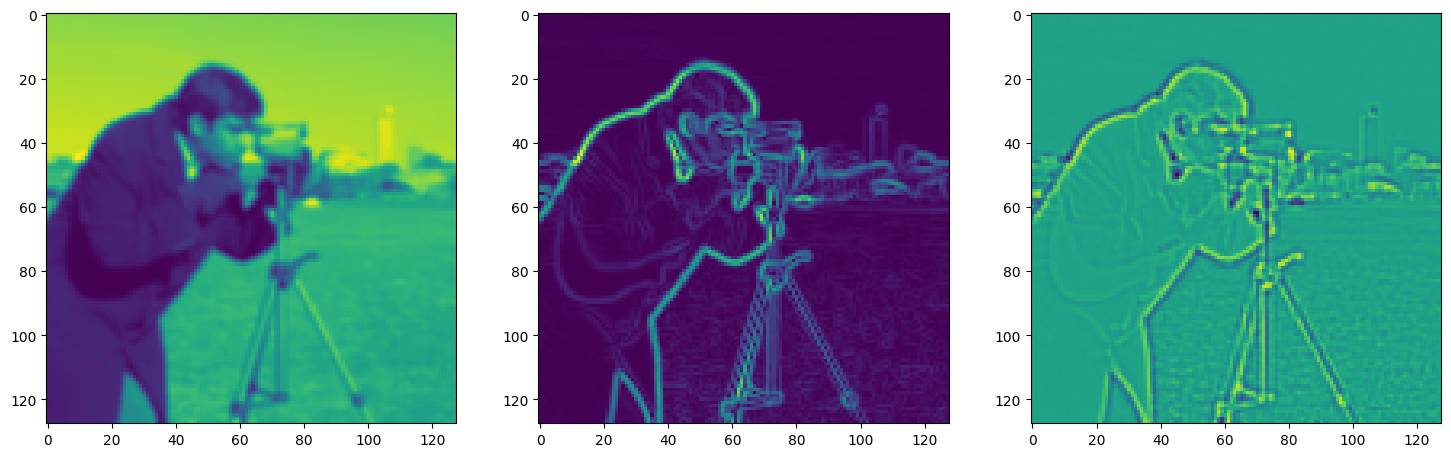
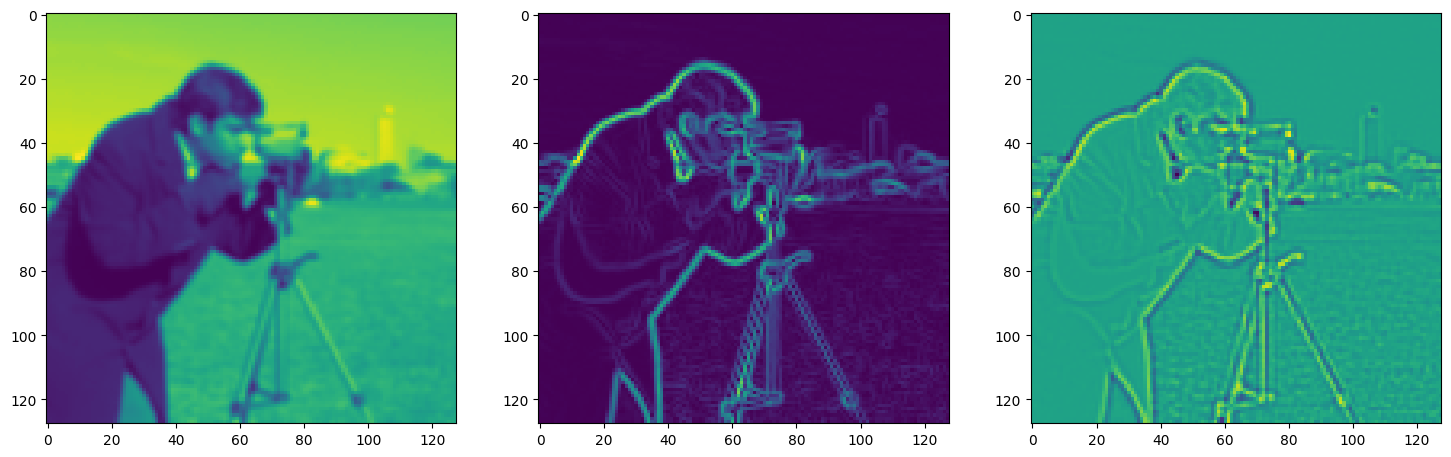
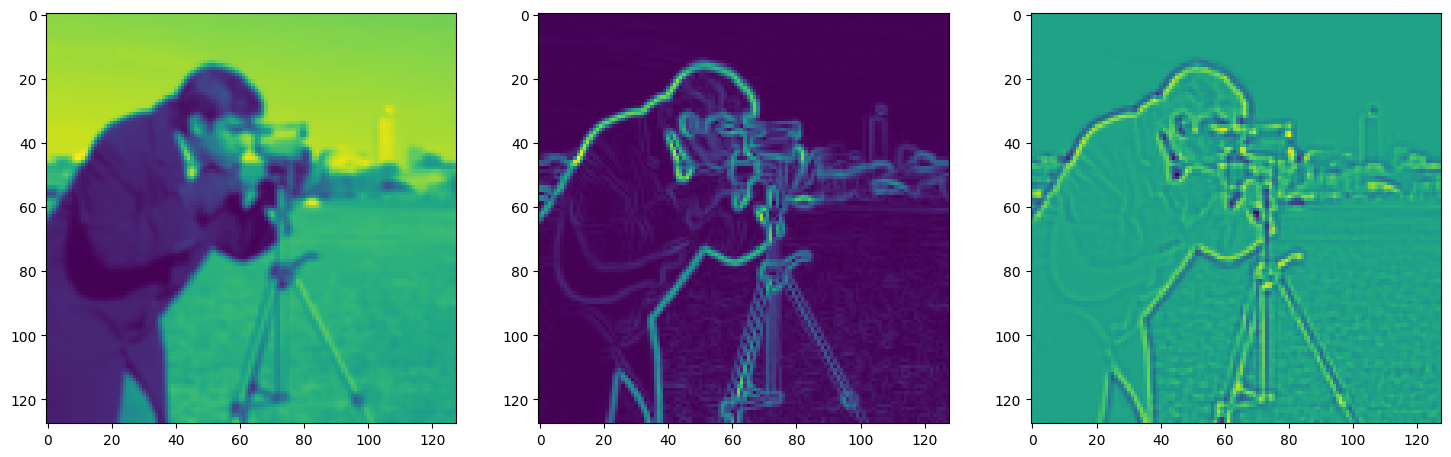
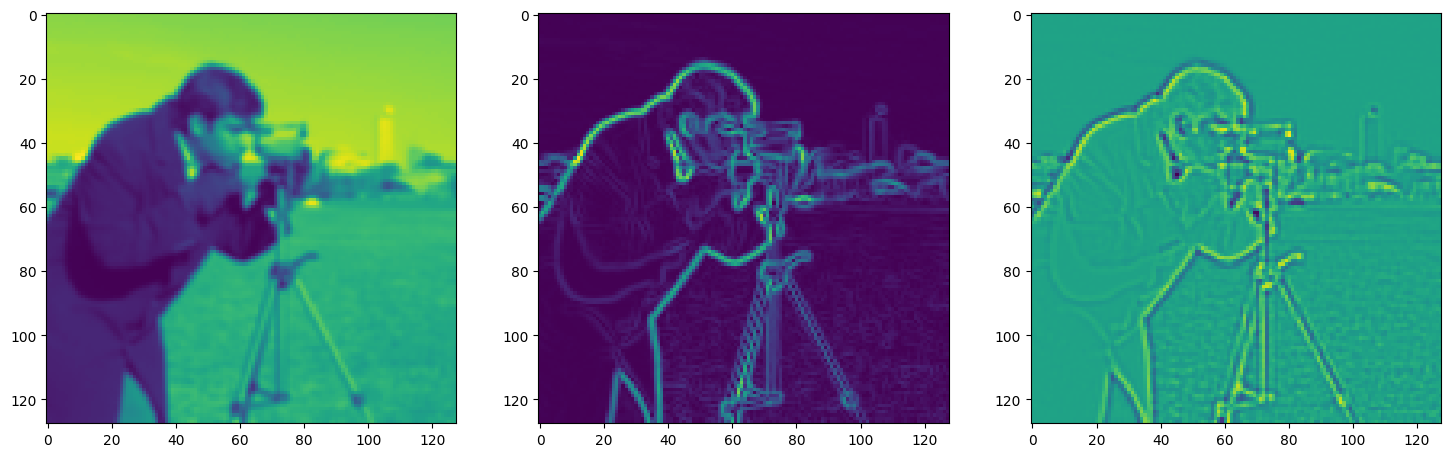
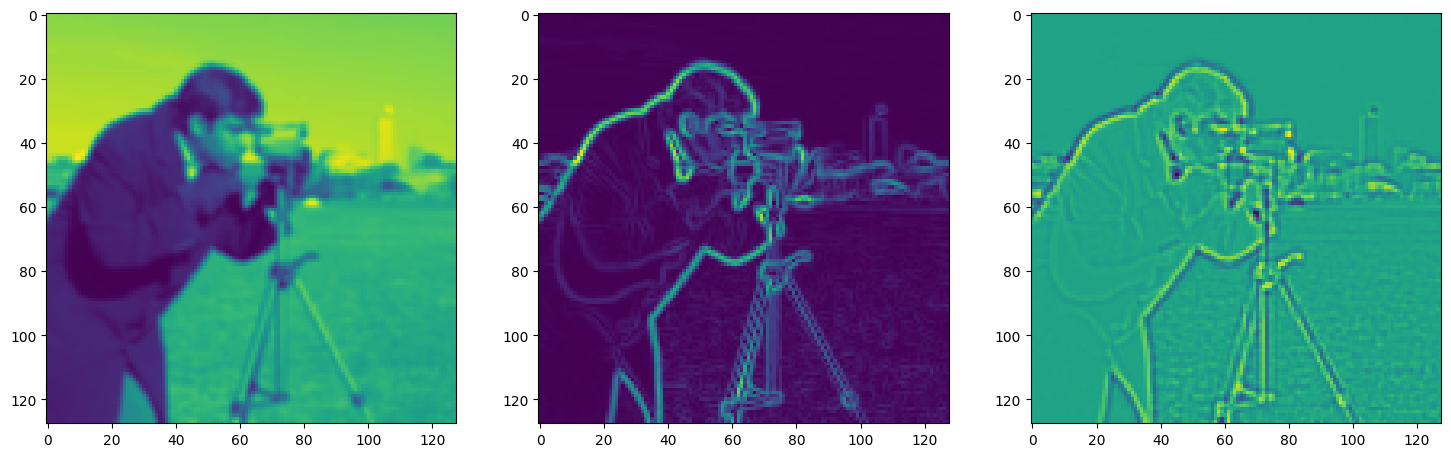
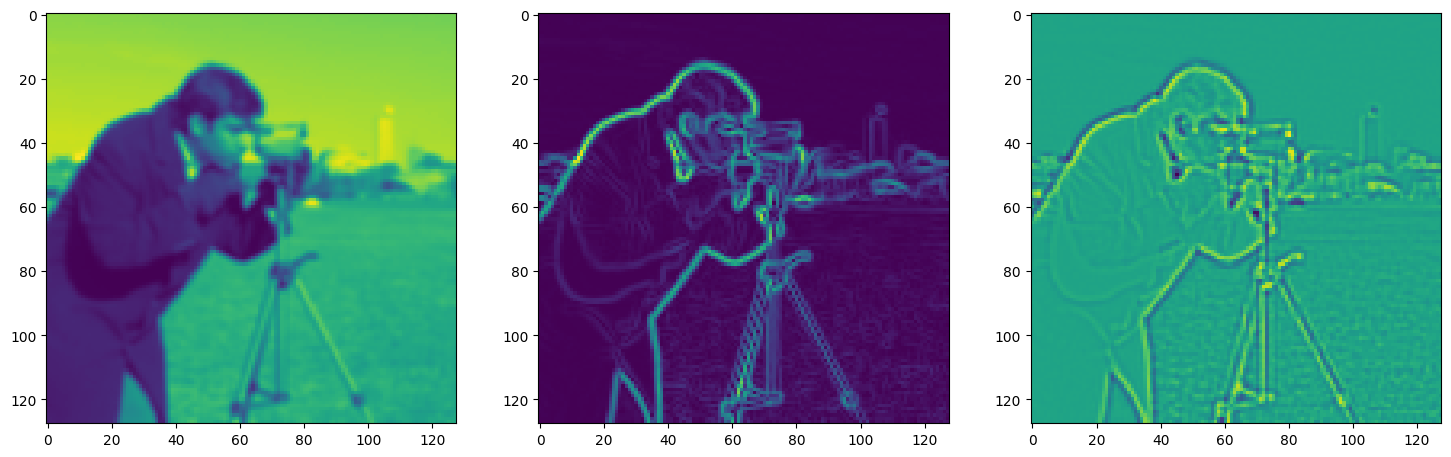
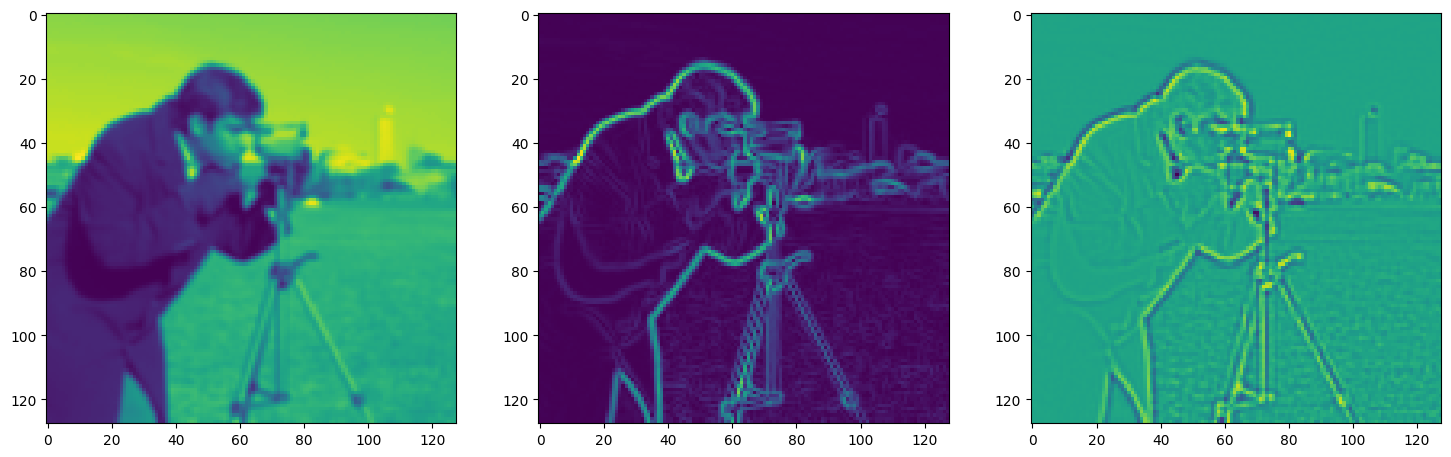
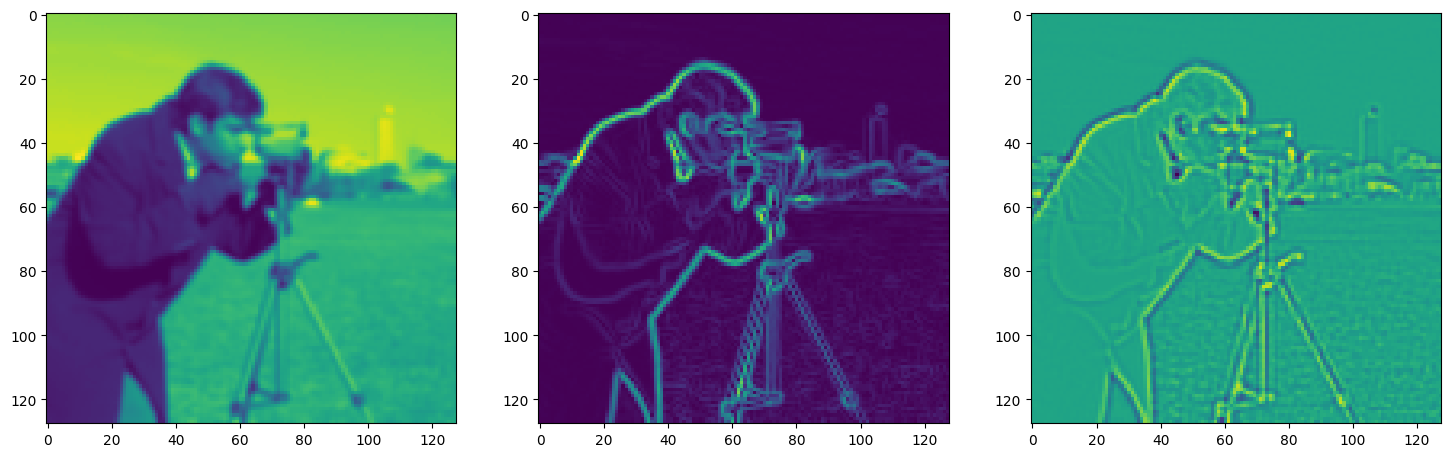
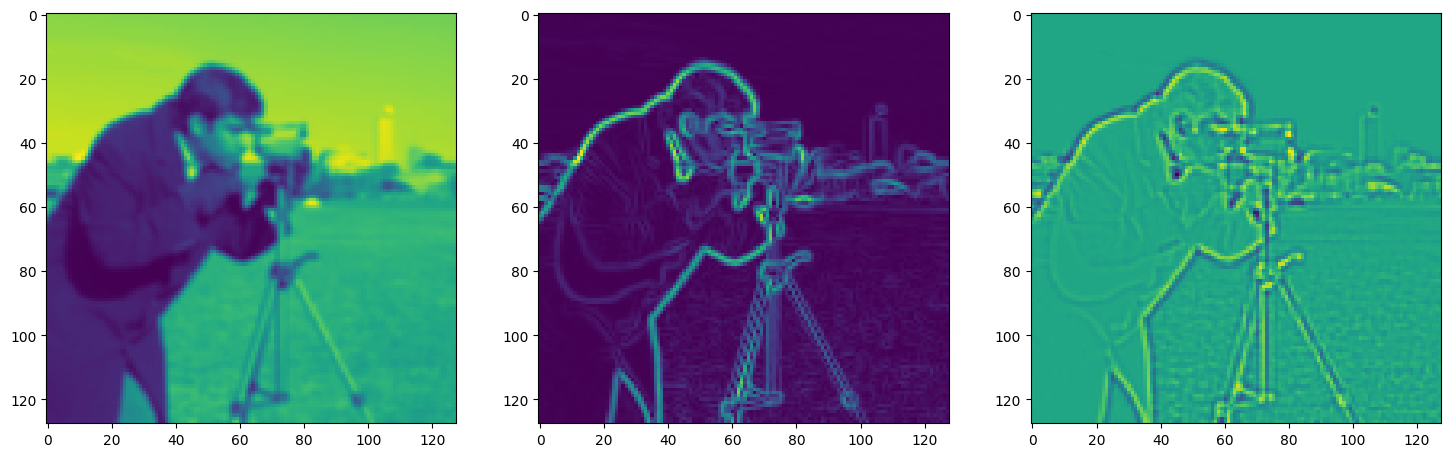
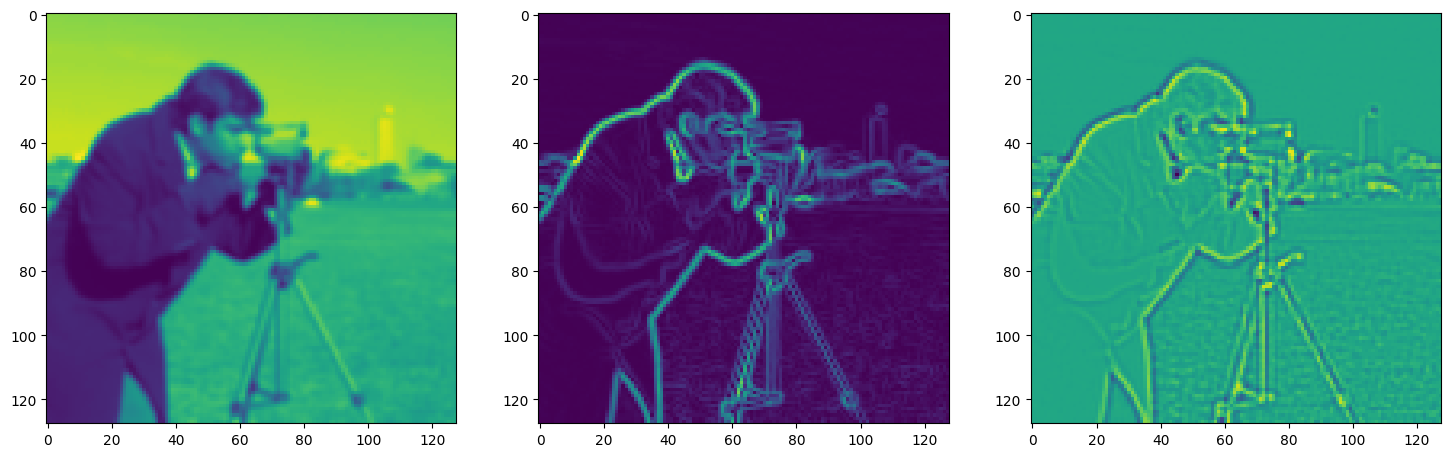
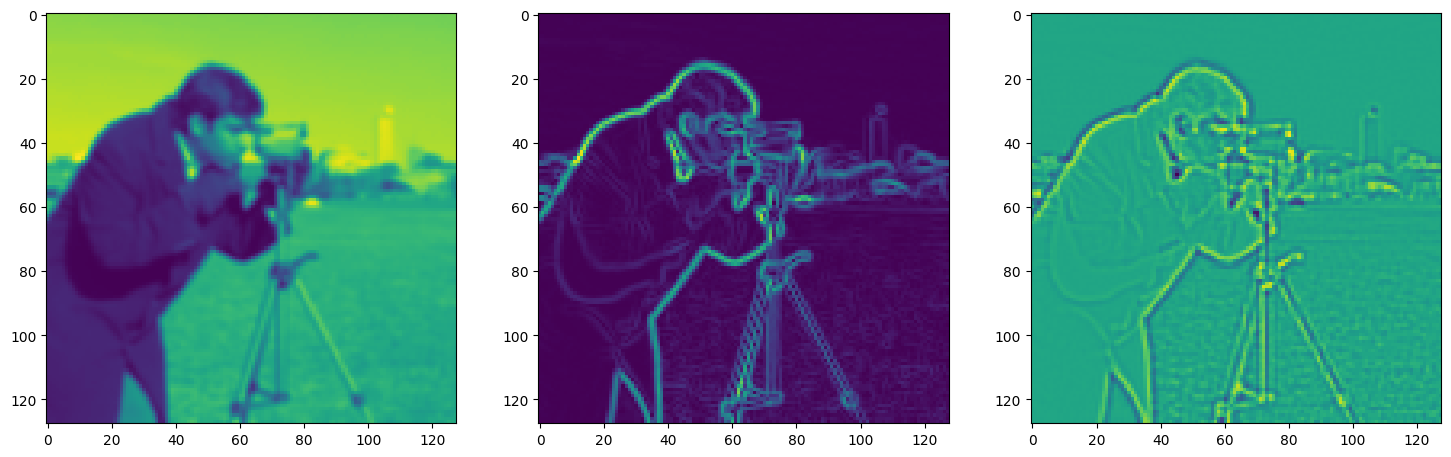
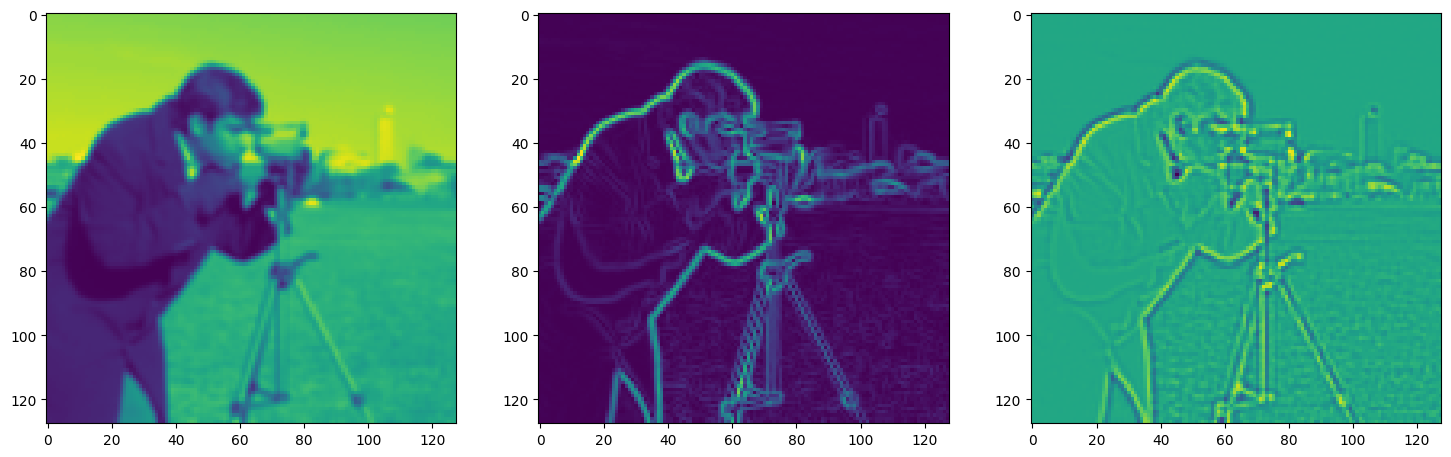
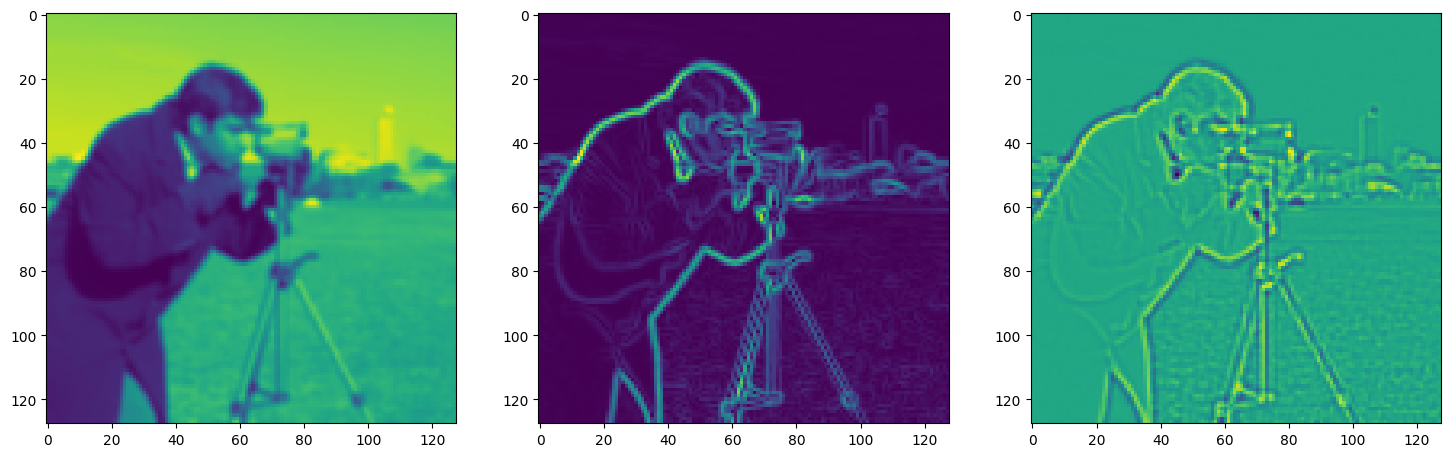
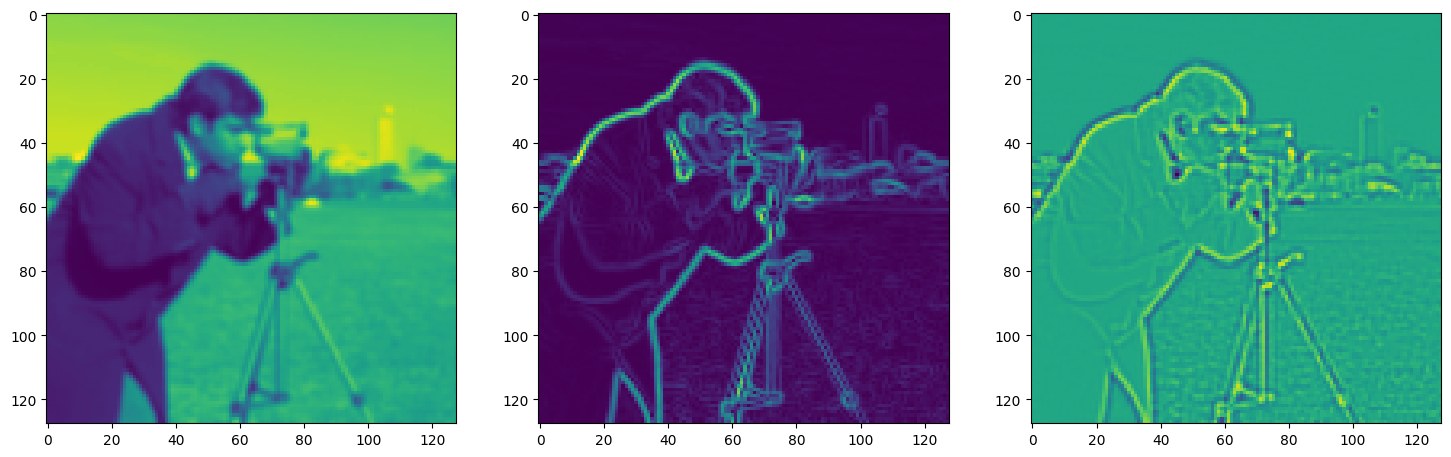
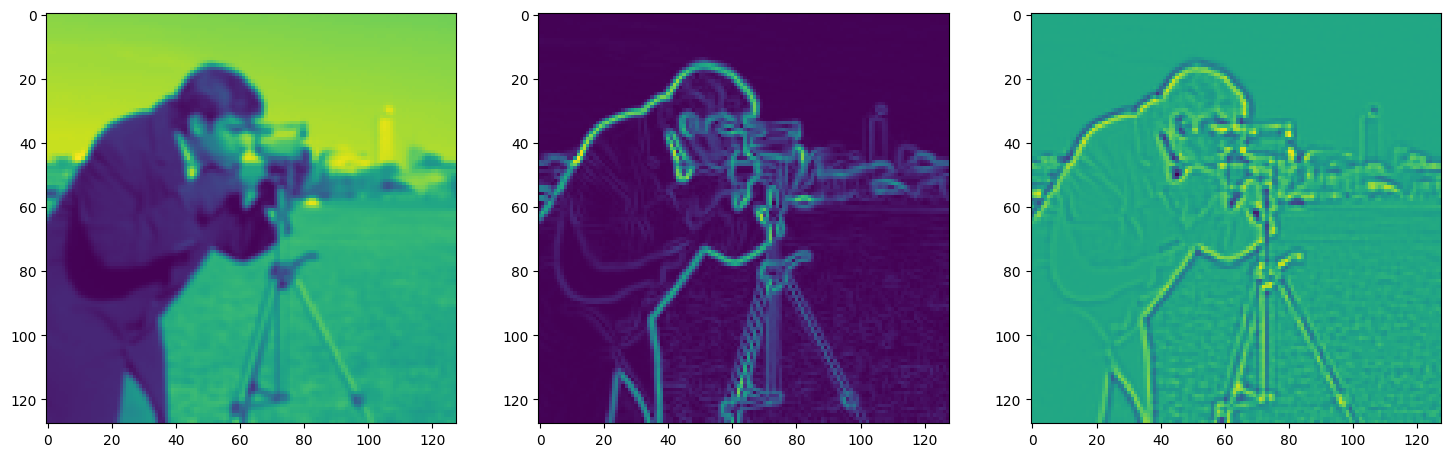
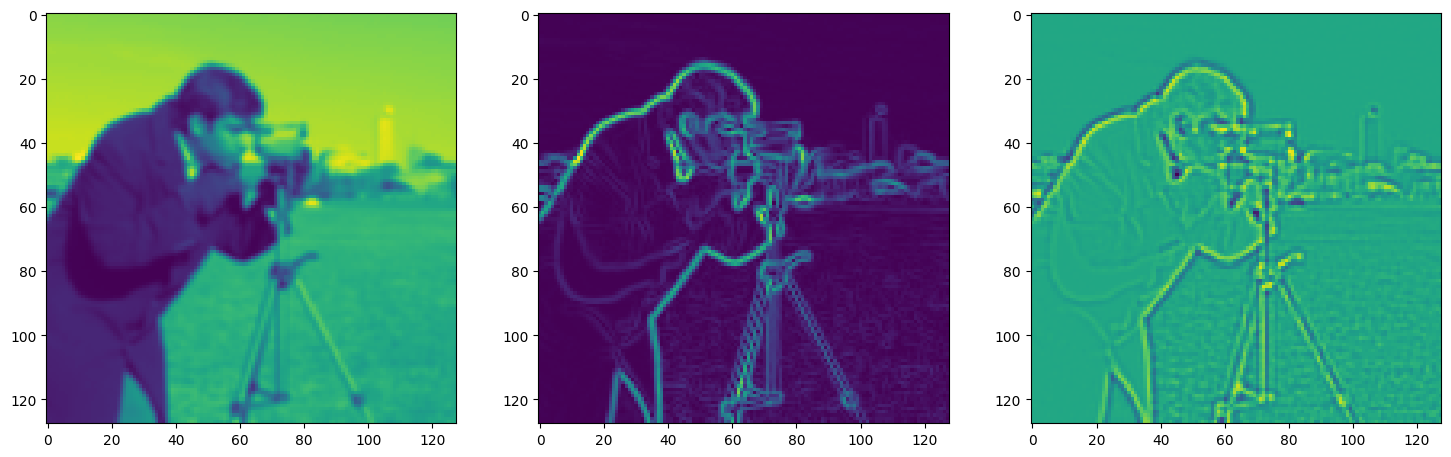
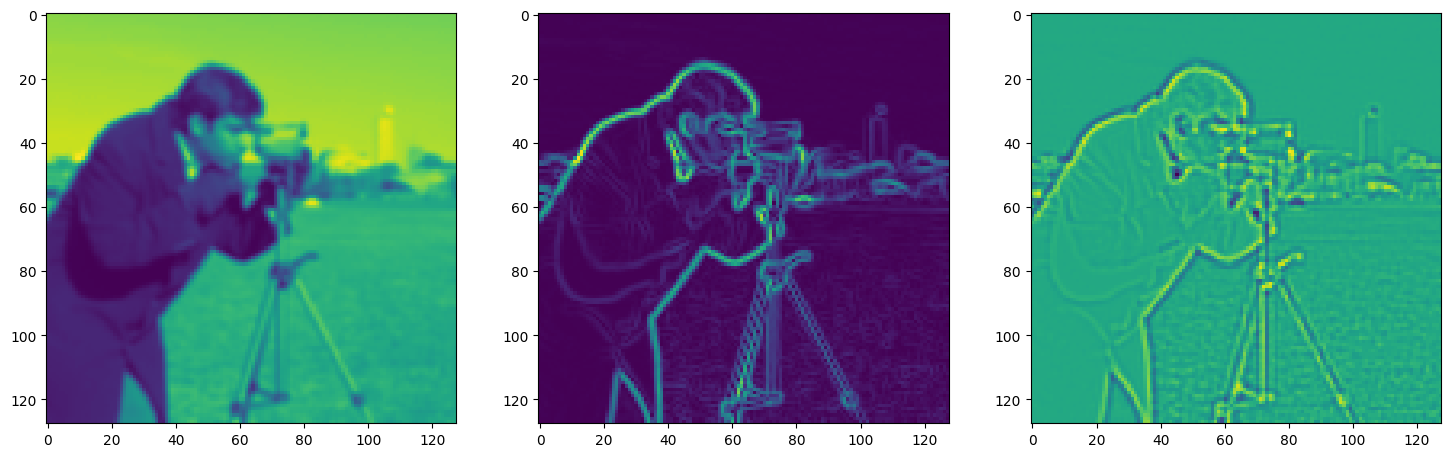
Now, let’s make it a bit harder. Let’s say we want to reconstruct an image but we only have access to its gradients!
That is, we now seek the function \(\Phi\) such that: \(\mathcal{L}=\int_{\Omega} \lVert \nabla\Phi(\mathbf{x}) - \nabla f(\mathbf{x}) \rVert\mathrm{d}\mathbf{x}\) is minimized, in which \(\Omega\) is the domain of the image.
import scipy.ndimage

class PoissonEqn(Dataset):
    def __init__(self, sidelength):
        super().__init__()
        img = get_cameraman_tensor(sidelength)

        # Compute gradient and laplacian
        grads_x = scipy.ndimage.sobel(img.numpy(), axis=1).squeeze(0)[..., None]
        grads_y = scipy.ndimage.sobel(img.numpy(), axis=2).squeeze(0)[..., None]
        grads_x, grads_y = torch.from_numpy(grads_x), torch.from_numpy(grads_y)

        self.grads = torch.stack((grads_x, grads_y), dim=-1).view(-1, 2)
        self.laplace = scipy.ndimage.laplace(img.numpy()).squeeze(0)[..., None]
        self.laplace = torch.from_numpy(self.laplace)

        self.pixels = img.permute(1, 2, 0).view(-1, 1)
        self.coords = get_mgrid(sidelength, 2)

    def __len__(self):
        return 1

    def __getitem__(self, idx):
        return self.coords, {'pixels':self.pixels, 'grads':self.grads, 'laplace':self.laplace}
Instantiate SIREN model#
cameraman_poisson = PoissonEqn(128)
dataloader = DataLoader(cameraman_poisson, batch_size=1, pin_memory=True, num_workers=0)

poisson_siren = Siren(in_features=2, out_features=1, hidden_features=256,
                      hidden_layers=3, outermost_linear=True)
poisson_siren.cuda()
Siren(
  (net): Sequential(
    (0): SineLayer(
      (linear): Linear(in_features=2, out_features=256, bias=True)
    )
    (1): SineLayer(
      (linear): Linear(in_features=256, out_features=256, bias=True)
    )
    (2): SineLayer(
      (linear): Linear(in_features=256, out_features=256, bias=True)
    )
    (3): SineLayer(
      (linear): Linear(in_features=256, out_features=256, bias=True)
    )
    (4): Linear(in_features=256, out_features=1, bias=True)
  )
)
Define the loss function#
def gradients_mse(model_output, coords, gt_gradients):
    # compute gradients on the model
    gradients = gradient(model_output, coords)
    # compare them with the ground-truth
    gradients_loss = torch.mean((gradients - gt_gradients).pow(2).sum(-1))
    return gradients_loss
Train the model#
total_steps = 1000
steps_til_summary = 10

optim = torch.optim.Adam(lr=1e-4, params=poisson_siren.parameters())

model_input, gt = next(iter(dataloader))
gt = {key: value.cuda() for key, value in gt.items()}
model_input = model_input.cuda()

for step in range(total_steps):
    start_time = time.time()

    model_output, coords = poisson_siren(model_input)
    train_loss = gradients_mse(model_output, coords, gt['grads'])

    if not step % steps_til_summary:
        print("Step %d, Total loss %0.6f, iteration time %0.6f" % (step, train_loss, time.time() - start_time))

        img_grad = gradient(model_output, coords)
        img_laplacian = laplace(model_output, coords)

        fig, axes = plt.subplots(1, 3, figsize=(18, 6))
        axes[0].imshow(model_output.cpu().view(128,128).detach().numpy())
        axes[1].imshow(img_grad.cpu().norm(dim=-1).view(128,128).detach().numpy())
        axes[2].imshow(img_laplacian.cpu().view(128,128).detach().numpy())
        plt.show()

    optim.zero_grad()
    train_loss.backward()
    optim.step()
Step 0, Total loss 16.082405, iteration time 0.003057
Step 10, Total loss 4.434361, iteration time 0.001914
Step 20, Total loss 1.665594, iteration time 0.001487
Step 30, Total loss 0.724829, iteration time 0.001626
Step 40, Total loss 0.335272, iteration time 0.001631
Step 50, Total loss 0.184486, iteration time 0.001456
Step 60, Total loss 0.123615, iteration time 0.001555
Step 70, Total loss 0.092790, iteration time 0.001478
Step 80, Total loss 0.071172, iteration time 0.001442
Step 90, Total loss 0.059844, iteration time 0.001549
Step 100, Total loss 0.051608, iteration time 0.001558
Step 110, Total loss 0.047639, iteration time 0.001494
Step 120, Total loss 0.070216, iteration time 0.001613
Step 130, Total loss 0.042079, iteration time 0.001813
Step 140, Total loss 0.038912, iteration time 0.001719
Step 150, Total loss 0.033385, iteration time 0.001613
Step 160, Total loss 0.030420, iteration time 0.001530
Step 170, Total loss 0.028471, iteration time 0.001814
Step 180, Total loss 0.038084, iteration time 0.001581
Step 190, Total loss 0.029641, iteration time 0.001464
Step 200, Total loss 0.025058, iteration time 0.001628
Step 210, Total loss 0.023223, iteration time 0.001459
Step 220, Total loss 0.022123, iteration time 0.001582
Step 230, Total loss 0.036758, iteration time 0.001497
Step 240, Total loss 0.021620, iteration time 0.001488
Step 250, Total loss 0.020993, iteration time 0.001635
Step 260, Total loss 0.019381, iteration time 0.001593
Step 270, Total loss 0.020076, iteration time 0.001535
Step 280, Total loss 0.030141, iteration time 0.001494
Step 290, Total loss 0.018392, iteration time 0.001555
Step 300, Total loss 0.016569, iteration time 0.001529
Step 310, Total loss 0.016443, iteration time 0.001474
Step 320, Total loss 0.015786, iteration time 0.001573
Step 330, Total loss 0.039000, iteration time 0.001455
Step 340, Total loss 0.022057, iteration time 0.001545
Step 350, Total loss 0.016721, iteration time 0.001589
Step 360, Total loss 0.014248, iteration time 0.001584
Step 370, Total loss 0.013907, iteration time 0.001489
Step 380, Total loss 0.013540, iteration time 0.001573
Step 390, Total loss 0.014559, iteration time 0.001492
Step 400, Total loss 0.017451, iteration time 0.001518
Step 410, Total loss 0.014687, iteration time 0.001617
Step 420, Total loss 0.012690, iteration time 0.001566
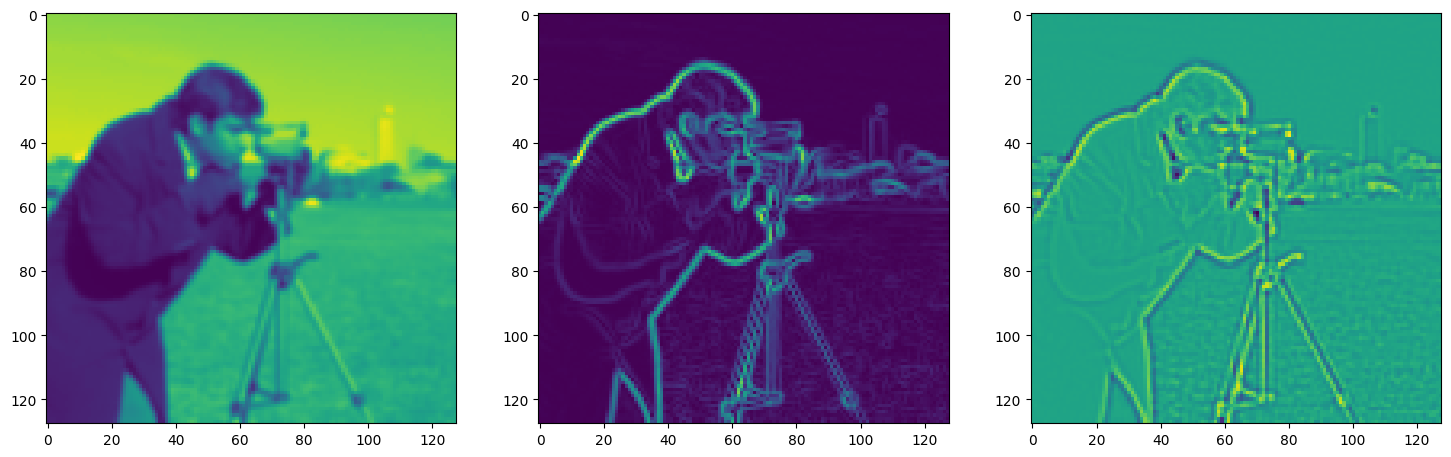
Step 430, Total loss 0.012461, iteration time 0.001595
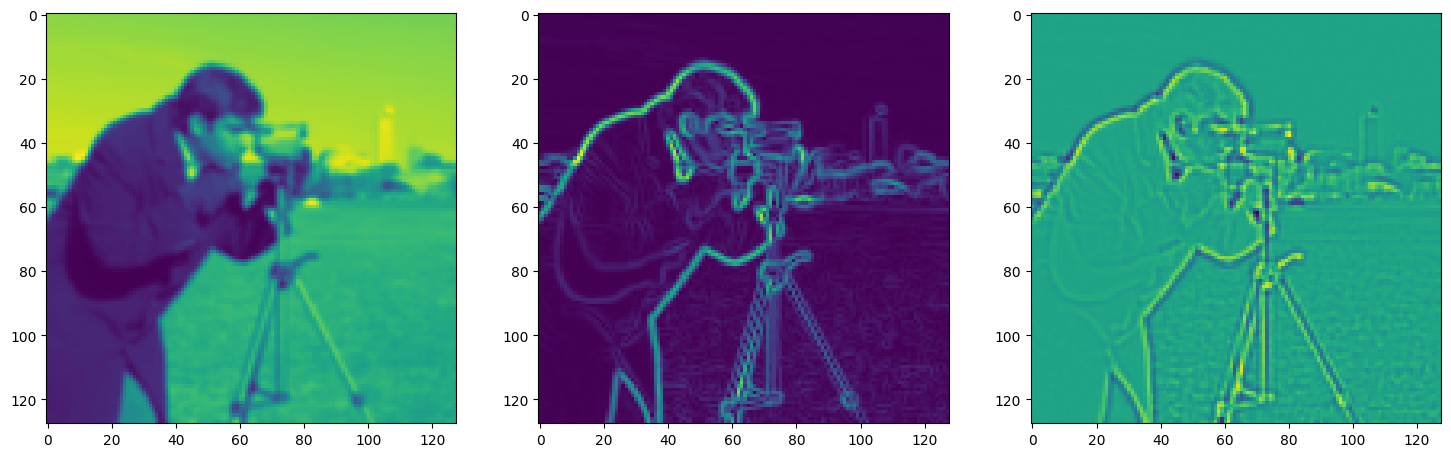
Step 440, Total loss 0.011988, iteration time 0.001545
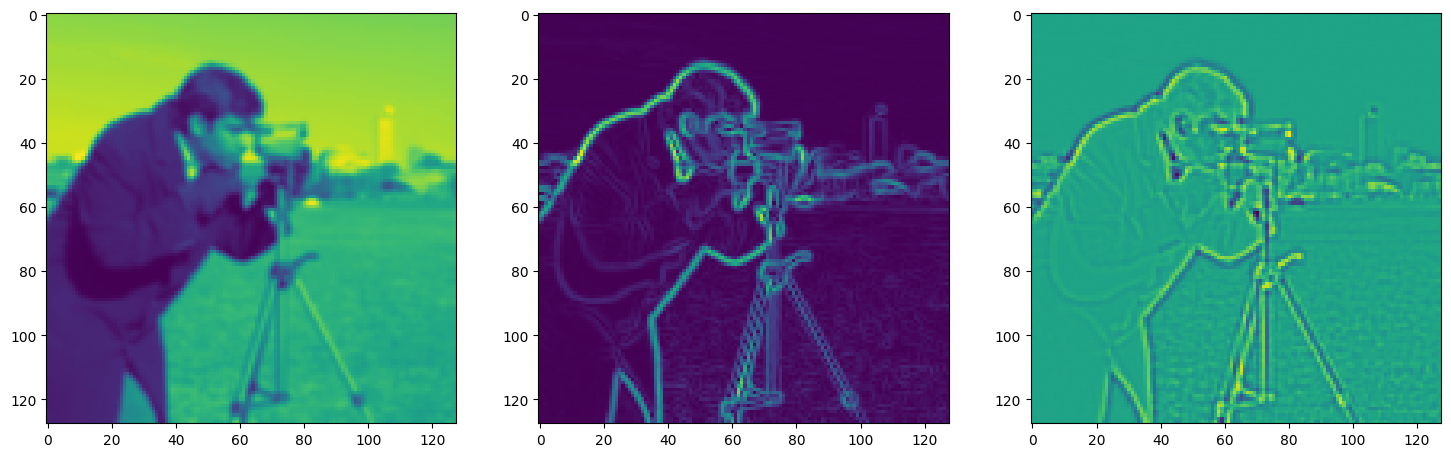
Step 450, Total loss 0.011807, iteration time 0.001588
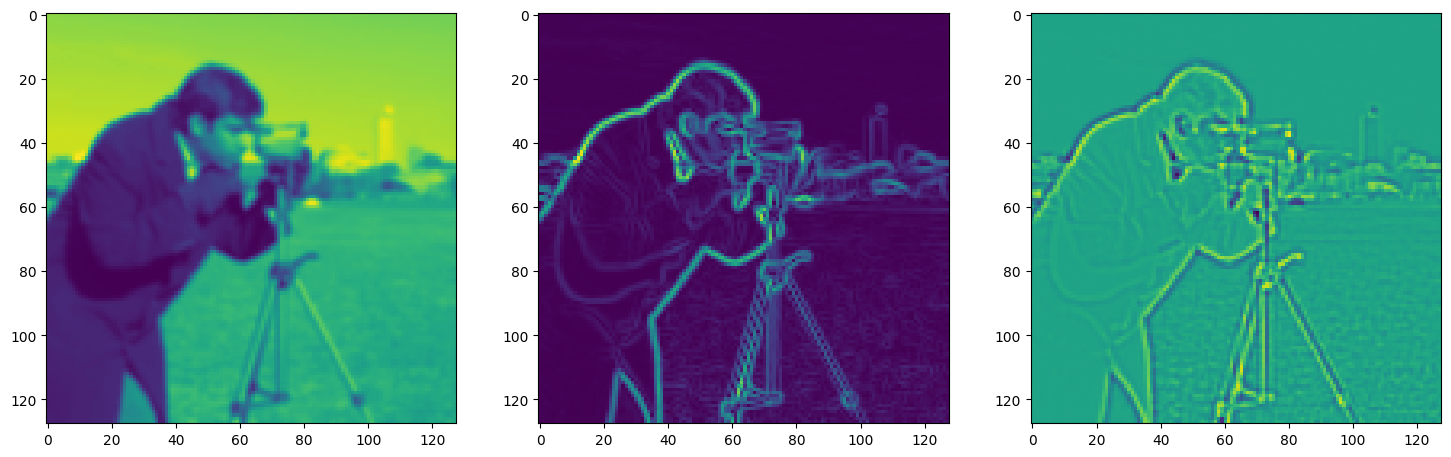
Step 460, Total loss 0.013722, iteration time 0.001428
Step 470, Total loss 0.022628, iteration time 0.001519
Step 480, Total loss 0.016508, iteration time 0.001616
Step 490, Total loss 0.012050, iteration time 0.001658
Step 500, Total loss 0.011336, iteration time 0.001584
Step 510, Total loss 0.010884, iteration time 0.001501
Step 520, Total loss 0.010552, iteration time 0.001600
Step 530, Total loss 0.010350, iteration time 0.001571
Step 540, Total loss 0.010176, iteration time 0.001546
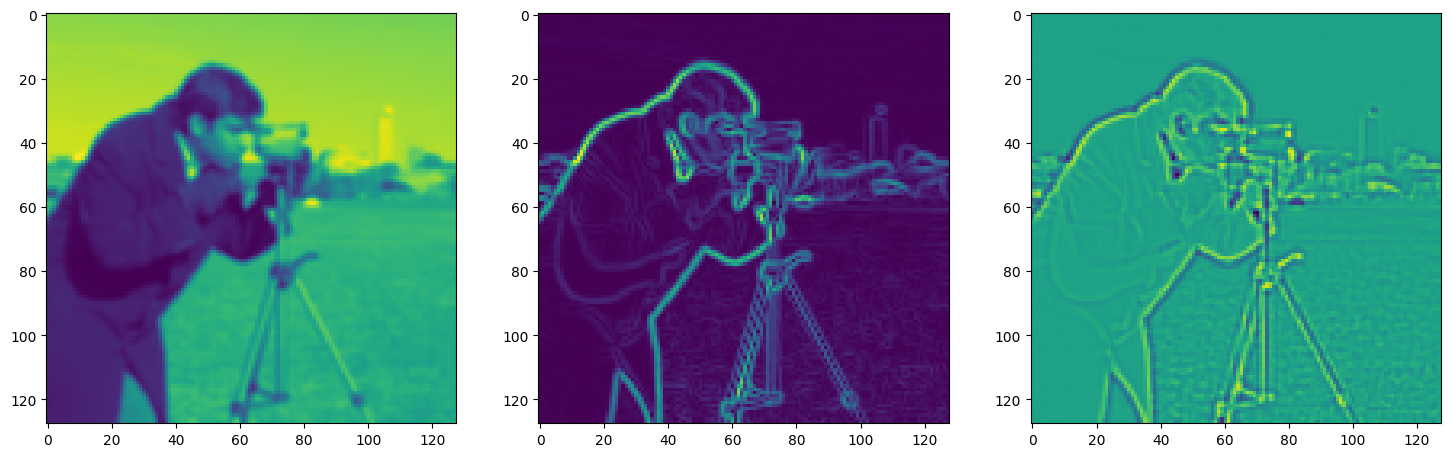
Step 550, Total loss 0.010027, iteration time 0.001560
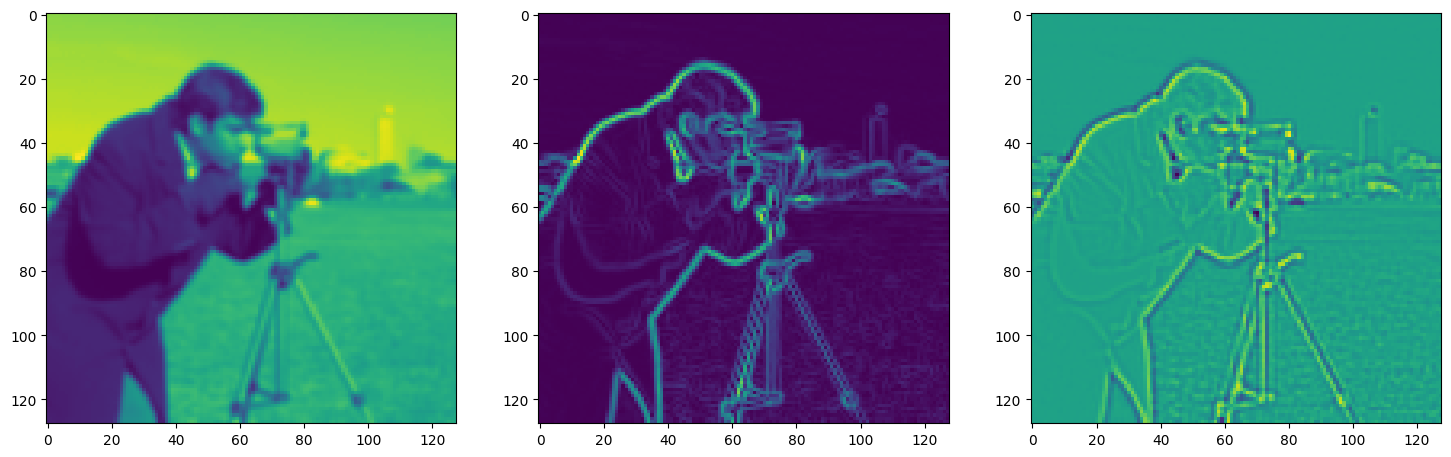
Step 560, Total loss 0.010373, iteration time 0.001611
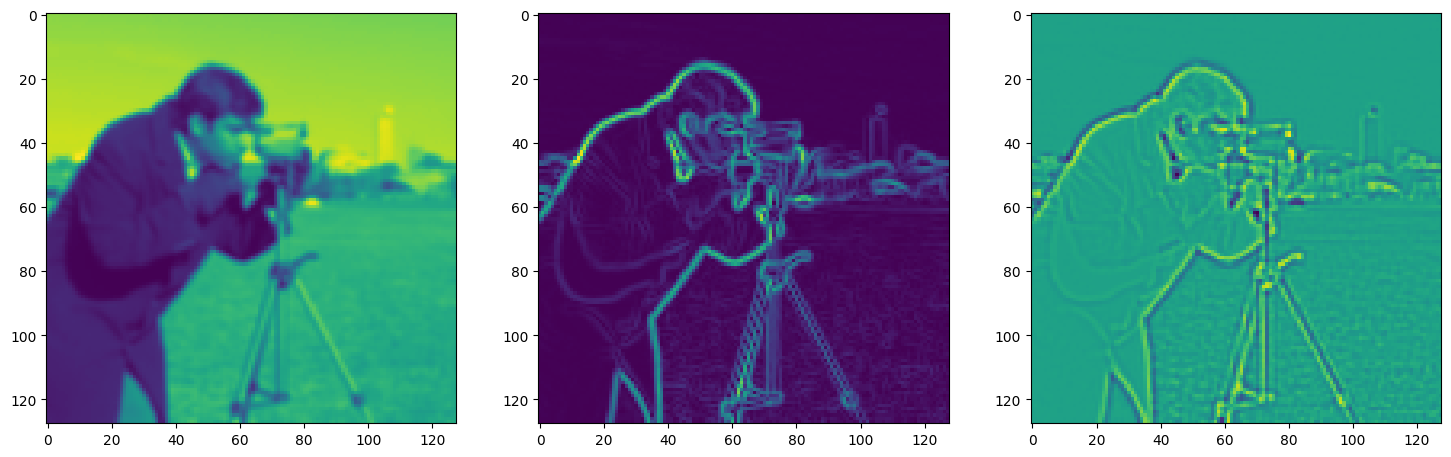
Step 570, Total loss 0.044359, iteration time 0.001496
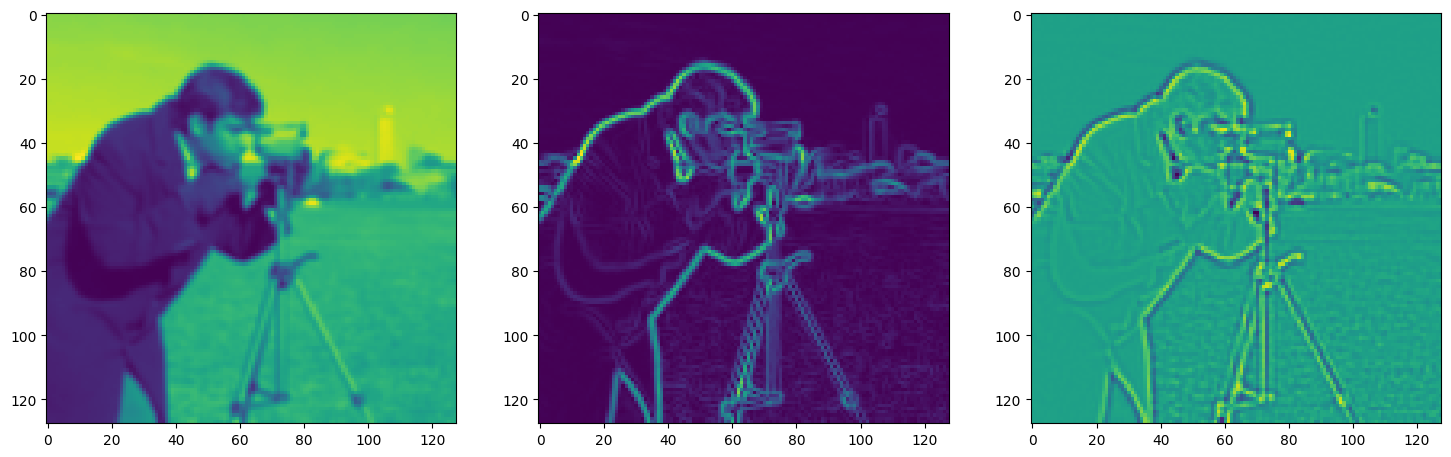
Step 580, Total loss 0.016315, iteration time 0.001571
Step 590, Total loss 0.011208, iteration time 0.001516
Step 600, Total loss 0.010159, iteration time 0.001469
Step 610, Total loss 0.009454, iteration time 0.001600
Step 620, Total loss 0.009159, iteration time 0.001560
Step 630, Total loss 0.008941, iteration time 0.001639
Step 640, Total loss 0.008817, iteration time 0.001563
Step 650, Total loss 0.008752, iteration time 0.001638
Step 660, Total loss 0.023890, iteration time 0.001548
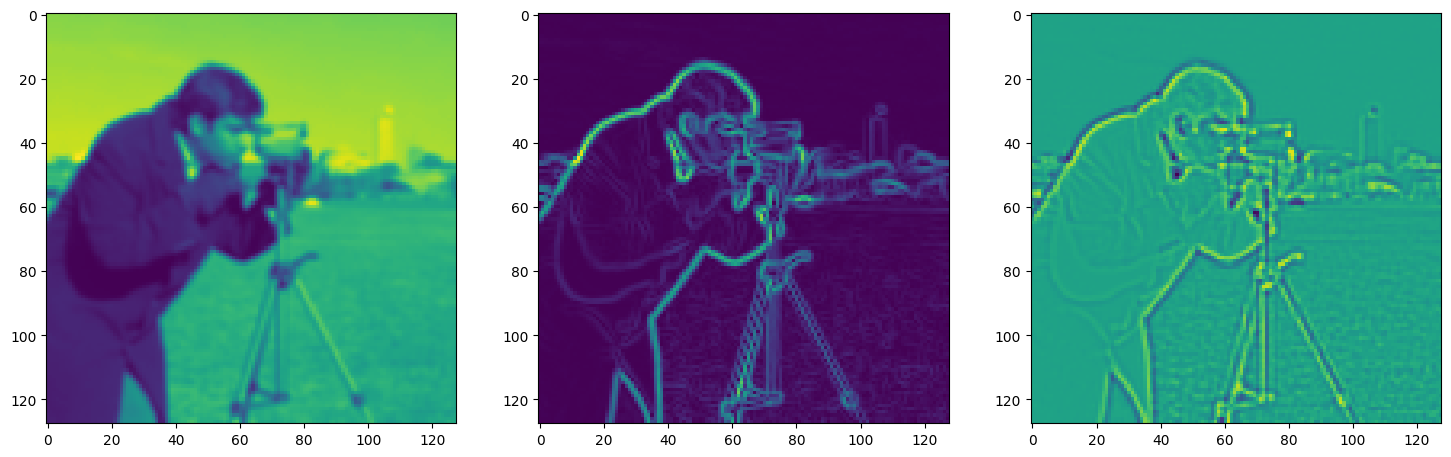
Step 670, Total loss 0.011903, iteration time 0.001833
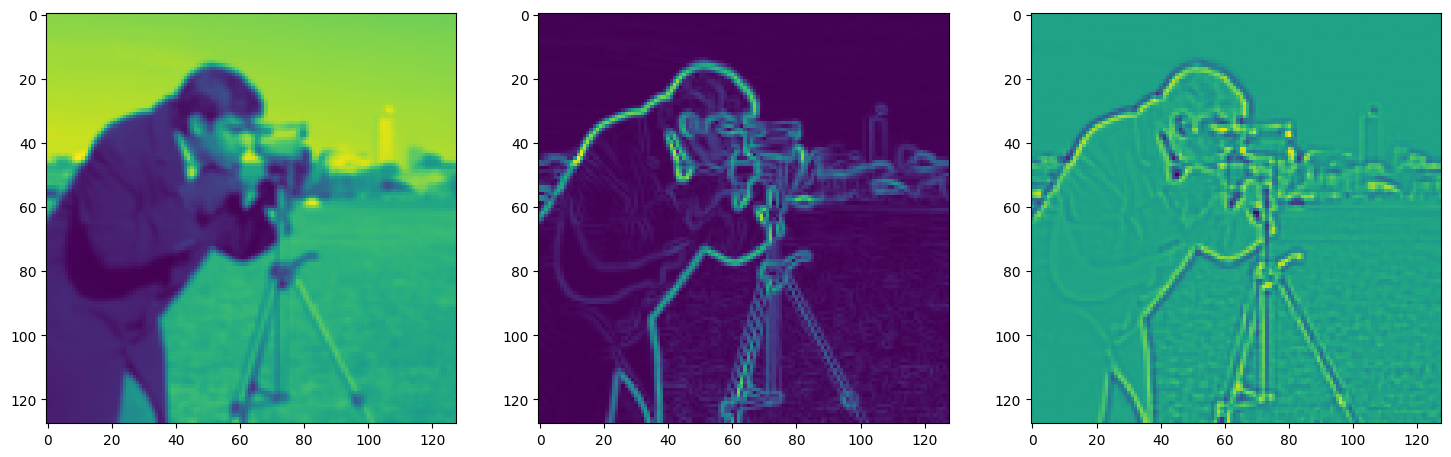
Step 680, Total loss 0.010384, iteration time 0.001573
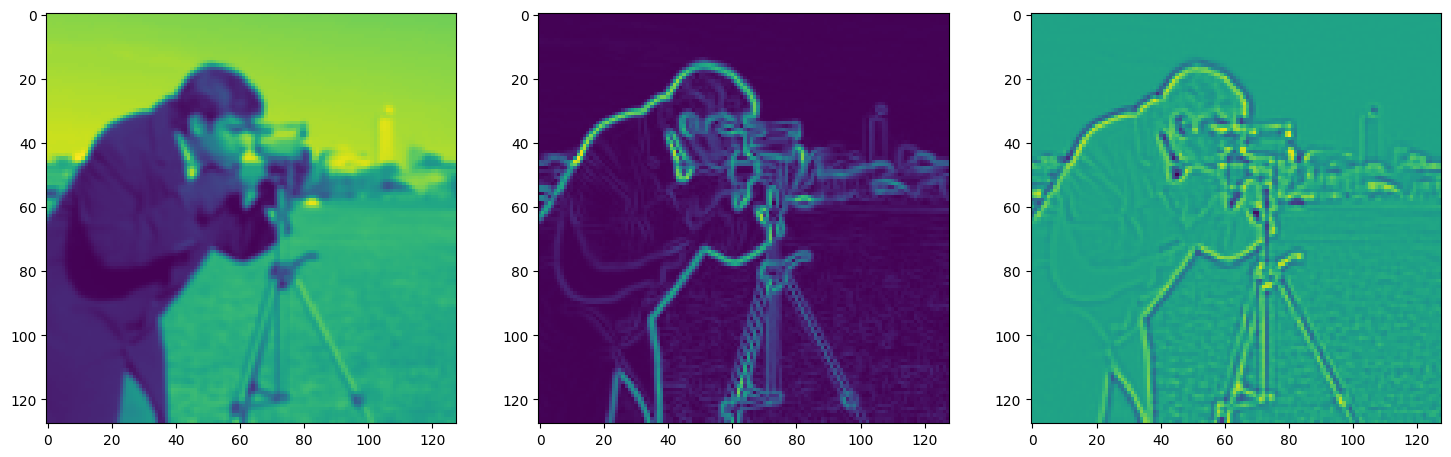
Step 690, Total loss 0.008881, iteration time 0.001731
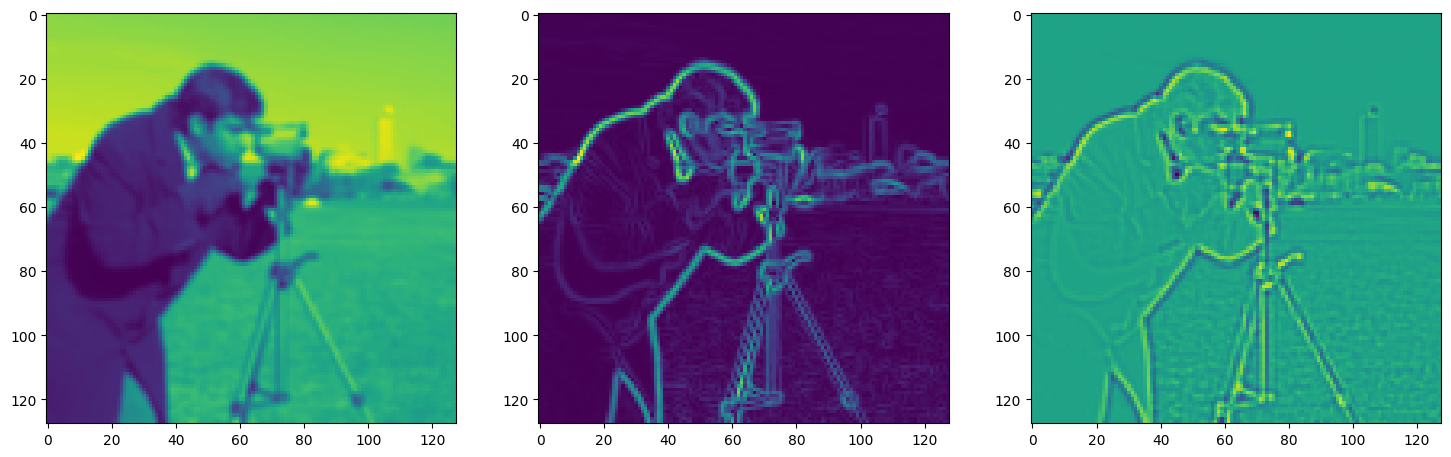
Step 700, Total loss 0.008381, iteration time 0.001497
Step 710, Total loss 0.008077, iteration time 0.001451
Step 720, Total loss 0.007929, iteration time 0.001637
Step 730, Total loss 0.007788, iteration time 0.001428
Step 740, Total loss 0.007790, iteration time 0.001869
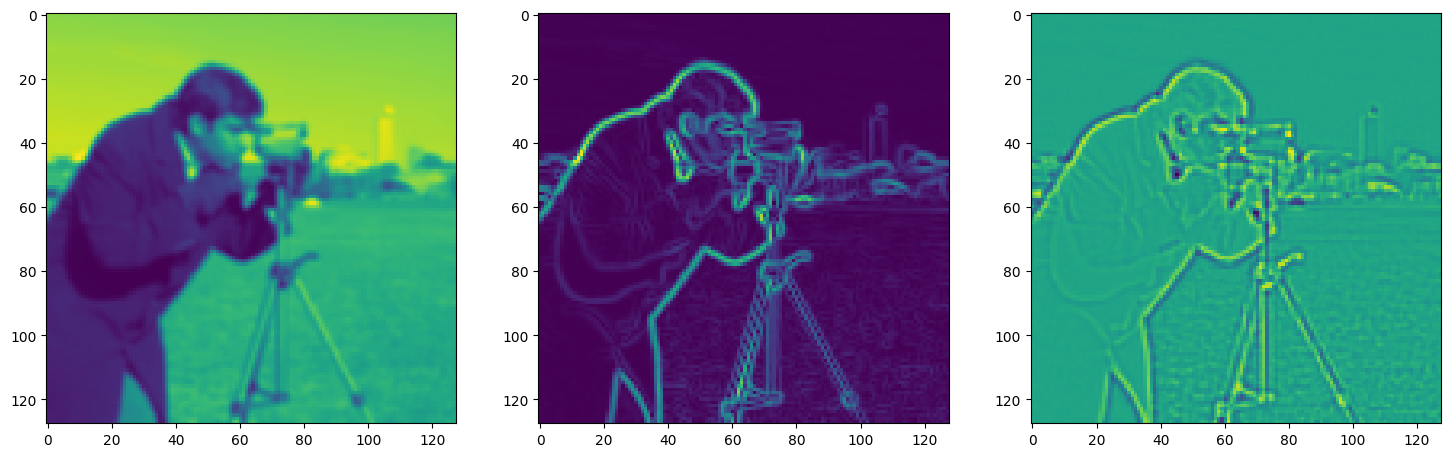
Step 750, Total loss 0.023985, iteration time 0.001502
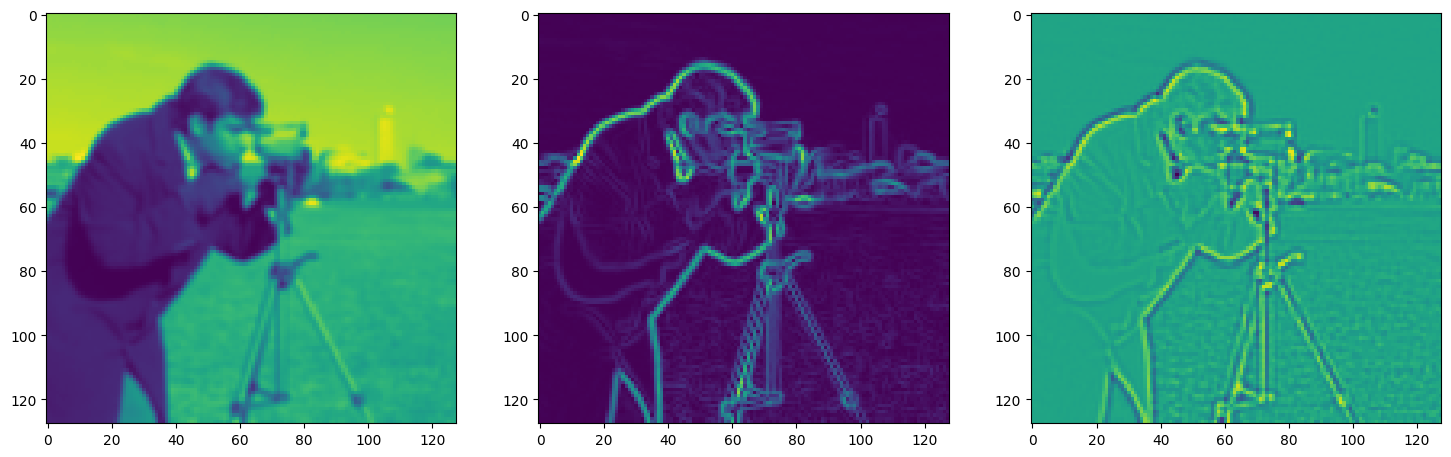
Step 760, Total loss 0.014367, iteration time 0.001581
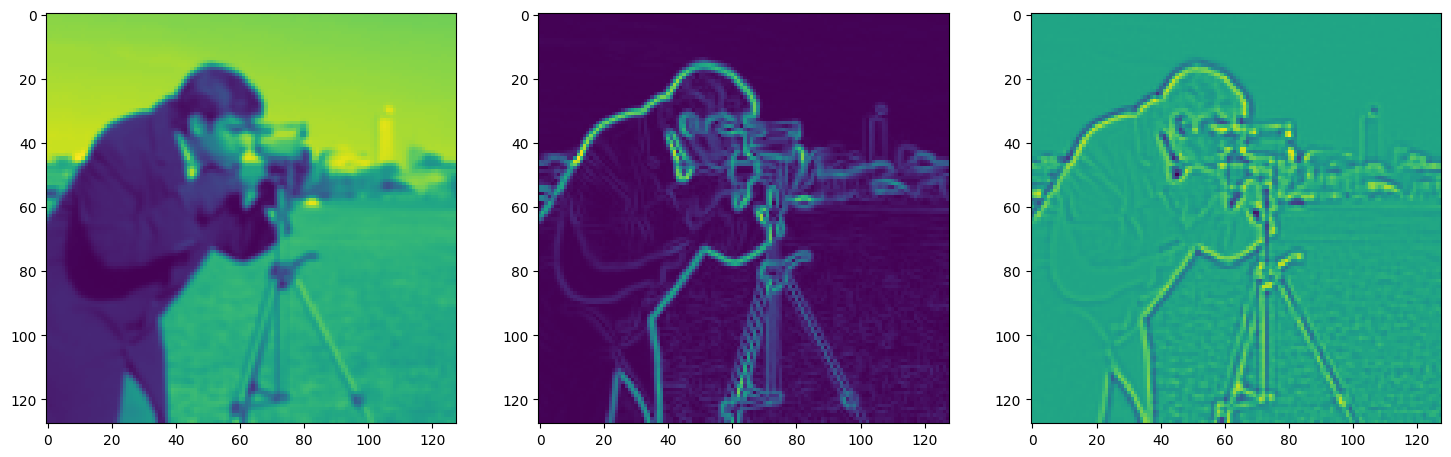
Step 770, Total loss 0.009977, iteration time 0.001491
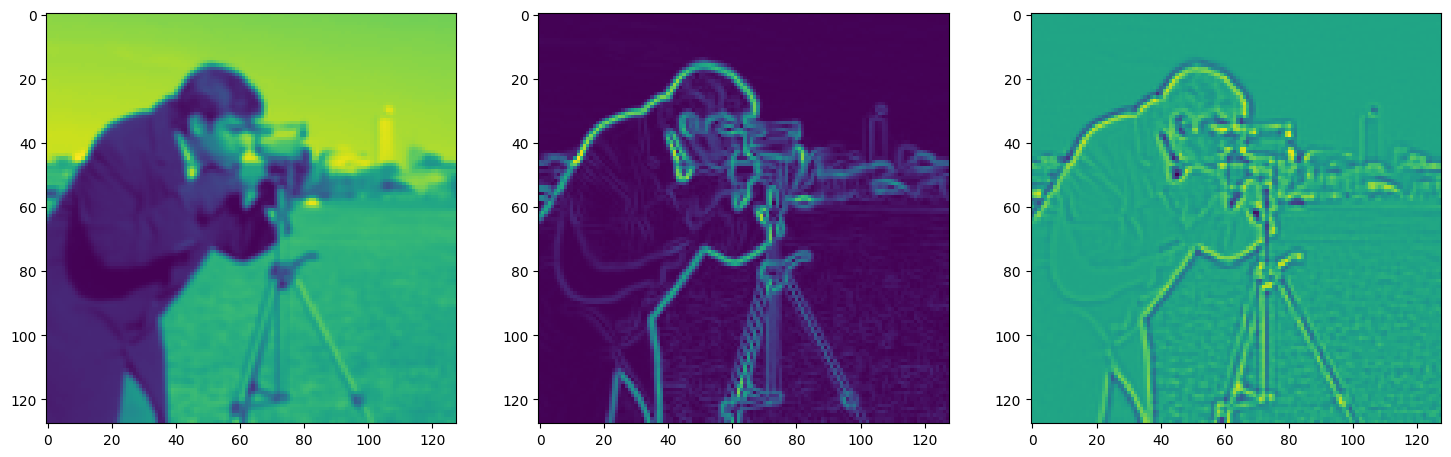
Step 780, Total loss 0.008088, iteration time 0.001537
Step 790, Total loss 0.007420, iteration time 0.001494
Step 800, Total loss 0.007165, iteration time 0.001528
Step 810, Total loss 0.006995, iteration time 0.001772
Step 820, Total loss 0.006945, iteration time 0.001549
Step 830, Total loss 0.010760, iteration time 0.001468
Step 840, Total loss 0.009743, iteration time 0.001571
Step 850, Total loss 0.007500, iteration time 0.001482
Step 860, Total loss 0.006997, iteration time 0.001571
Step 870, Total loss 0.006662, iteration time 0.001717
Step 880, Total loss 0.006393, iteration time 0.002085
Step 890, Total loss 0.006251, iteration time 0.001374
Step 900, Total loss 0.006207, iteration time 0.001548
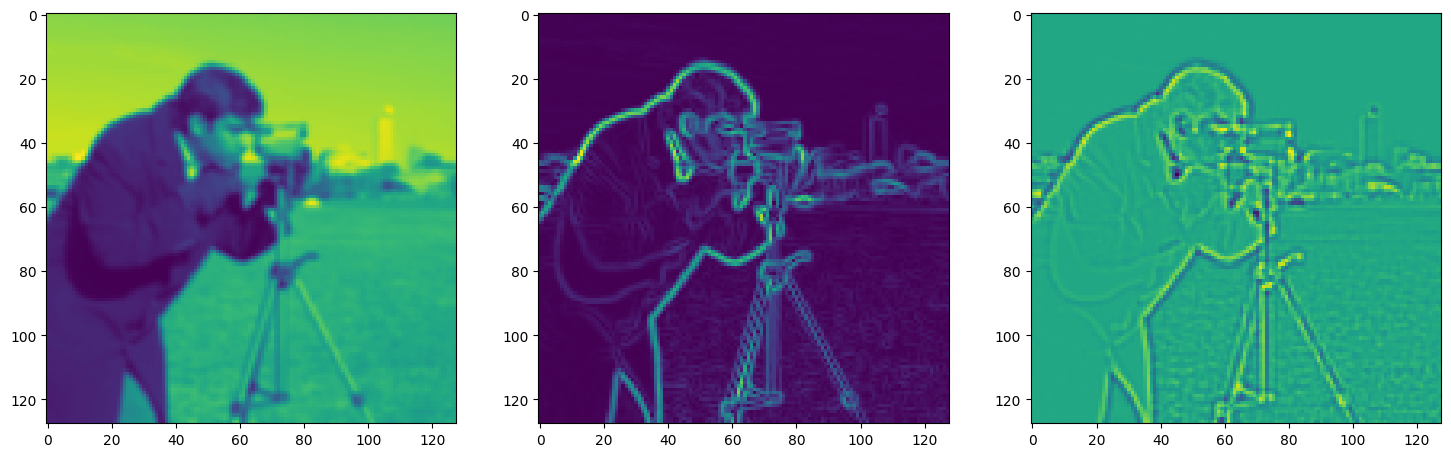
Step 910, Total loss 0.012152, iteration time 0.001693
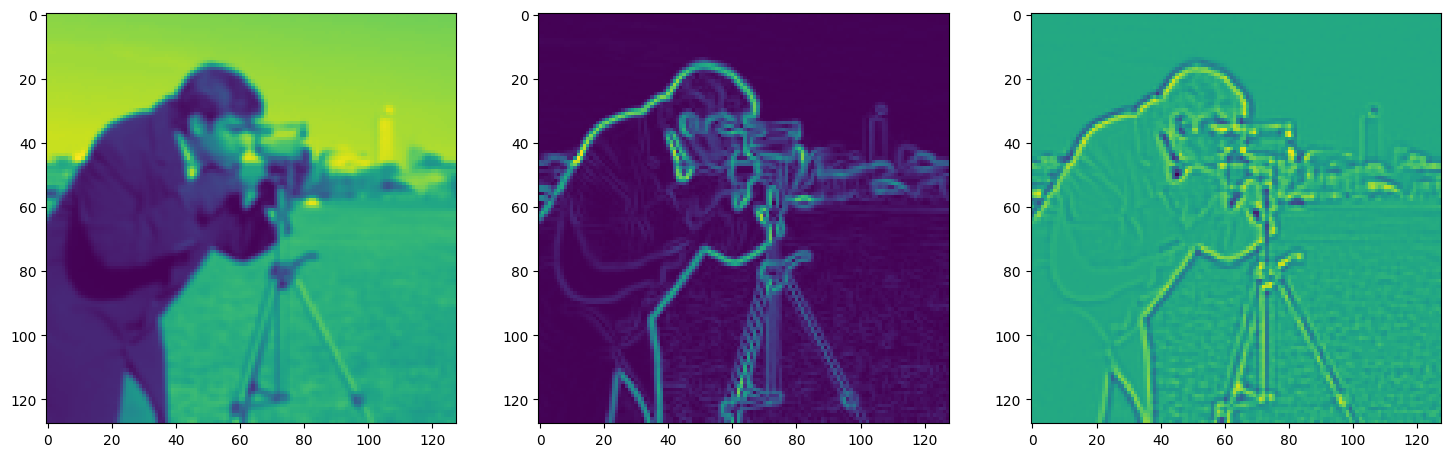
Step 920, Total loss 0.015004, iteration time 0.001559
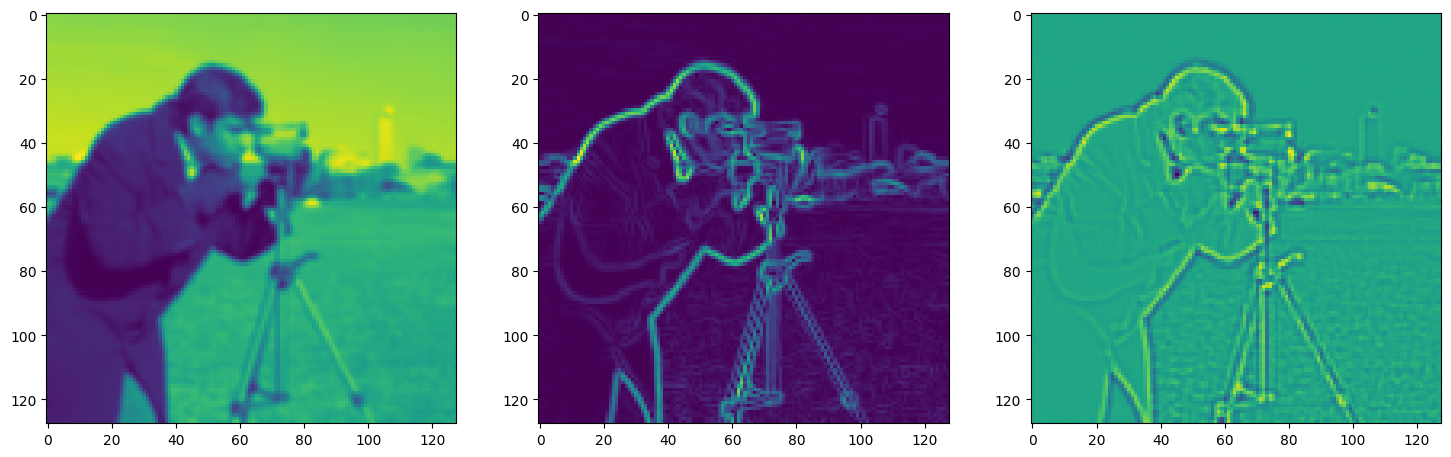
Step 930, Total loss 0.008816, iteration time 0.001462
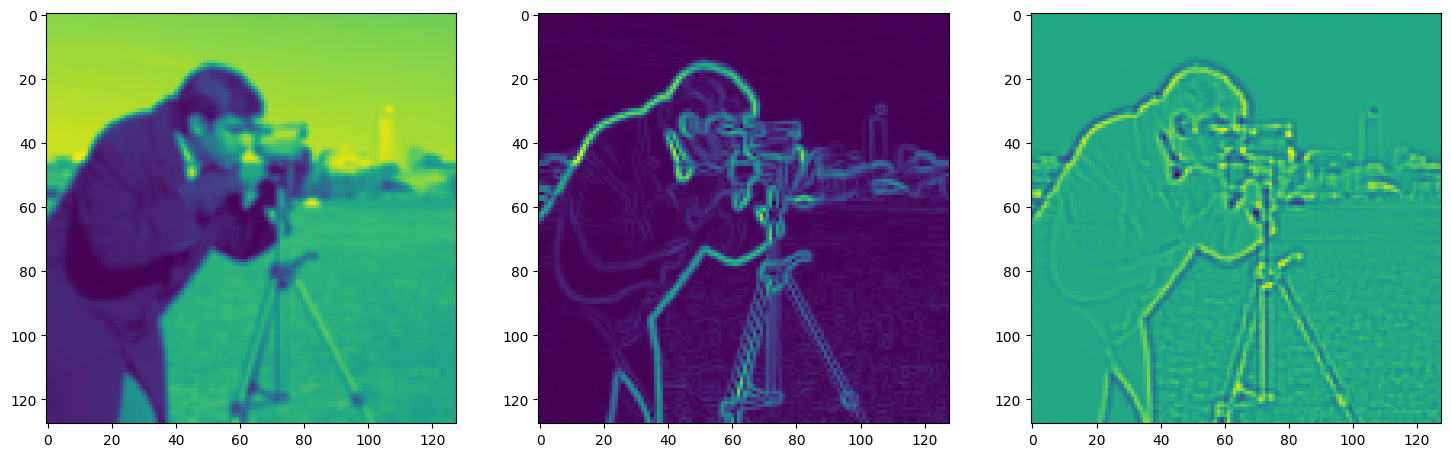
Step 940, Total loss 0.006670, iteration time 0.001614
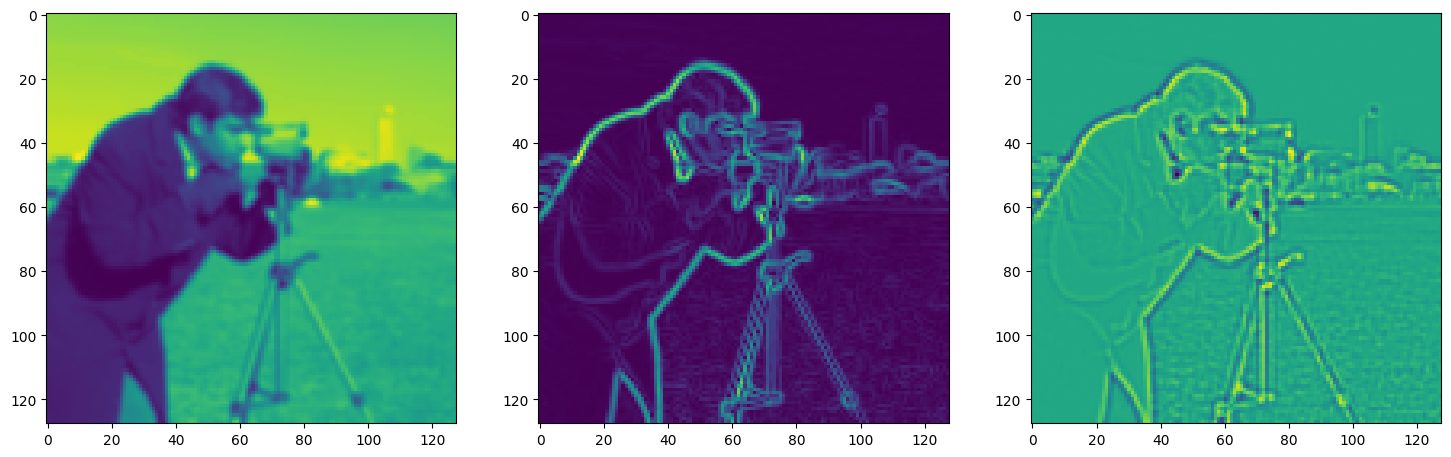
Step 950, Total loss 0.006041, iteration time 0.001507
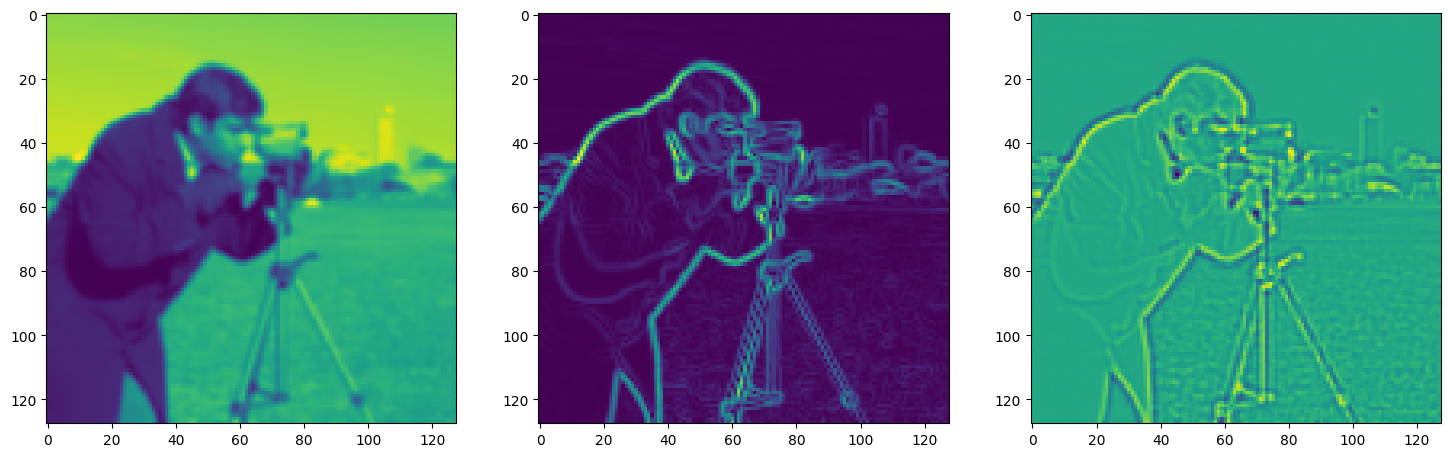
Step 960, Total loss 0.005791, iteration time 0.001564
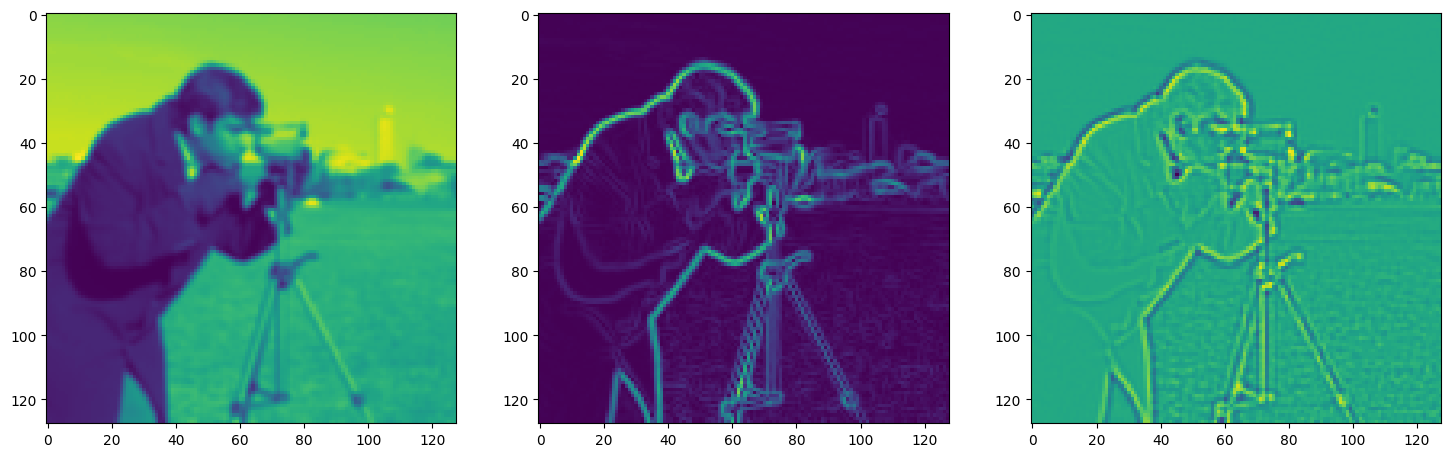
Step 970, Total loss 0.005623, iteration time 0.001581
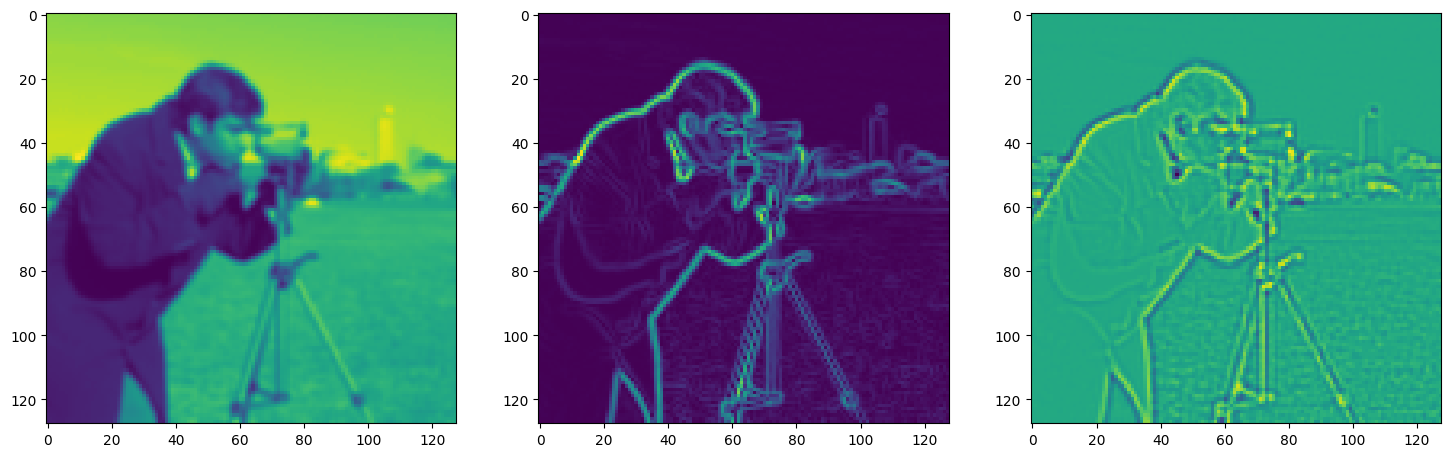
Step 980, Total loss 0.005517, iteration time 0.001659
Step 990, Total loss 0.005425, iteration time 0.001589
Initialization scheme & distribution of activations#
We now reproduce the empirical result on the distribution of activations, and will thereafter show empirically that the distribution of activations is shift-invariant as well!
from collections import OrderedDict
import matplotlib
import numpy.fft as fft
import scipy.stats as stats


def eformat(f, prec, exp_digits):
    s = "%.*e"%(prec, f)
    mantissa, exp = s.split('e')
    # add 1 to digits as 1 is taken by sign +/-
    return "%se%+0*d"%(mantissa, exp_digits+1, int(exp))

def format_x_ticks(x, pos):
    """Format odd tick positions
    """
    return eformat(x, 0, 1)

def format_y_ticks(x, pos):
    """Format odd tick positions
    """
    return eformat(x, 0, 1)

def get_spectrum(activations):
    n = activations.shape[0]

    spectrum = fft.fft(activations.numpy().astype(np.double).sum(axis=-1), axis=0)[:n//2]
    spectrum = np.abs(spectrum)

    max_freq = 100
    freq = fft.fftfreq(n, 2./n)[:n//2]
    return freq[:max_freq], spectrum[:max_freq]


def plot_all_activations_and_grads(activations):
    num_cols = 4
    num_rows = len(activations)

    fig_width = 5.5
    fig_height = num_rows/num_cols*fig_width
    fig_height = 9

    fontsize = 5

    fig, axs = plt.subplots(num_rows, num_cols, gridspec_kw={'hspace': 0.3, 'wspace': 0.2},
                            figsize=(fig_width, fig_height), dpi=300)

    axs[0][0].set_title("Activation Distribution", fontsize=7, fontfamily='serif', pad=5.)
    axs[0][1].set_title("Activation Spectrum", fontsize=7, fontfamily='serif', pad=5.)
    axs[0][2].set_title("Gradient Distribution", fontsize=7, fontfamily='serif', pad=5.)
    axs[0][3].set_title("Gradient Spectrum", fontsize=7, fontfamily='serif', pad=5.)

    x_formatter = matplotlib.ticker.FuncFormatter(format_x_ticks)
    y_formatter = matplotlib.ticker.FuncFormatter(format_y_ticks)

    spec_rows = []
    for idx, (key, value) in enumerate(activations.items()):
        grad_value = value.grad.cpu().detach().squeeze(0)
        flat_grad = grad_value.view(-1)
        axs[idx][2].hist(flat_grad, bins=256, density=True)

        value = value.cpu().detach().squeeze(0) # (1, num_points, 256)
        n = value.shape[0]
        flat_value = value.view(-1)

        axs[idx][0].hist(flat_value, bins=256, density=True)

        if idx>1:
            if not (idx)%2:
                x = np.linspace(-1, 1., 500)
                axs[idx][0].plot(x, stats.arcsine.pdf(x, -1, 2),
                                 linestyle=':', markersize=0.4, zorder=2)
            else:
                mu = 0
                variance = 1
                sigma = np.sqrt(variance)
                x = np.linspace(mu - 3*sigma, mu + 3*sigma, 500)
                axs[idx][0].plot(x, stats.norm.pdf(x, mu, sigma),
                                 linestyle=':', markersize=0.4, zorder=2)

        activ_freq, activ_spec = get_spectrum(value)
        axs[idx][1].plot(activ_freq, activ_spec)

        grad_freq, grad_spec = get_spectrum(grad_value)
        axs[idx][-1].plot(grad_freq, grad_spec)

        for ax in axs[idx]:
            ax.tick_params(axis='both', which='major', direction='in',
                                    labelsize=fontsize, pad=1., zorder=10)
            ax.tick_params(axis='x', labelrotation=0, pad=1.5, zorder=10)

            ax.xaxis.set_major_formatter(x_formatter)
            ax.yaxis.set_major_formatter(y_formatter)
model = Siren(in_features=1, hidden_features=2048,
              hidden_layers=10, out_features=1, outermost_linear=True)

input_signal = torch.linspace(-1, 1, 65536//4).view(1, 65536//4, 1)
activations = model.forward_with_activations(input_signal, retain_grad=True)
output = activations[next(reversed(activations))]

# Compute gradients. Because we have retain_grad=True on
# activations, each activation stores its own gradient!
output.mean().backward()

plot_all_activations_and_grads(activations)
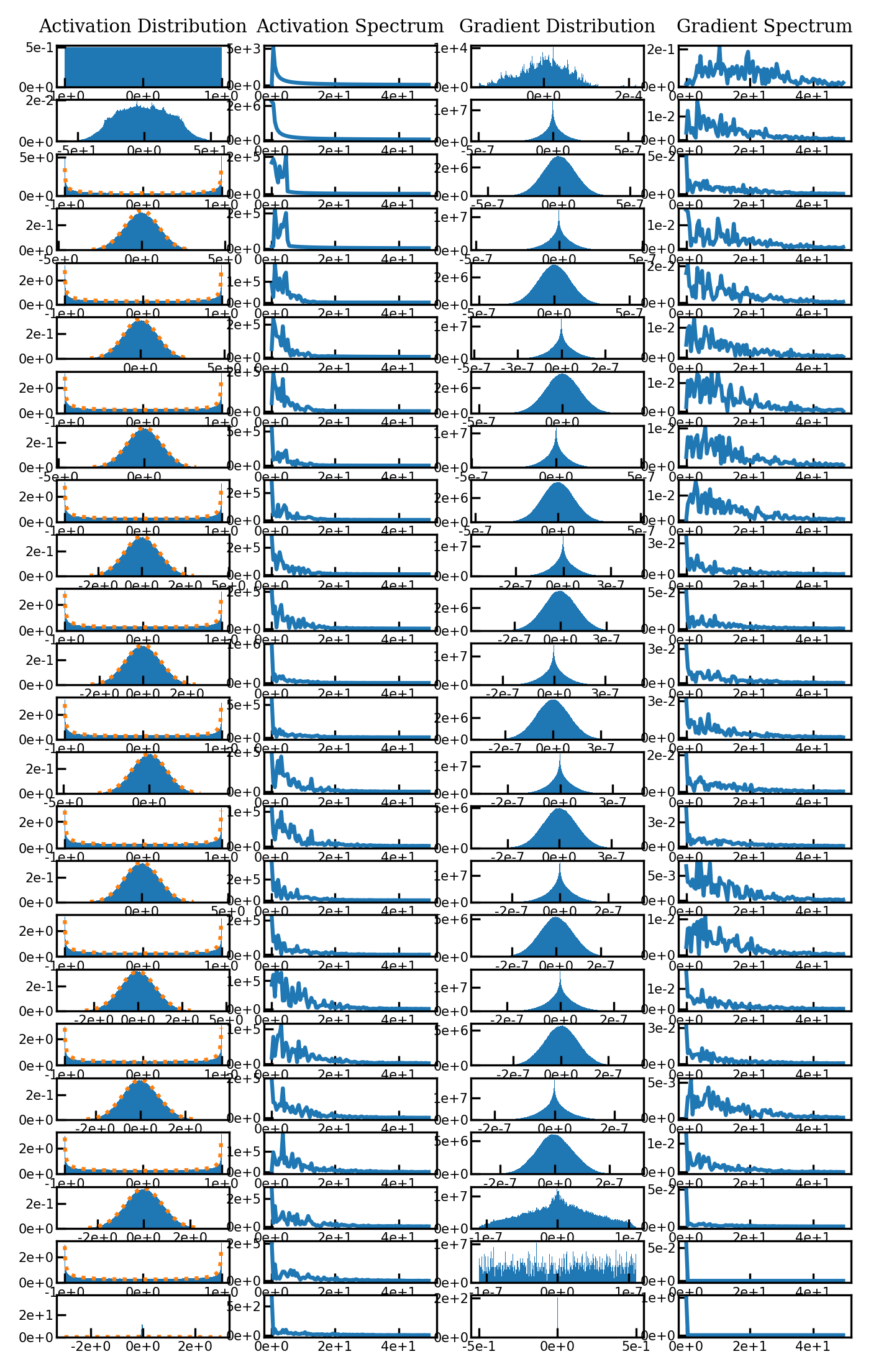
Note how the activations of Siren always alternate between a standard normal distribution with standard deviation one, and an arcsine distribution. If you have a beefy computer, you can put this to the extreme and increase the number of layers - this property holds even for more than 50 layers!
Distribution of activations is shift-invariant#
One of the key properties of the periodic sine nonlinearity is that it affords a degree of shift-invariance. Consider the first layer of a Siren: You can convince yourself that this layer can easily learn to map two different coordinates to the same set of activations. This means that whatever layers come afterwards will apply the same function to these two sets of coordinates.
Moreoever, the distribution of activations similarly are shift-invariant. Let’s shift our input signal by 1000 and re-compute the activations:
input_signal = torch.linspace(-1, 1, 65536//4).view(1, 65536//4, 1) + 1000
activations = model.forward_with_activations(input_signal, retain_grad=True)
output = activations[next(reversed(activations))]

# Compute gradients. Because we have retain_grad=True on
# activations, each activation stores its own gradient!
output.mean().backward()

plot_all_activations_and_grads(activations)
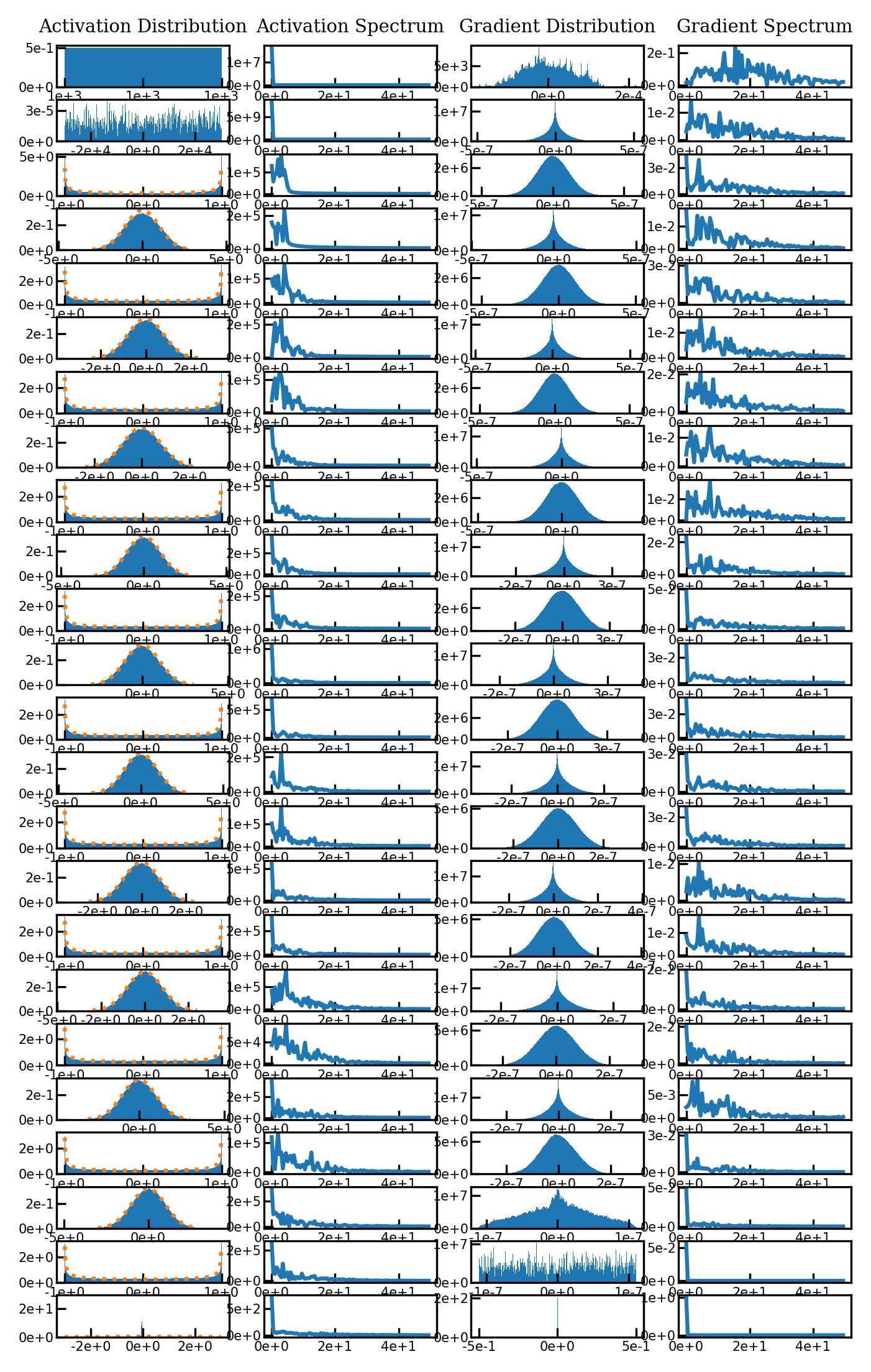
As we can see, the distributions of activations didn’t change at all - they are perfectly invariant to the shift.